 Itnews.Au
 AI-Enhanced Credential Harvesting Operation Exposed
Article Content

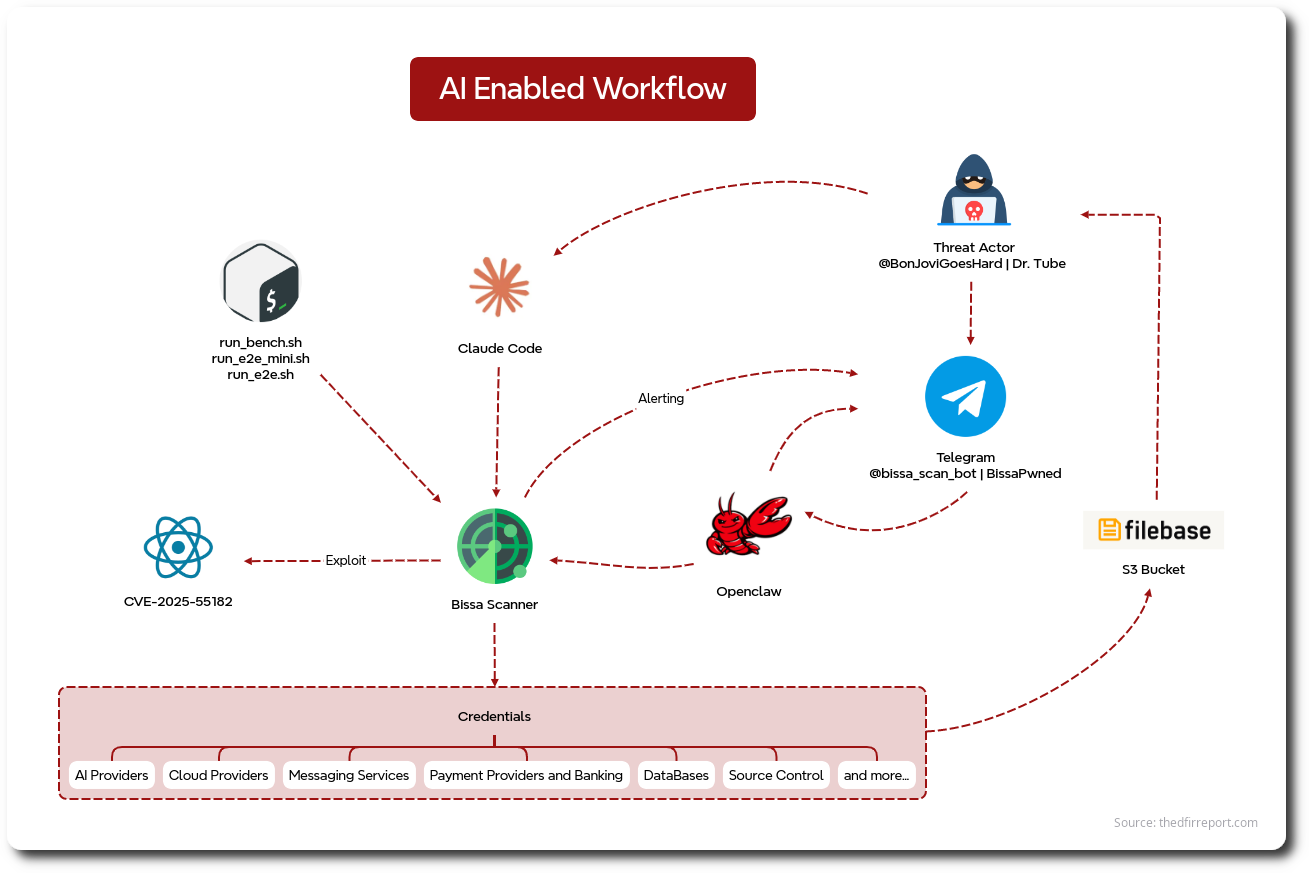
- •Bissa scanner exploited over 900 targets using the React2Shell vulnerability.
- •Claude Code and OpenClaw were integrated into the threat actor's workflow.
- •The operation harvested credentials from major AI and cloud service providers.
A threat actor has integrated Anthropic's Claude Code AI into a large-scale credential harvesting operation named Bissa scanner. This operation has successfully exploited over 900 targets since September 2025, utilizing the React2Shell vulnerability (CVE-2025-6789) for remote code execution. The exposed server contained over 13,000 files and 30,000 unique .env filenames, indicating a systematic approach to data collection. The harvested credentials span various sectors, including AI providers and cloud services. The operation also employed OpenClaw for workflow management and troubleshooting. Despite patches being available since December 2025, the exploitation continues, raising significant security concerns. Researchers noted that the AI tools were used for development support rather than direct exploitation.
Ask AI about this cluster
Answers cite the sources they use
Timeline
More articles in this cluster (3)
Following this threat?
Track React2Shell and Anthropic in your own feed — you're alerted when they show up in new reporting, leak sites or exploitation.
Free account · no card needed
Continue Reading
 Wiz Launches AI-Accelerated Security for FedRAMP High Environments Wiz has introduced AI Agents within its FedRAMP High authorized environment, Wiz for U.S. Government, to enhance security in public sector organizations managing sensitive data. The AI Agents provide machine-speed risk remediation and actionable insights across the application lifecycle. This initiative comes as…
  Critical Zero-Day Exploited in BeyondTrust Remote Support by China-linked Group A critical vulnerability in BeyondTrust Remote Support, tracked as CVE-2026-102764 with a CVSS score of 9.3, has been exploited by the China-linked espionage group Armory Castle since August 29, 2026. This flaw allows unauthenticated remote attackers to perform file operations, gaining root control and access to…