 Cve.Tools
 Critical Remote Code Execution Vulnerability in GitBucket Disclosed
Article Content

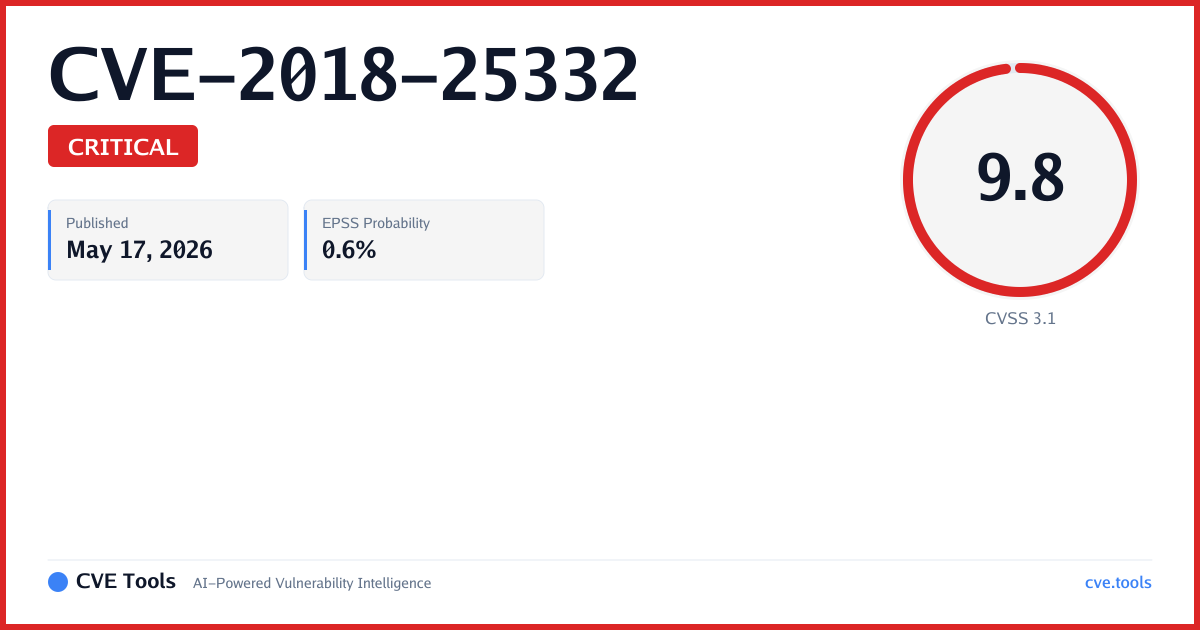
- •CVE-2018-25332 allows unauthenticated remote code execution in GitBucket 4.23.1.
- •Attackers can exploit weak token generation and insecure file uploads to execute commands.
- •Three independent sources confirmed the vulnerability before its public disclosure.
A critical vulnerability (CVE-2018-25332) has been identified in GitBucket version 4.23.1, allowing unauthenticated remote code execution. Attackers can exploit weak secret token generation and insecure file upload functionality to execute arbitrary commands. The attack vector involves brute-forcing the Blowfish encryption key and uploading malicious JAR plugins via the git-lfs endpoint. This vulnerability has been validated by three independent sources prior to publication. Organizations using GitBucket are urged to assess their systems for this vulnerability. The flaw was published on May 17, 2026, and poses a significant risk to affected users.
Ask AI about this cluster
Answers cite the sources they use
Timeline
More articles in this cluster (4)
Following this threat?
Track CVE-2018-25332 in your own feed — you're alerted when they show up in new reporting, leak sites or exploitation.
Free account · no card needed
Continue Reading
 Critical Zero-Day Exploited in BeyondTrust Remote Support by China-linked Group A critical vulnerability in BeyondTrust Remote Support, tracked as CVE-2026-102764 with a CVSS score of 9.3, has been exploited by the China-linked espionage group Armory Castle since August 29, 2026. This flaw allows unauthenticated remote attackers to perform file operations, gaining root control and access to…
  CISA Warns of Exploited Vulnerabilities in ProFTPD, ONLYOFFICE, Strapi, and More The U.S. Cybersecurity and Infrastructure Security Agency (CISA) added five vulnerabilities to its Known Exploited Vulnerabilities (KEV) catalog, including critical flaws in ProFTPD, ONLYOFFICE Docs, Strapi, Apache Struts, and ISC BIND. These vulnerabilities are being by Chinese actors for cyber espionage, targeting…