 News.Ycombinator
 Discovery of Fast16 Malware: Precursor to Stuxnet Targeting Iranian Nuclear Program
Article Content

- •Fast16 malware predates Stuxnet by five years, dating back to 2005.
- •It targets high-precision computing systems, subtly corrupting mathematical outputs.
- •The discovery alters perceptions of early state-sponsored cyber sabotage capabilities.
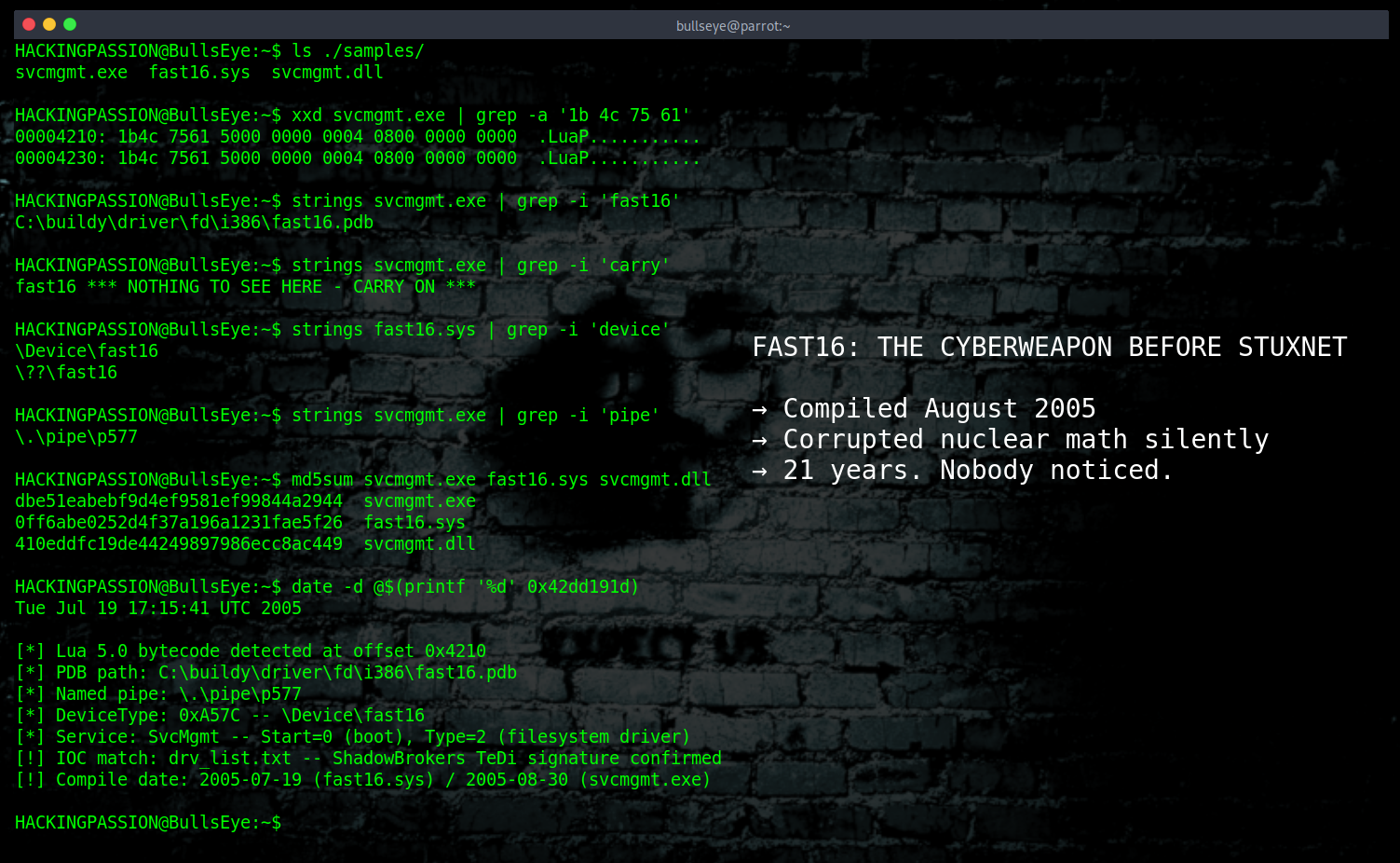
Researchers at SentinelOne have uncovered a malware framework named fast16, which dates back to 2005 and predates the infamous Stuxnet worm by five years. Fast16 is designed to subtly corrupt high-precision mathematical computations, specifically targeting systems involved in nuclear and engineering simulations. The malware operates by embedding a Lua scripting engine within its binary, allowing it to modify outputs without detection. Its delivery mechanism resembles a 'cluster munition,' deploying multiple payloads across vulnerable systems. Fast16's discovery challenges the timeline of cyber warfare, indicating that sophisticated state-sponsored cyber sabotage efforts were underway long before Stuxnet became public in 2010. The malware's components were found to reference critical engineering software used in Iran's nuclear program, suggesting a targeted approach to undermine its capabilities. The implications of this finding extend to understanding the evolution of cyber weapons and their potential impact on national security.
Ask AI about this cluster
Answers cite the sources they use
Timeline
More articles in this cluster (17)
Following this threat?
Track Fast16 in your own feed — you're alerted when they show up in new reporting, leak sites or exploitation.
Free account · no card needed
Continue Reading
 CISA Mandates Urgent Patching of Five Critical Flaws Exploited by Flax Typhoon The U.S. Cybersecurity and Infrastructure Security Agency (CISA) has ordered federal agencies to patch five critical vulnerabilities by October 11, 2026, following exploitation by the China-linked hacking group Flax Typhoon. The vulnerabilities, added to CISA's Known Exploited Vulnerabilities (KEV) catalog, include…
  Critical Zero-Day Exploit Found in BeyondTrust Remote Support BeyondTrust disclosed a critical vulnerability, CVE-2026-102764, in its Remote Support product, exploited by the suspected China-linked group ARMORY CASTLE since August 2026. This flaw, with a CVSS score of 9.3, allows attackers to perform arbitrary file uploads and gain host-level control without requiring…