 Devdiscourse
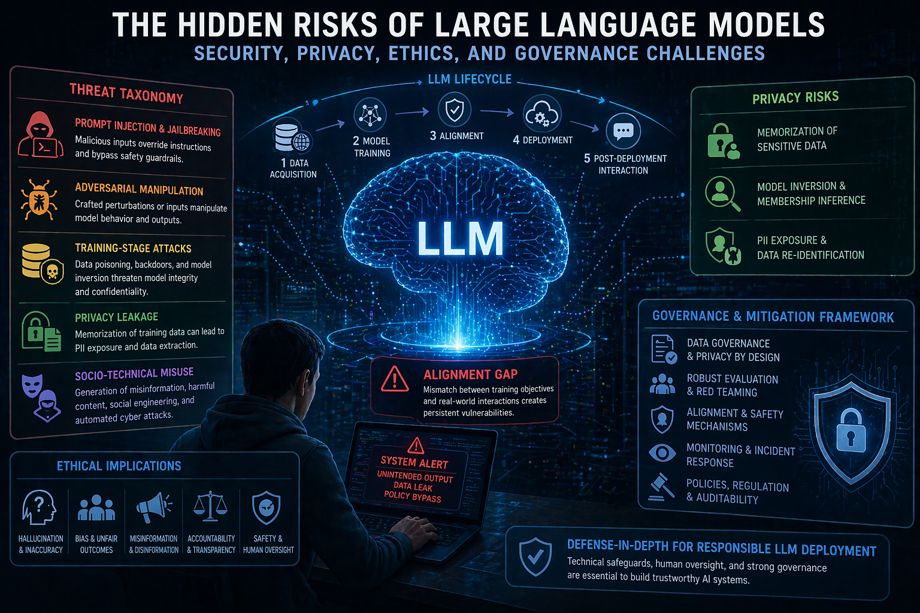
 Emerging Risks from Large Language Models Highlighted in New Study
Article Content

- •Large language models introduce significant security and privacy risks.
- •Prompt injection and model inversion are key attack vectors identified.
- •Existing governance mechanisms are inadequate to manage these evolving threats.
A recent study published in AI examines the security, privacy, and ethical risks associated with large language models (LLMs). It identifies a range of threats including data leakage, prompt injection, and model inversion attacks, which can compromise sensitive information and influence decision-making. The study emphasizes the unpredictability of LLM outputs due to their probabilistic nature, leading to issues like hallucinations where incorrect information is generated. The research outlines a layered framework for mitigation but warns that existing governance mechanisms are lagging behind the rapid deployment of these technologies. The findings suggest that LLMs are not just tools but complex systems that introduce systemic vulnerabilities. The study calls for enhanced safeguards to address these evolving risks, particularly in high-stakes sectors such as healthcare and finance.
Ask AI about this cluster
Answers cite the sources they use
Timeline
More articles in this cluster (3)
Continue Reading
 CVE-2015-3306 Exploited in ProFTPD FTP Servers CVE-2015-3306, a vulnerability in ProFTPD 1.3.5, allows remote attackers to read and write arbitrary files using the SITE CPFR and SITE CPTO commands. This exploit can lead to unauthorized access and potential remote code execution, as the commands are executed with the privileges of the ProFTPD service. Active…
  CISA Mandates Urgent Patching of Five Critical Flaws Exploited by Flax Typhoon The U.S. Cybersecurity and Infrastructure Security Agency (CISA) has ordered federal agencies to patch five critical vulnerabilities by October 11, 2026, following exploitation by the China-linked hacking group Flax Typhoon. The vulnerabilities, added to CISA's Known Exploited Vulnerabilities (KEV) catalog, include…