 En.Bloomingbit
 South Korea Launches Expanded Bug Bounty Program for Financial Sector
Article Content

- •South Korea's bug bounty program now includes crypto firms and insurance agencies.
- •Participants can earn rewards up to 10 million won for reporting vulnerabilities.
- •The number of companies under the program has increased from 32 to 70.
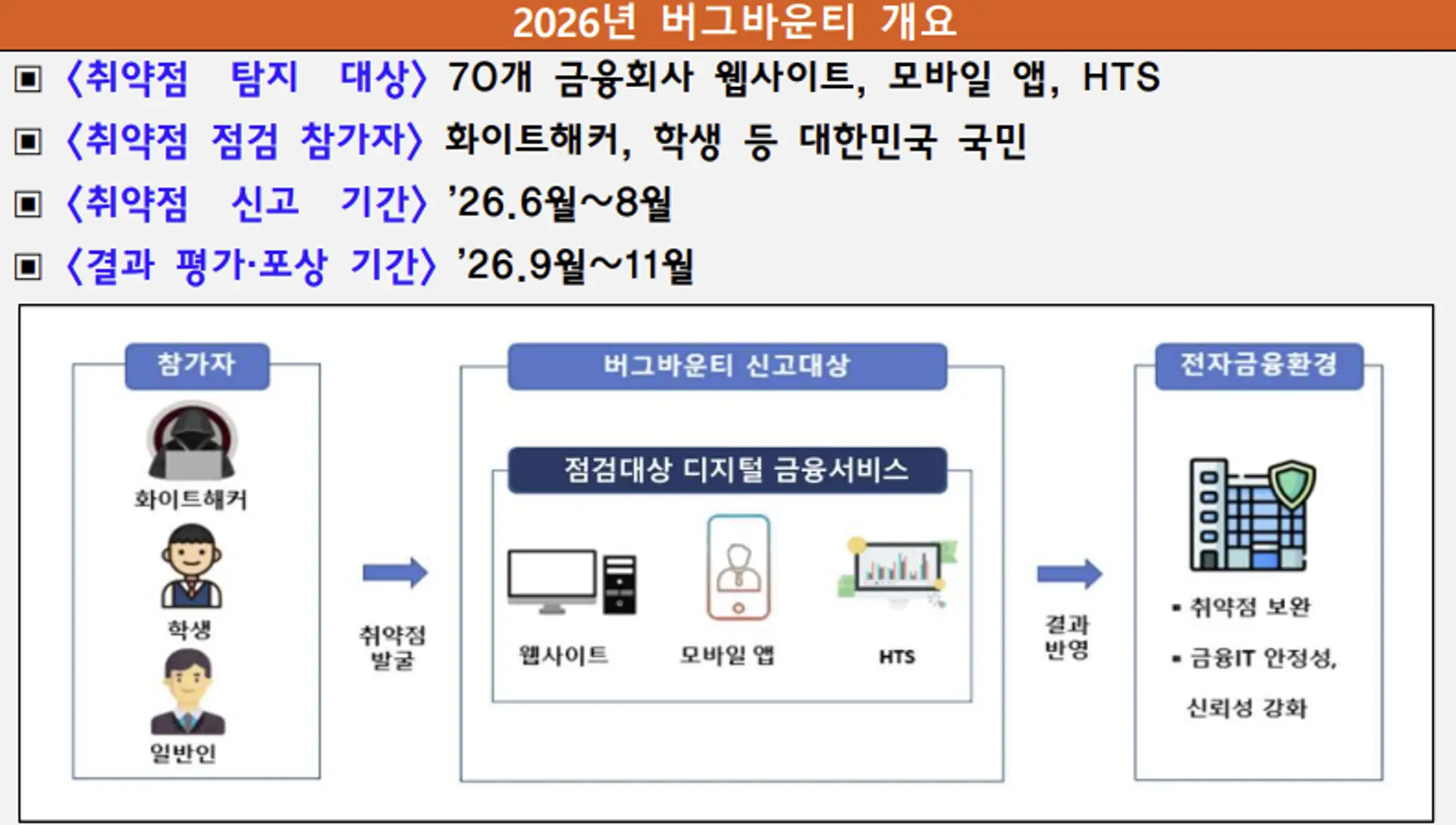
On May 18, 2026, South Korea's Financial Supervisory Service announced the expansion of its bug bounty program, now including virtual asset service providers and corporate insurance agencies. The program aims to enhance the cybersecurity posture of financial institutions by incentivizing white-hat hackers to identify vulnerabilities in digital financial services, including websites and mobile applications. The number of companies eligible for vulnerability checks increased from 32 to 70, covering a total of 306 services. Participants can earn rewards up to 10 million won for each reported vulnerability, with evaluations conducted by the Financial Security Service. This initiative is part of a broader strategy to proactively address cyber threats in an evolving digital landscape. Officials emphasized the importance of collective intelligence from white-hat hackers to bolster security measures in the financial sector.
Ask AI about this cluster
Answers cite the sources they use
Timeline
More articles in this cluster (2)
Continue Reading
 Critical WSO2 API Manager Vulnerability Under Active Exploitation A critical vulnerability (CVE-2026-5430) in WSO2 API Manager is being actively exploited, allowing unauthenticated attackers to forge admin tokens via JWT authentication bypass. This flaw, which has a CVSS score of 10.0, affects multiple WSO2 products including API Manager, Universal Gateway, Traffic Manager, and API…
  Critical Linux Kernel Vulnerability CVE-2025-39682 Under Active Exploitation A critical vulnerability (CVE-2025-39682) in the Linux kernel allows remote code execution through mishandling of zero-length TLS records. This flaw affects kTLS-enabled hosts running vulnerable kernel versions, exposing them to attackers without authentication. CISA added this vulnerability to its Known Exploited…