 Back Kyivindependent
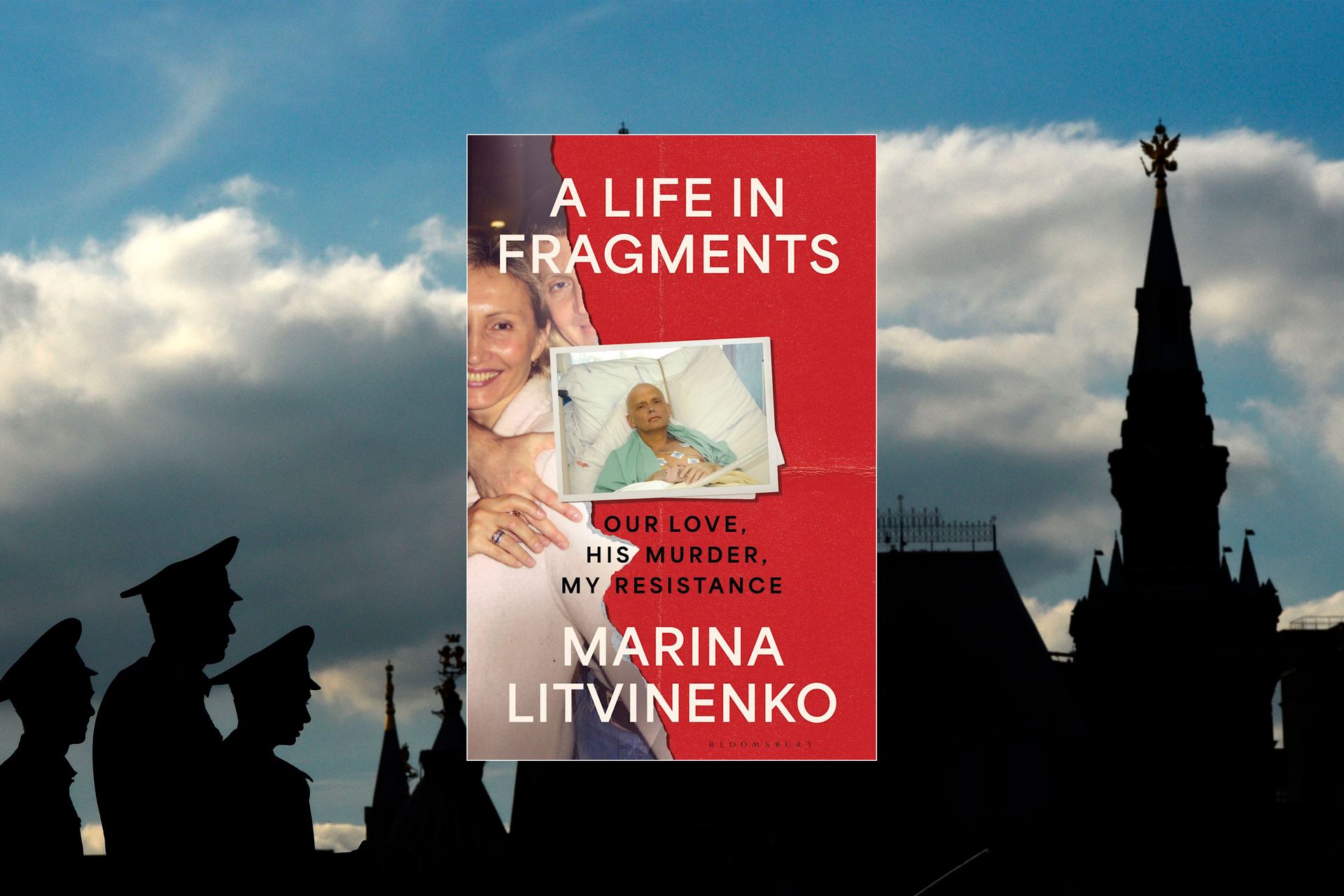
20 years after his murder in Britain, Alexander Litvinenko's wife writes memoir to remind of Russian threat
Russia's threat to international security was apparent long before its invasion of Ukraine. One of the clearest and most chilling warnings came in 2006, with the murder of Alexander Litvinenko, a former FSB agent turned outspoken Kremlin critic.
At great risk to his own safety, Litvinenko had worked to expose the Kremlin's links to organized crime, publicly accusing Russian President Vladimir Putin and his inner circle of using political violence to tighten their grip on power and deploying Russia’s security services to silence critics.
Despite gaining asylum in the U.K., Litvinenko was poisoned by Russian security service agents with polonium-210, a highly radioactive substance.
British officials decried the Kremlin for carrying out an act of "nuclear terrorism" on their soil that not only robbed Litvinenko of his life but put the safety of countless others at risk via nuclear contamination. Though for Litvinenko's wife, Marina, that wasn't enough — she wanted justice for her husband.
"I wasn't content to accept his death as an appalling tragedy, or retreat quietly into being 'just' a widow. Instead, I would fight for justice — no matter the personal cost," she writes in her new memoir "A Life in Fragments: Our Love, His Murder, My Resistance."
The memoir covers the start of Marina and Alexander Litvinenko's relationship, his career in Russia's security services, the risks he took by speaking out against corruption and organized crime, the exile that followed, his murder, and Marina's years-long struggle to hold his killers accountable.
In 2021, the European Court of Human Rights found beyond reasonable doubt that Litvinenko was poisoned by Russian agent Andrey Lugovoy. The assassin is now a Russian lawmaker.
Alongside the story of Marina and Alexander runs a wider account of Russian state violence — from the 1999 apartment bombings across three cities that frenzied up public support for the Second Chechen War, to the full-scale invasion of Ukraine — each episode offering further proof of the regime's brutality.
Marina's account of her husband’s stand further underscores the rot of Russia’s post-Soviet elite, and how a democratic Russia under Putin never stood a chance. When he was assigned to a unit in the Russian security services willing to cross boundaries, she describes it as “one of the most ill-judged recruitments in history."
Litvinenko's decision to publicly reject any involvement in the unit's kidnappings and murders proved life-changing. After spending weeks in pre-trial detention on trumped-up charges designed to break his spirit, he fled Russia for good. Living in exile, he worked with the British and Spanish governments by providing intelligence on Russian organized crime and the activities of Russian intelligence operatives, while continuing to speak out against corruption and abuses of power within the Kremlin.
What makes this sequence of events particularly compelling is Marina’s ability to trace the evolution of Litvinenko’s thinking. As he increasingly came to terms with the scale of Russia’s crimes, not only against its own people but also against neighbouring countries, his views became more sharply defined. His friendships with figures such as Akhmed Zakayev , the Chechen independence leader and foreign minister-in-exile, played an important part in this process.
"Through their long discussions, Sasha ( Editor's note: Sasha is the diminutive form of Alexander ) learned of the abuses committed by Russian forces in Chechnya — executions, torture, systematic rape. He started to properly understand Chechnya's history of oppression, and why independence was so important to its people, who had their own language and traditions," Marina writes.
"Sasha came to Akhmed's ambitions for a free Chechnya and vowed to do what he could to support the struggle."
Marina's own bravery and determination cannot be overlooked. In "A Life in Fragments," she emerges as far more than the wife of a dissident. The reader is introduced to someone who, from an early age, declined to accept authority unquestioningly — a quality that, amid the Kremlin's barrage of propaganda, would have served so many of her compatriots well.
Despite the ever-present risks that came with Litvinenko's stand against the criminals in power, Marina and her son, Anatoly, accompanied Litvinenko into exile, resettling in the U.K., where they were compelled to reinvent their lives in the fullest sense.
Strength to follow Litvinenko into exile and later to fight for justice after his murder came from a simple source, she tells the reader: love. It is her love for her husband, she writes, that is stronger than even hate for Putin. For this reason, she refuses to be "just" a widow and fade quietly into private life.
The chapters of "A Life in Fragments" that follow Litvinenko's murder are especially hard to bear for readers now living through the war in Ukraine, as they echo a familiar refrain from Western allies: that support in the fight against the Kremlin will last "as long as it takes."
British officials assure Marina that those responsible for her husband's death will be brought to justice, yet with time, they yield to the illusion that cooperation with Russia — whether in pursuit of trade or in the fight against the Islamic State in Syria — remains possible.
"I couldn't believe that the British government still thought it could work with a man who had committed nuclear terrorism on the streets of London. Not only that, I couldn't believe that they wouldn't prioritise keeping their own citizens safe. Countless innocent people had been put at risk when Sasha was poisoned. I believed that showing Putin even an ounce of weakness would surely lead to more killings on British soil, because he knew there would be no consequences," she writes.
"A Life in Fragments" is not only a memoir of personal loss or family tragedy but one of the darkest examples of the lengths the Kremlin will go to silence its critics. More than anything, Litvinenko's story reminds us of the international community’s repeated failure to confront this threat.
Just l2 years later, once more in the U.K., the Kremlin poisoned former Russian military officer and double agent Sergei Skripal and his daughter Yulia.
Litvinenko’s murder exposed the Kremlin’s disregard for international law, national sovereignty and the most basic norms governing relations between states.
The West’s failure to respond decisively at the time, 20 years ago, to deter further acts of aggression or to hold those responsible to account has only reinforced the Kremlin’s sense of impunity.
The full story
This article is one source in a clustered incident — the cluster page carries the summary, timeline and every other outlet covering it.
