 Back Airandspaceforces
 Air Force Names 7 to Vie for New MMA Drone Program
Audio of this article is brought to you by the Air & Space Forces Association, honoring and supporting our Airmen, Guardians, and their families. Find out more at afa.org
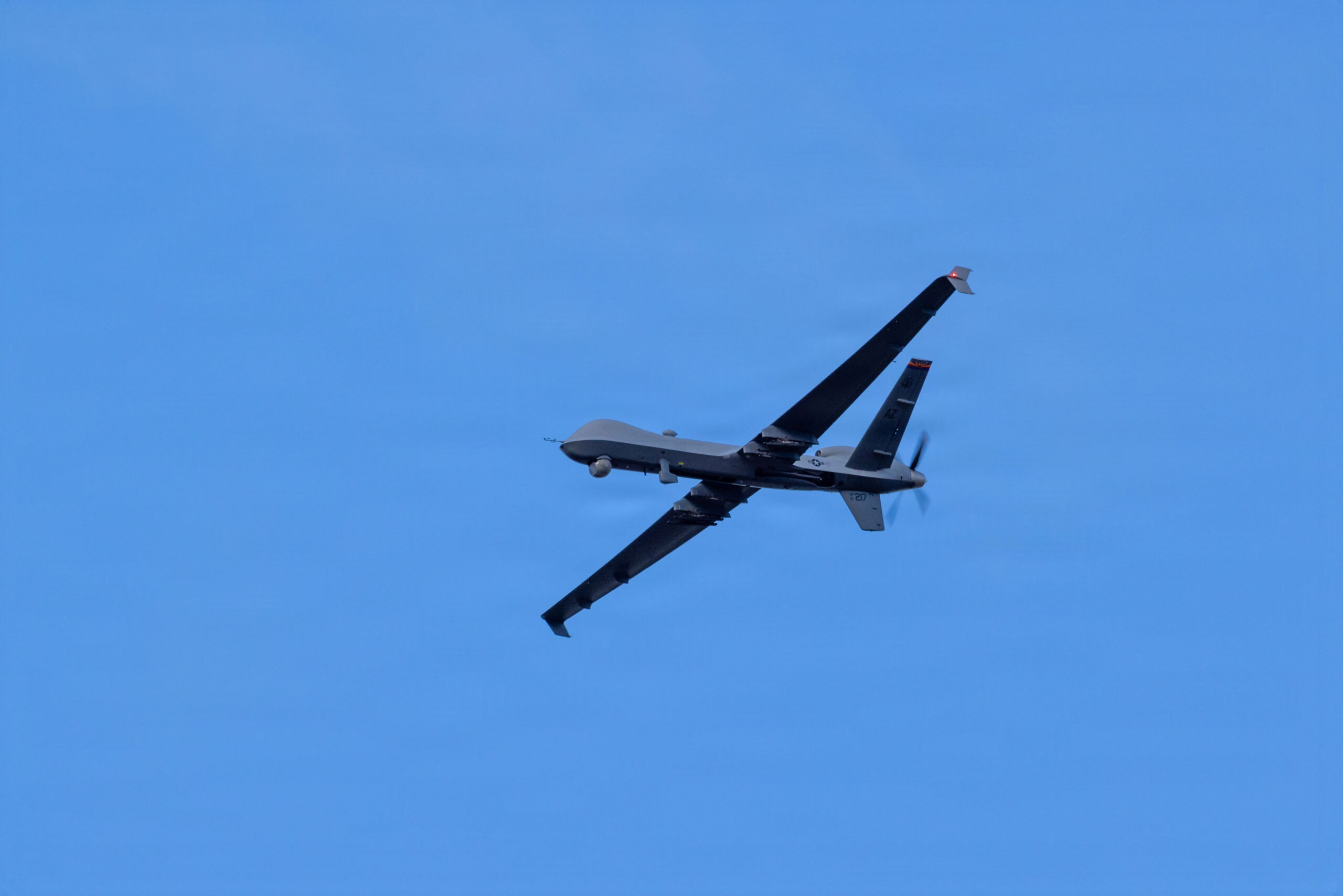
The Air Force and the Pentagon’s Defense Innovation Unit have narrowed the field to seven companies which will be invited to compete to develop low-cost, semi-autonomous drones to succeed the MQ-9A Reaper , multiple sources confirmed to Air & Space Forces Magazine.
Anduril, Chaos Industries, General Atomics Aeronautical Systems, Grid Aero, Otto Aerospace, Shield AI, and Swarm Aero all made the cut to continue to develop their candidates for the Massed Modular Aircraft. The companies got the word Sept. 30.
The Air Force and DIU did not immediately respond to queries. Spokespeople from each of the companies either declined to or did not respond to queries. It is unclear how many companies submitted proposals, and therefore how many firms were cut from the competiton.
The Air Force wants to field 500 MMAs by 2032, Air Force Secretary Troy Meink said Sept. 14 at AFA’s Air, Space & Cyber Conference.
DIU—an acquisition office created to tap into commercial and non-traditional suppliers—sought on July 7 proposals for cheap, attritable drones that could take on the MQ-9’s trademark missions of persistent intelligence, surveillance, reconnaissance and strike. The Air Force soon confirmed it was working with DIU on the concept.
The solicitation followed the loss of dozens of MQ-9s in operations against Iran earlier this year. DIU said at the time that the military’s reliance on “exquisite” aircraft that cost $30 million or more per tail has become “unsustainable against adversaries utilizing layered defenses enabled by increasingly low-cost antiaircraft capabilities.”
The MQ-9As that were lost did not cost that much, but General Atomics no longer makes that model and instead is offering a larger MQ-9B that can approach or exceed the $30 million level, depending on how it is equipped.
MMA is aiming for a lower price point. DIU’s solicitation sought drones that could fly together in groups large enough to overwhelm an enemy, even if several were shot down, while also forcing the enemy to expend precious anti-aircraft munitions. The Air Force must be able to affordably replace aircraft lost without busting the budget.
Air Force leaders said in a Sept. 3 briefing that they expect to pay $10 million per MMA airframe, pluse whatever sensors or other capabilities are added to it. During that briefing, Lt. Gen. Christopher Niemi, the Air Force’s new chief modernization officer, said Secretary Meink pushed to accelerate the MMA fielding schedule in the wake of the Iran losses. Maj. Gen. Joseph Kunkel, DIU’s military deputy, told reporters that the Pentagon wants to see a prototype within a year of issuing a contract, and field it at scale as soon as 2029.
Responding to the summer solicitation, industry rapidly moved to pitch their concepts. General Atomicspitched a new drone called Wildfire that could carry at least two Long Range Anti-Ship Missiles, four Joint Strike Missiles, or a similar combination of heavy stand-off weapons.
Swarm Aero, a California startup, proposed a new Group 5 drone dubbed Gamera, and displayed a full-scale model at the Air, Space & Cyber conference.
Audio of this article is brought to you by the Air & Space Forces Association, honoring and supporting our Airmen, Guardians, and their families. Find out more at afa.org
The full story
This article is one source in a clustered incident — the cluster page carries the summary, timeline and every other outlet covering it.
