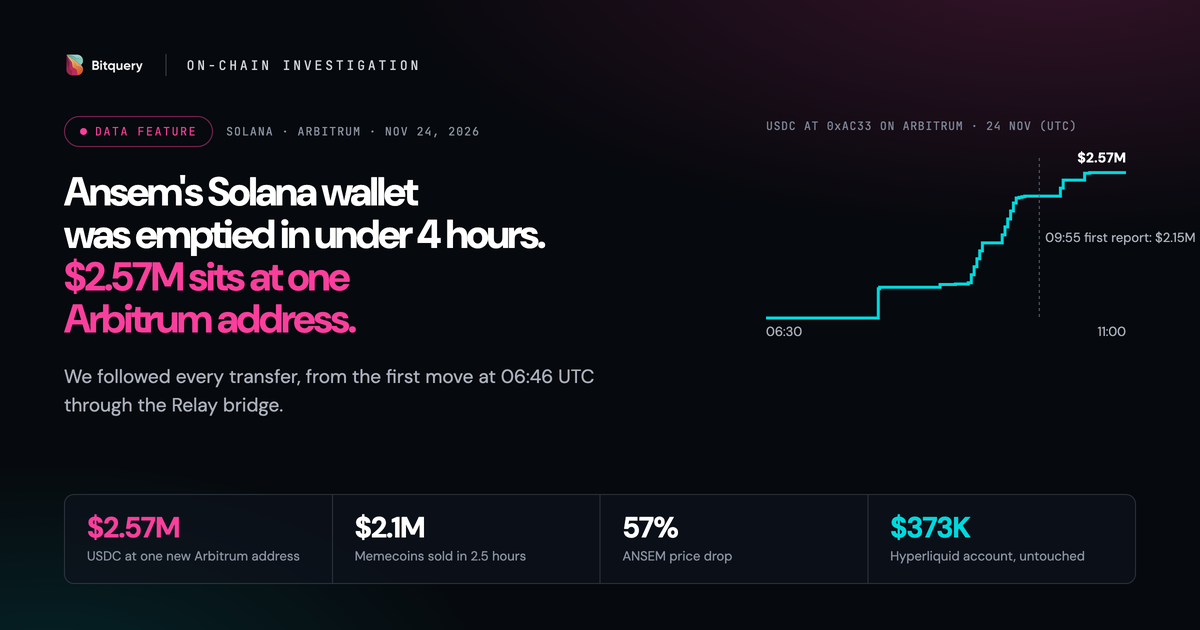
It took less than 4 hours to move millions out of a famous trader's Solana wallet. We followed every transfer, from the first one at 06:46 UTC to the address where the money sits now.
$2.57M In USDC reached one new Arbitrum address, 0xAC33, in under 4 hours. Lookonchain's first count of $2.15M was right when it posted.
In USDC reached one new Arbitrum address, 0xAC33, in under 4 hours. Lookonchain's first count of $2.15M was right when it posted.
57% ANSEM fell from $0.0367 to $0.0158 in under an hour as the wallet sold. Its market cap went from $15.2M to $6.3M.
ANSEM fell from $0.0367 to $0.0158 in under an hour as the wallet sold. Its market cap went from $15.2M to $6.3M.
29,104 SOL Went into the Relay bridge, mostly in 2,000 SOL chunks. Each chunk landed as USDC on Arbitrum 2 minutes later.
Went into the Relay bridge, mostly in 2,000 SOL chunks. Each chunk landed as USDC on Arbitrum 2 minutes later.
$373K Still sat in the Hyperliquid account this wallet bridged to in October. Nothing from the drain went there.
Still sat in the Hyperliquid account this wallet bridged to in October. Nothing from the drain went there.
6 More Hyperliquid accounts paid the same address $659 that afternoon, five of them within 25 seconds. Bullpen says 18 to 19 accounts were hit.
More Hyperliquid accounts paid the same address $659 that afternoon, five of them within 25 seconds. Bullpen says 18 to 19 accounts were hit.
01 · What happened Ansem's Solana wallet was emptied in under 4 hours
Early on 24 November, a Solana wallet sent $515K in USDC, a dollar stablecoin, to a brand-new address. Two hours later, it started selling its memecoins. By late morning, nearly everything it held sat at one new address on another chain.
The wallet belongs to Ansem, who posts as @blknoiz06 on X. He is a well-known Solana memecoin trader, and a coin named after him, ANSEM (The Black Bull), trades on Solana. Lookonchain , an account that tracks big wallets, flagged the selling first. At 09:55 UTC, it posted that the wallet "was indeed hacked".
Bitquery reads every transfer on Solana and Arbitrum, so we followed the money step by step. Lookonchain's $2.15M count was right when it posted, and the total kept growing to $2.57M. All of it crossed over one bridge, Relay. Its earlier bridge transfer went to its own account on Hyperliquid, a trading exchange with its own chain. That account was left alone. Ansem then posted on X that the wallet was hacked. That evening, Bullpen, the trading app he named, said the breach hit 18 to 19 accounts.
02 · The stakes Why one trader's wallet matters to everyone else
A hot wallet is a wallet whose key lives on a phone, a laptop or a browser. It is fast to trade from, and it is only as safe as the device that holds the key. This one held millions and was emptied in one morning. The wallet's own key signed every transfer, and nothing on chain points to a bug in an app or protocol.
Other people paid for it too. Anyone holding ANSEM watched the price fall by more than half while the wallet sold into the market. And the money now sits in one place, in USDC. Circle, the company that issues USDC, can freeze USDC at a single address. That window closes the moment the money moves.
03 · The sell-off The wallet sold $2.1M of memecoins, and ANSEM fell 57%
The selling started two hours after the first transfer. In its busiest 15 minutes, it sold more than three-quarters of a million dollars of tokens. It sold into pools on Pumpswap and Meteora, two Solana DEXs. It kept selling in bursts for two more hours, through dozens of coins.
ANSEM took the hardest hit. Its price held steady all morning, then fell by more than half in under an hour. Its market cap went from $15.2M to $6.3M. It bounced back a little, but stayed well below where it started. We covered the coin's first months in an earlier story on The Black Bull .
04 · The bridge The Relay bridge carried everything to Arbitrum
A bridge moves money from one blockchain to another. Relay works by deposit. You send coins to its address on one chain. Its payer then sends you coins on the other chain, usually within seconds. Arbitrum is a network built on top of Ethereum, with cheap fees.
The wallet sent more than 29,000 SOL to Relay, mostly in equal chunks. Each chunk came out on Arbitrum as USDC two minutes later. The first $515K took a longer path, through two new Solana wallets and a one-use wallet on Arbitrum.
Near the end, the wallet changed its pattern. It sent 870 SOL to each of two new wallets, and both passed it to Relay 9 seconds later. Minutes after that, a third new wallet did the same with a smaller amount. The money still ended up in the same place.
05 · The landing $2.57M in USDC sits at one Arbitrum address
The money landed at 0xAC33…1B4d on Arbitrum , in 28 payments. A 29th transfer, worth a hundredth of a cent, is spam. Its first payment, $27 at 06:57, came from somewhere else. It started at an older Solana address, covered in the section. In the afternoon, $659 more arrived from other people's Hyperliquid accounts, covered in section 07. The address has never sent a transaction.
Most of it came straight from Relay's payer. The rest passed through three fresh Arbitrum wallets first, which sent it on within seconds or minutes.
06 · Hack or sale Why the data points to a stolen key
Lookonchain called it a hack. The chain cannot tell a thief from an owner, because both sign with the same key. So we tested it against the wallet's own history.
The best clue came from Relay's public explorer. On 30 October, the wallet sent 88,888 USDC through the same bridge. It landed in a Hyperliquid account, 0xb2b7…1a8c , 1 second later. Two of the wallet's other transfers in November line up with trades on that account within seconds. That account is where the owner trades.
On the day of the drain, nothing went there. Late that morning, the account still held $373K and a large short on Bitcoin. Its last trade was the evening before. A Hyperliquid account has its own key. A thief with only the Solana key would empty the Solana wallet and leave this account alone. That is what the data shows.
A second Solana address is part of the story. On-chain analyst Specter pointed out that the first $27 into 0xAC33 came from "an old Ansem Solana wallet". We traced it. The money started in GYfEZ…xYcV , an address that has traded memecoins since April 2024. Its first move came at 06:45, one minute before the main one's. It sold its few remaining tokens, then sent its last SOL through three new addresses and Relay to 0xAC33. A second test of $0.70 took the same road. Our labels do not name its owner, and it has no direct transfers with the main one.
Ansem gave his answer on X shortly before 11:00 UTC. He wrote that the wallet was hacked. He believes someone got into his Bullpen profile, where he had imported the Solana private key. That fits the data. A key stored in one app exposes every Solana wallet imported there, which would explain two wallets emptied a minute apart. It would not expose a Hyperliquid account with its own key. Specter had read the older wallet as a sign of an insider. Ansem's account makes that less likely. The chain still cannot show how the key leaked. Bullpen's own statement, and the afternoon drains below, raise our confidence that this is a theft to high.
07 · The wider breach The same address drained 6 more Hyperliquid accounts
That evening, Bullpen posted that money had left some accounts in transfers their owners did not make. The accounts were opened in its early beta, from April to June 2024. Its first count was 18 to 19 accounts, Ansem's among them. It said it had taken the affected test service offline.
The chain shows part of that. Hyperliquid keeps a record of every request to withdraw, and of who gets paid. In the early afternoon, six other accounts there asked to send their USDC to the thief. One paid 0xAC33 directly. Five paid a new Arbitrum wallet, which passed all $380 on to 0xAC33. All five came within half a minute. No one clicks through five accounts that fast by hand. A script did it. The six accounts lost $659 in total. By evening, three held $1 each and three held nothing.
Two of the six also lost the ETH in their own wallets. That afternoon, each wallet sent its last ETH straight to 0xAC33. The wallet itself sent each one. That takes the wallet's own private key. So for these users, whoever did this held the keys themselves.
That fits Ansem's untouched account. The thief emptied the accounts whose keys it held. Ansem says he imported only a Solana key into Bullpen. That evening, his Hyperliquid account still held its large Bitcoin short.
We found six of the accounts Bullpen counts. The others may have held nothing. Or they held coins on chains we did not check. The wallets we found first moved money in 2025, a year after Bullpen's window. An account opened then may have been funded later. So this does not settle Bullpen's dates either way.
08 · Address poisoning Scammers moved in within the hour
Address poisoning is a scam. Someone makes an address that starts and ends like yours, then sends you a tiny or fake transfer. The hope is that you copy the wrong address from your history time. It works because most wallets show only the first and last few characters.
The thief's own wallets became targets. Look-alike addresses sent fake USDC and zero-value transfers to them within the hour. One copy of the relay wallet sent 0xAC33 exactly 32,645 fake USDC, matching a real transfer to the cent. We covered this scam on Solana and Ethereum before.
09 · What The first move out of 0xAC33 will show the cash-out
At 17:00 UTC on 24 November 2026, nearly all the money still sat at one address, in one token, on one chain, and the address had never sent a transaction. The first transfer out will show where the money is meant to go: an exchange, another bridge or a mixer. Until then, Circle can still freeze it.
For ANSEM holders, the heavy selling ended by late morning. The wallet still sold small amounts after that, and anything left in it is open to whoever holds its key. Bullpen says it will the affected users and post updates every three hours. We will update this story when the money moves.
10 · The method How we traced the Ansem wallet drain
We read every transfer out of Ansem's Solana wallet on 24 November. We also read every transfer into and out of each new wallet it paid. We matched each Relay deposit on Solana with a payout on Arbitrum by amount and time, then checked the totals on both sides. For the October bridge transfer, we used Relay's public explorer. Hyperliquid balances come from the exchange's own state, read at 10:41 UTC and again at 17:02 UTC. For the afternoon drains, we read Hyperliquid's record of signed requests. We kept every withdrawal that paid 0xAC33 or 0x222b….
The full story
This article is one source in a clustered incident — the cluster page carries the summary, timeline and every other outlet covering it.
