 Back Asahi
Arrest made in mobile phishing scheme targeting Chinese tourists
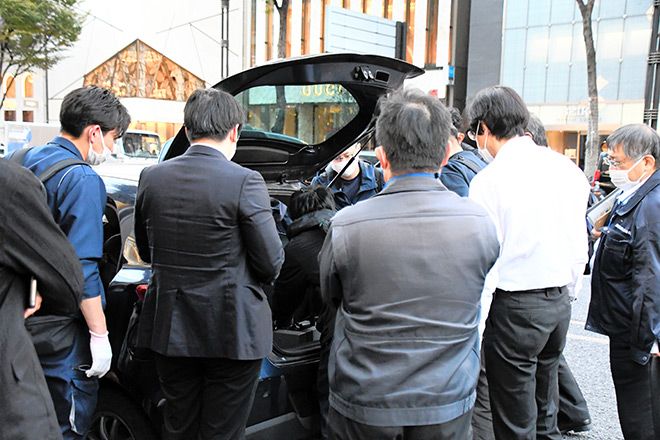
Metropolitan Police Department investigators a car suspected of operating as a “fake cell tower” in Tokyo’s Ginza district on Nov. 7. (Natsuno Otahara)
A sting operation conducted in broad daylight in Tokyo’s bustling Ginza district busted a mobile “fake cell tower” used in phishing schemes that mainly targeted Chinese tourists, investigators said.
As shoppers and passers-by looked on, more than a dozen police officers and communication ministry officials surrounded a car on Nov. 7 and searched the back seat and trunk.
They had detected a suspicious signal from the vehicle that used the same frequency as legitimate mobile phone services.
Investigators suspect the car was used to disrupt cellphone services and send phishing messages posing as instructions from Chinese banks and credit card companies.
Police arrested the driver, a 31-year-old Chinese national living in Tokyo’s Kita Ward, on suspicion of operating an unlicensed radio station.
Authorities say this is the first arrest in Japan concerning suspected interference with a mobile phone carrier’s radio communications.
The suspect, who was referred to prosecutors on Nov. 9, has denied involvement in illegal activity.
“I’ve never used radio equipment before. There was no radio equipment in the car, and I don’t know anything it,” police quoted him as saying.
According to investigations by police, the communications ministry and mobile carriers, 10,000 nearby cellphones lost service for one to two hours on days when such interfering signals were detected.
Similar incidents had occurred sporadically not only in Ginza but also Shibuya and Shinjuku.
Police suspect the man drove through busy districts in the capital with equipment capable of transmitting signals using the older 2G communications standard.
A fake cell tower uses a device known as an “IMSI catcher” to impersonate a legitimate mobile base station. Investigators suspect the device interfered with nearby 4G and 5G connections and instead connected affected phones to an older 2G network, allowing phishing texts to be sent.
Japanese carriers no longer offer 2G service, although it remains in use in some countries, including China. Its authentication system is considered more vulnerable than those used by 4G and 5G.
The messages, written in Chinese, were fake notices from Chinese banks and credit card companies that asked recipients to enter card numbers and other personal information, investigators said.
“I received a text message on my cellphone while I was shopping. After entering my credit card information, I was billed for purchases I didn’t recognize,” one person told police.
A senior investigator said the perpetrators likely “directed victims to phishing sites, stole their credit card and personal information, and then used it to obtain cash advances or buy goods.”
10,000 PHONES LOSE SERVICE
Signs of trouble emerged in December 2024, when a mobile carrier detected repeated communication disruptions in busy areas of Tokyo and alerted police.
In January 2025, police started receiving reports from Chinese tourists and others suspicious text messages and subsequent unauthorized credit card charges. The problem also drew attention on social media.
In May 2025, the communications ministry warned that suspected illegal radio equipment was interfering with mobile phone services. It urged people to be cautious if their phones suddenly lost service or received suspicious text messages.
Police, the ministry and mobile carriers continued investigating the suspected “fake cell towers,” leading to the Ginza operation on Nov. 7.
Police said the man is suspected of installing radio equipment in the car and transmitting signals without the communication minister’s permission, disrupting a carrier’s equipment and interfering with important radio communications.
Police are analyzing equipment and other items seized from the car and investigating whether others were involved. Similar radio-interference operations have been uncovered overseas.
The communications ministry has warned people not to click links in suspicious text messages or emails, and to refrain from entering IDs, passwords or other personal information.
The original articles in Japanese are available at Link 1 and Link 2 . Please note that a paid subscription is often required to read the full Japanese versions.
Study: More dogs could save Japan billions in elder care costs
Tokyo’s 23 wards all tighten rules on ‘minpaku’ private lodgings
Japan’s Disney cruise liner gets a name ahead of 2029 launch
Emergency cybersecurity package due after data leaks
Apartment rents in central Tokyo forecast to rise 11% by 2030
Hiroshima office building offers foot-controlled elevators
7 years after her letter, a surprise reunion with the imperial couple
China’s marriage rate in third quarter tumbles to 18-year low
DRONE WARS/ Startups rush into the defense sector, emerging as key players
Quake injures 22, damages homes and roads in central Japan
Study: More dogs could save Japan billions in elder care costs
South Korea exports nearly double in October on AI investment boom
Tokyo’s 23 wards all tighten rules on ‘minpaku’ private lodgings
Japan minister: Cap on foreign workers should eventually shrink
Why McDonald’s means so much to a rural Japanese city
Nightclub death sheds light on Vietnamese drug scene in Osaka
Emergency cybersecurity package due after data leaks
BASEBALL/ At 14, Rentaro Seki chooses pro Giants over high school team
Imperial couple pose for photo with ‘No-Face’ anime character
Japan’s Disney cruise liner gets a name ahead of 2029 launch
Arrest made in mobile phishing scheme targeting Chinese tourists November 9, 2026
Arrest made in mobile phishing scheme targeting Chinese tourists
Quake injures 22, damages homes and roads in central Japan November 9, 2026
Quake injures 22, damages homes and roads in central Japan
DRONE WARS/ Startups rush into the defense sector, emerging as key players November 7, 2026
DRONE WARS/ Startups rush into the defense sector, emerging as key players
YOASOBI A peek through the music industry’s curtain at the producers who harnessed social media to help their idols go global.
A peek through the music industry’s curtain at the producers who harnessed social media to help their idols go global.
Diplomatic Documents A series based on diplomatic documents declassified by Japan’s Foreign Ministry
A series based on diplomatic documents declassified by Japan’s Foreign Ministry
Memories of Hiroshima and Nagasaki Here is a collection of first-hand accounts by “hibakusha” atomic bomb survivors.
Here is a collection of first-hand accounts by “hibakusha” atomic bomb survivors.
Taste of Life Cooking experts, chefs and others involved in the field of food introduce their special recipes intertwined with their paths in life.
Cooking experts, chefs and others involved in the field of food introduce their special recipes intertwined with their paths in life.
Memories of Nikkei Americans A series Japanese-Americans and their memories of World War II
A series Japanese-Americans and their memories of World War II
In-house News and Messages
The full story
This article is one source in a clustered incident — the cluster page carries the summary, timeline and every other outlet covering it.
