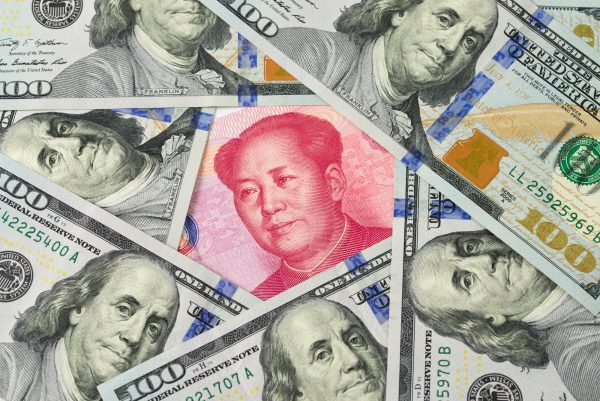
After Russia’s full-scale invasion of Ukraine in 2022, the United States sought to freeze Russia out of the global financial system, leading many to speculate that weaponization of the U.S. dollar’s dominance of that system would accelerate the world’s shift away from the greenback. Speculation only intensified when Washington launched its war against Iran earlier this year and tightened its financial sanctions on the country.
U.S. President Donald Trump’s tariff policies, threats against allies, and attempts to undermine the Federal Reserve’s independence have further called into question the future of dollar dominance. But this debate is hardly new. Chinese leaders have been calling for de-dollarization of the world economy since the global financial crisis of 2008 – a call increasingly echoed by other major emerging economies in the BRICS grouping. The renminbi (also known as the yuan) is widely seen as a candidate to replace the greenback, at least in China’s neighborhood and among countries participating in its Belt and Road Initiative.
The yuan is expanding its role in trade settlement. Average daily usage of China’s CIPS (Cross-Border Interbank Payment System), a predominantly yuan-based payment system that has been in operation since 2015, rose from 339 billion yuan ($50.8 billion) in January 2022 to 828 billion yuan in June 2026. And the of China’s cross-border settlement in yuan increased from 21 percent in January 2014 to 49 percent in July 2026.
But there is little sign of de-dollarization in global financial markets. As of June 2026, foreign holdings of dollar assets, including bonds, equities, and direct investment, account for more than 70 percent of world GDP excluding the United States. The dollar still dominates central bank reserves, export invoicing, and foreign exchange transactions, whereas the yuan accounts for single-digit shares of each.
This discrepancy between ambition and reality stems from the Chinese government’s draconian capital controls, which allow it to maintain a tight grip on the country’s financial system. Onshore yuan is still not freely convertible, and domestic holders of the currency struggle to move money out of China.
Moreover, despite decades of market reform, the Chinese government has been unwilling to reduce state ownership in favor of private property rights. This institutional foundation of China’s political economy, combined with anemic growth and the government’s relentless targeting of private wealth to remedy fiscal weaknesses, has raised the risk of capital flight, prompting authorities to tighten foreign exchange controls even more.
Given that the yuan’s non-convertibility is a feature, not a bug, of the Chinese economic system, China’s yuan-based trade with Russia and Iran, intended to help them bypass U.S. sanctions, is less de-dollarizing the world economy and more de-weaponizing the dollar. Instead of being strangled, heavily sanctioned economies like Russia and Iran can now sell fossil fuels to China and settle the transactions using CIPS.
Crucially, however, Russia and Iran are paid in onshore, non-convertible yuan, meaning that their proceeds are trapped in China. As Dmitry Tulin, a first deputy governor of the Central Bank of Russia, told the Duma in 2023, China does not “welcome” the circulation of its currency abroad, making it hard for Russia to get yuan “in cash.” Likewise, in September, Iranian President Masoud Pezeshkian told Fox News that “our money in China is blocked … We can’t even get our own money out of a country to which we have supplied goods.”
That means Russia and Iran can use their onshore yuan to pay for Chinese exports and little else. It essentially amounts to barter trade. But Russia and Iran need to purchase goods from suppliers in other countries, such as Turkiye and the United Arab Emirates, and pay for their proxies, such as Hezbollah and the Houthis. As a result, both countries use shadow banking and money-laundering networks to convert onshore yuan into dollars and other hard currencies. The mechanics of these underground financial networks are well-documented , as they are the same ones that wealthy Chinese use to smuggle their money out of the country.
China offers Iran, Russia, and other states a way to circumvent U.S. sanctions and continue doing business, albeit at an elevated cost. This is not de-dollarization, but a defanging of the greenback that undermines Washington’s ability to harness its currency’s global dominance for economic statecraft and geopolitical ends. Paradoxically, rather than diminishing the dollar’s standing, it may end up bolstering it by highlighting the lack of a comparable alternative.
Copyright: Project Syndicate, 2026.
The full story
This article is one source in a clustered incident — the cluster page carries the summary, timeline and every other outlet covering it.
