 Back Darkreading
Chinese AI Project Scouts Spies in Taiwan Chip Industry
Breaking cybersecurity news, news analysis, commentary, and other content from around the world, with an initial focus on the Middle East & Africa, the Asia Pacific, Europe, and Latin America.
The CCP built a Big Data system to scrape reams of information and learn individuals abroad, to potentially target and exploit them. Think Alice Huang Lite.
The Chinese government is keeping tabs on ethnic Chinese people abroad via an AI-powered Big Data mining program. In some cases, the program is helping the government design influence operations targeting high-ranking individuals in the artificial intelligence (AI) industry.
Since the AI boom began, world leaders have been feeling out how to exploit it to cement their power. While Washington's emphasis has been on shorter-term AI ventures — tracking immigrants and political protestors, identifying social services to cut, etc. — the Chinese Communist Party (CCP) has been building something more durable: a data center that facilitates gargantuan Web scraping from social media and other public sources, feeds the results into machine learning algorithms, and outputs actionable intelligence for the apparatchiks in Beijing.
That's according to documents leaked to China watchdog NetAskari. In a report shared with Dark Reading and Sky News UK ahead of publication, NetAskari detailed a program that balances straightforward government PR with unsavory surveillance. Sometimes the data gathering has been designed around Cambridge Analytica-style targeted propaganda campaigns. In more nefarious cases, it has been used to identify individuals in political and economic spheres of interest who might one day make good spies or unwitting assets in spy campaigns.
Related: Malicious Linux Implants Mimic Asian Mail Security Products
"A foreign nation with rather undemocratic tendencies is running an extensive, AI-charged analysis and information-scraping operation to find ways to influence other nations' internal social, economic, and political landscapes," a NetAskari analyst explains in an interview with Dark Reading over Signal. "That this system is particularly aiming at the Chinese diaspora, to see if [foreign citizens] can be used to further these ambitions, even if they might not be aware of it, is rather shocking."
Chinese Plots Against Chip Industry VIPs
On Nov. 8, NVIDIA CEO Jensen Huang — one of the few most important people in the most important industry in the world — emailed his staff, admitting to an affair with a newly outed spy. The Ministry of State Security (MSS) agent, Alice Huang, redirected Nvidia semiconductors to China, where they're banned, and translated intelligence from the CEO to the CCP.
While the MSS ran Huang, the United Front Work Department (UFWD) took its own, less dramatic approach to the challenge of breaching Taiwan's semiconductor industry .
The UFWD's main game is influence operations , at and abroad. according to NetAskari. Its mission includes gauging and shaping media narratives China abroad, engaging Chinese diaspora communities — to their benefit or detriment, depending on the situation — and, in certain cases, attempting to gain influence over powerful or otherwise useful individuals and organizations in China and abroad.
Related: UAE, Saudi Arabia Face Onslaught of Increasingly Complex Cyberattacks
In this instance, the UFWD appears to have been scoping out ethnic Chinese individuals involved in the semiconductor industry. A leaked report titled "Profiles of Ethnic-Chinese Leading Talent in the Chip Field, Their Circle Characteristics, and Work Recommendations" identifies executives of the Taiwanese AI company Skymizer, high-performing students at a top Taiwanese research university, and an AI research center director at Microsoft, among others, as individuals of note. It then details strategies for getting closer to these VIPs, like "leverage non-official organizations — hometown associations, alumni associations, professional societies — for relationship-building and cooperation."
The system used to generate this report is called the "Overseas Chinese Affairs Big Data Platform."
The Overseas Chinese Affairs Big Data Platform ("Smart Eye")
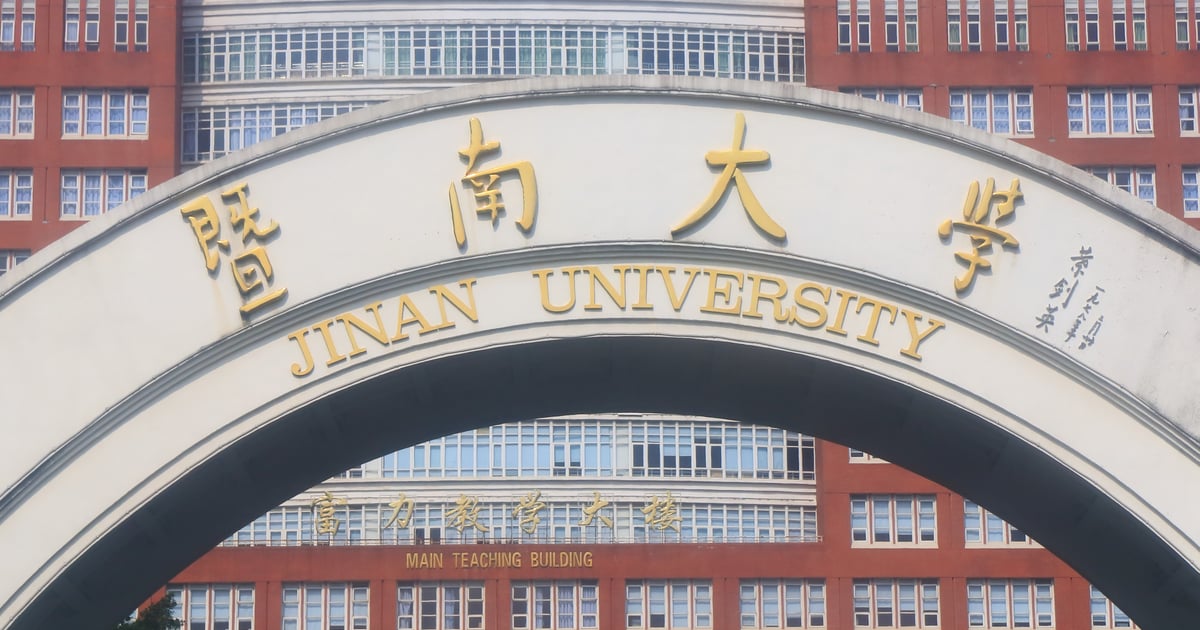
The platform's brain is a 500-square-meter Big Data laboratory at Jinan University in Guangzhou, built to comfortably house rows of server racks and at least 100 employees.
Related: Cybercriminals Hack Brazilian Government Servers to Host Phishing Sites
Basically, it's built to ingest massive amounts of online information overseas Chinese communities, identify people, relationships, and public sentiments, and convert it all into actionable reports for CCP leadership, according to NetAskari.
Social media provides much of the content. The platform scrapes liberally from platforms like Instagram, , and X, plus Chinese platforms like Weibo and WeChat. As a rule, the actual scrapers are run on machines located in foreign countries. As with Chinese hacking campaigns more broadly, the machines doing the crimes are also shielded behind rotating proxy networks . The goal of this obfuscation, one leaked document explains, is to “ensure the security of data collection and prevent the collection system from being traced and discovered" by targeted platforms.
The data then makes its way to China for processing. Foreign languages are translated into Chinese, keywords are extracted, and meaningful links drawn. UFWD then cross-references these data with preexisting records of notable people identified as being involved in the media, sciences, politics, etc., as well as blacklisted and "two-faced people." These two sources feed a "business system" — the layer that seems to draw meaningful connections public sentiments, the results of influence operations, and more.
Sometimes, the final reports outputted by this multitiered system simply concern public relations trends. Sometimes they've been used to identify ethnic Chinese individuals of note around the world — be they Taiwanese engineers, social media influencers, or something in between — and unearth strategies for how to utilize them to further the ends of the Chinese Communist Party.
Using AI to Expand CCP Influence
Overall, the NetAskari analyst describes the Overseas Chinese Affairs Big Data Platform as "a worldwide dragnet that uses open source intelligence (OSINT) and Big Data analysis to identify and find potential collaborators, partners, and affiliates that the UFWD can work with to further their goal [of] extending the Communist Party's influence abroad and creating a 'China-friendly' environment in other nations' political, economic, and social settings."
It's nothing the UFWD wasn't doing before, to be sure. Instead, the analyst adds, "What used to be done manually, at a much slower speed, is now supercharged via AI and modern technology."
That, ultimately, is the rub. The leaked documents contain only outdated references, from 2021, how machine learning (ML) and natural language processing (NLP) algorithms fit into this picture. It's unclear whether, and how, more modern large language models have been incorporated into — and potentially supercharged — the system. The better the AI gets, the more wide-ranging and granular the Overseas Chinese Affairs Big Data Platform can become, with real consequences for people who may not know they are being targeted by a foreign nation.
"A surveillance state can't accept that its own citizens are escaping to other nations, outside the reach of Beijing's grasp. For the best part of the last 20 years, most people had the luxury to ignore this part of the Chinese-state. Often practical and physical limitations restricted Chinese organiations to expand too quickly abroad or even get a foothold. But with remote methods like the ones we have seen applied in the Big-Data center of Jinan University, these 'natural boundaries' don't apply anymore," the analysti laments.
"Pair it now with ever growing globalization, China's stepping out onto the world stage, and crises of democracy in many Western nations, and it is not hard to see why such operations should concern even average citizens in the US or Europe," he says. "Even if they have no personal ties to China."
Nate Nelson is a journalist and award-winning scriptwriter. In addition to Dark Reading he writes for Darknet Diaries, the most popular show in cybersecurity across all media.
He began his career as a freelancer, ghostwriting Forbes and CNBC op-eds for executives in tech and finance. Then he transitioned to journalism at Threatpost, where he covered cybersecurity news and trends. Throughout those years he co-created a cybersecurity podcast, Malicious Life, which in its day climbed into the Top 20 technology podcasts charts on Apple Podcasts and Spotify.
He holds degrees from New York University and Bard College. As a born and bred New Yorker, he enjoys a superiority complex, but is polite enough to keep it to himself.
Want more Dark Reading stories in your Google results?
The Autonomous Endpoint Management Advantage
The Autonomous Endpoint Management Advantage
2026 State of Cybersecurity Report: Bridging the Divide
2026 State of Cybersecurity Report: Bridging the Divide
The State of Cloud Security: The Latest Challenges
The State of Cloud Security: The Latest Challenges
How Organizations Are Managing Incident Response
How Organizations Are Managing Incident Response
How Enterprises Are Developing Secure Applications
How Enterprises Are Developing Secure Applications
From Shadow AI to Rogue Agents: Securing the AI You Can't See
From Shadow AI to Rogue Agents: Securing the AI You Can't See
LLM Security Architecture: Building Secure AI Systems from the Ground Up
LLM Security Architecture: Building Secure AI Systems from the Ground Up
Resilient Architecture: Designing Systems That Survive Compromise
Resilient Architecture: Designing Systems That Survive Compromise
Prompt Injection 101: What It Is and How to Stay Ahead
Prompt Injection 101: What It Is and How to Stay Ahead
The Long Tail Is Now the Front Line: Reducing Frontier-AI & Third-Party App Risk
The Long Tail Is Now the Front Line: Reducing Frontier-AI & Third-Party App Risk
The full story
This article is one source in a clustered incident — the cluster page carries the summary, timeline and every other outlet covering it.
