 Back Mickryan.Substack
Communications Slowdowns, Seven Vivaldi Insights, More Sanctions Relief ...
My weekly update on Ukraine and the Pacific, as well as my Big Five recommended war and national security readings.
I really want our relations – between Ukraine and America, and with all our other partners – to be strong, truly friendly, and without misunderstandings. Because without a strong America that cares what happens in the world, the world would definitely be a worse place. President Zelenskyy, 24 October 2026.
Talks to end the war between America and Iran made little visible progress this week. On 19 October sources told The New Arab that a breakthrough was expected that week, with Qatar and Pakistan pushing both sides towards concessions, and Iran’s foreign minister’s proposal to reopen the Strait of Hormuz within seven days if Washington met several Iranian demands. But by 22 October , President Trump was telling a reporter that “We are not negotiating with” Iran, that “Something one way or another will happen, fairly soon” and that “Most people seem to think it’s after the election.”
Russia is positioning itself as a go-between on Iran, with Iran International reporting that Putin discussed Iran with Steve Witkoff and Sergey Lavrov visited Tehran, and the first Russian diesel tanker sailed for New York.
The Starlink/Starshield debacle continues with speed throttling apparently remaining in place for Ukrainian drones and interceptors moving over certain speeds. Operation Vivaldi has concluded, and I have proposed seven initial insights from the operation.
In the Pacific, Beijing is continuing its campaign of pressure on Taiwan while the US-Japanese Exercise Keen Sword begins near Taiwan, and Taiwan ponders its joint command and control.
Welcome to this week’s update and The Big Five.
The Starlink, Starshield and Patriot Slowdown. Speaking at the Hudson Institute on 23 October, President Zelenskyy said that agreed deliveries of interceptor missiles used against Russian ballistic missiles remain delayed. Additionally, Starlink and Starshield restrictions remain in place despite Trump’s claim that service was restored. He said the restrictions affect operations because “the Russians attack us almost every day”.
I have covered this issue in updates, and it goes without saying that the longer these delays continue, the more Ukrainians will die. It is as simple as that. AP reports that Vice President Vance hinted at White House coordination with Elon Musk. Marco Rubio and Pete Hegseth denied any administration involvement, according to an ABC News report .
The First Tanker Sails. On 23 October the Kremlin said that the first tanker of Russian diesel under Trump’s deal with Putin had left for the United States. Spokesman Dmitry Peskov said that “The first oil tanker has sailed off to customers, and regular supplies will continue.” According to the Associated Press, Deputy Prime Minister Alexander Novak put the first cargo at 40,000 tons, and the marine intelligence firm Kpler says the vessel is bound for New York, with arrival expected on 7 November . It would be the first Russian diesel delivered to the United States since July 2023.
AP estimates the cargo at 300,000 barrels, roughly 7 per cent of what the United States uses in a day, and quotes energy policy experts who doubt that it will do much to lower prices. ISW assesses in its 21 October assessment that the diesel decision “represents a unilateral concession in the US negotiating posture to Russia”, and its 22 October assessment concludes that the Kremlin’s interest in talks is aimed at securing economic concessions from the United States.
Diplomacy. US representative Steve Witkoff met European officials and Zelenskyy in Oslo and then met Putin in St Petersburg on 21 October. It was during his meeting that he spoke the words that have now become infamous:
You talk so much my president, President Trump, being a humanitarian. You are a humanitarian also, sir, and I salute that. I commend you.
You talk so much my president, President Trump, being a humanitarian. You are a humanitarian also, sir, and I salute that. I commend you.
According to CBS News , Russia said it would study the proposals but expects the talks to take a long time. Putin’s aide Yury Ushakov said that proposals he attributed to Ukraine and the European Union “contained little that was useful in the context of resolving the Ukrainian crisis”. Ushakov said Moscow was “prepared, in principle, to resume the talks in early November”, while Euromaidan Press reports that he spoke of mid-November with Abu Dhabi as the likely venue.
This represents more of the same from Russia. While Putin is being particularly successful at manipulating key decision makers in Washington DC, he believes he has little reason to engage in substantive negotiations. His theory of victory, which involves corroding Ukrainian and European will, remains his primary obsession. And, given he is not receiving even the slightest push back on his atrocities against Ukrainian civilians from the US president, Putin feels he is in a good position to continue the war.
Putin is doing little that is new, however. He is just doing what he has done for the duration of the war: make minor gains on the ground with massive (and increasing) casualties, bombard Ukrainian cities and infrastructure to degrade societal cohesion and destroy Ukraine’s political will to resist and engage in a global misinformation campaign to convince “elites” that Russia is winning. He rolled out his narrative again this week , stating that “it is now obvious to everyone that defeating Russia on the battlefield would be impossible, while inflicting a strategic defeat on it is unrealistic… In fact, if we consider the political processes in Europe, to take one example, it becomes obvious that the people of Europe do not want to fight against Russia.”
The only new element of this approach is that he now has the President of the US on his side. Whether this will be a decisive element in Putin’s war against Ukraine remains to be seen. But it is almost certain that Trump’s decision to not hide his true feelings Russia or Ukraine anymore will have profound impacts on Ukraine, Europe and NATO.
Putin has also retained his maximalist goals for his invasion of Ukraine. As recent as this week, Putin reinforced his historical narrative of Ukraine not being a real nation. In an interview with journalist Pavel Zarubin, Putin stated that “I think that it is not their territory but the historical territory of Russia.”
To make matters even worse, the Kyiv Independent has published an article speculating that Trump may be considering further sanctions relief for Russia .
Putin Wants Xi in the Room. Moscow is seeking to work on a larger stage. A Wall Street Journal report . stated this week that Putin used a call with Trump on 9 October to propose a trilateral summit with Xi Jinping on the sidelines of the APEC summit on 18 and 19 November. Peskov said that “Russia is engaging in discussions a potential meeting”, and Rubio acknowledged that “these discussions continue” but said “no such meeting has been finalized”.
For Putin, a photograph with Trump and Xi would signal that Russia sits at the table of great powers regardless of what happens in Ukraine. The reality is that Russia has nowhere near the military, cultural or economic power of the US or China. But Putin is adept at manipulating his own people, and gullible folks in the West, that Russia remains a global power.
Kyiv and its European partners would not be in the meeting. It is hard to imagine the Ukrainians or EU abiding by any decision made at such a meeting. Separately, President Zelenskyy has raised hopes for a trilateral Ukraine-US-Russia meeting. As a report in the Kyiv Post notes:
Zelensky argued that progress remains unlikely without Washington’s direct involvement and pressure on the Kremlin, while urging the US to keep the issue a priority at all levels. Ukraine’s goal, he said, remains to move beyond technical-level negotiations to a meeting of leaders, since the most important issues can only be settled through direct discussions.
Zelensky argued that progress remains unlikely without Washington’s direct involvement and pressure on the Kremlin, while urging the US to keep the issue a priority at all levels. Ukraine’s goal, he said, remains to move beyond technical-level negotiations to a meeting of leaders, since the most important issues can only be settled through direct discussions.
What Ukrainians Think. The Kyiv International Institute of Sociology (KIIS) surveyed 1,031 adults by telephone from 8 to 16 October. The Kyiv Post reports that 61 per cent reject giving up the whole of Donbas in exchange for security guarantees, 35 per cent would accept it and 4 per cent are undecided. That shows no statistically significant change since late July and early August. Opposition stood at 57 per cent among those interviewed on 8 and 9 October and 62 per cent among those interviewed afterwards.
KIIS said that “At least for now, the campaign of pressure on Ukraine has not led to greater willingness to accept this proposal.” Kharkiv region was the most willing, with 45 per cent open to it, and 66 per cent in Kyiv rejected it. The survey notes that 62 per cent are ready to endure the war for as long as necessary, 21 per cent for several months to six months and 4 per cent for one year. On duration, 10 per cent expect the war to end by the close of 2026, 13 per cent in the first half of 2027 and 17 per cent by the end of 2027, while 39 per cent expect it to run to 2028 or later. A majority say they can endure as long as necessary, and most still reject a way out on Moscow’s terms.
Vivaldi’s Initial Lessons. On 19 October Brigadier General Biletskyi announced the end of Operation Vivaldi. According to Censor.NET , he said the 3rd Army Corps liberated 277 square kilometres and put Russian losses at more than 8,000 killed and wounded, with 270 prisoners and the 144th Division routed. He said Ukrainian casualties were one seventh of Russia’s.
Biletskyi also said the operation’s main value is that Russia’s operational plan in the east of Ukraine was disrupted, noting that:
The enemy's key objective for 2026 has been destroyed. Therefore, the strategic significance of this operation is measured not in kilometres, but in the fact that the enemy's main plan has been thwarted. That plan was to encircle the entire Donetsk region, including Sloviansk and Kramatorsk, advancing towards Barvinkove and capturing Donetsk region through two converging attacks. This plan has been disrupted.
The enemy's key objective for 2026 has been destroyed. Therefore, the strategic significance of this operation is measured not in kilometres, but in the fact that the enemy's main plan has been thwarted. That plan was to encircle the entire Donetsk region, including Sloviansk and Kramatorsk, advancing towards Barvinkove and capturing Donetsk region through two converging attacks. This plan has been disrupted.
Moscow intended to push from a bridgehead on the Chornyi Zherebets River towards Sviatohirsk and split Ukrainian forces east of the Oskil. The corps has reached that river, which shortens the front and gives it a better defensive position.
Brigadier General Biletskyi also stated this week that “The Ukrainian army can conduct offensive operations against a numerically superior enemy” and that a frontal assault on Sloviansk and Kramatorsk would be “quite costly, bloody and by no means certain to succeed”. He identified Dobropillia as the only area where Russia has had some success.
Shaping and Deception. That shaping operations and deception well in advance of the operation were crucial is hardly a new lesson, as shaping and deception operations were critical in almost every 19 th and 20 th century military operation. That said, a crucial element in modern war is suppressing the drone-saturated close and deep areas controlled by the enemy as well as denying enemy drones’ visibility of friendly preparations (except those parts of the deception plan). These shaping and deception activities take months, and require considerable integration of tactical, operational and strategic capabilities. It also demands considerable patience from senior military – and political – leaders.
Shaping and Deception. That shaping operations and deception well in advance of the operation were crucial is hardly a new lesson, as shaping and deception operations were critical in almost every 19 th and 20 th century military operation. That said, a crucial element in modern war is suppressing the drone-saturated close and deep areas controlled by the enemy as well as denying enemy drones’ visibility of friendly preparations (except those parts of the deception plan). These shaping and deception activities take months, and require considerable integration of tactical, operational and strategic capabilities. It also demands considerable patience from senior military – and political – leaders.
Operational Security. Just as it did with the Kursk incursion, and the operations in southern Ukraine earlier in 2026, the Ukrainian armed forces sustained a blanket blackout reporting their offensive operations during Vivaldi. This is extraordinarily difficult to achieve in the modern world and requires the willing acceptance by journalists of limitations on their reporting. This, again, is nothing new. During the Second World War, the allies would at times limit reporting before and during the initial stages of an operation.
Operational Security. Just as it did with the Kursk incursion, and the operations in southern Ukraine earlier in 2026, the Ukrainian armed forces sustained a blanket blackout reporting their offensive operations during Vivaldi. This is extraordinarily difficult to achieve in the modern world and requires the willing acceptance by journalists of limitations on their reporting. This, again, is nothing new. During the Second World War, the allies would at times limit reporting before and during the initial stages of an operation.
Manoeuvre is still possible. The operation shows that manoeuvre is not dead, but it has changed shape. Tanks are not dead but are used differently in different phases of an operation than in eras. At the same time, wheeled and tracked mobility is still crucial if a successful shaping phase, and break-in battle, are to be exploited and enemy positions destroyed in depth and large amounts of terrain recaptured and friendly towns liberated.
Manoeuvre is still possible. The operation shows that manoeuvre is not dead, but it has changed shape. Tanks are not dead but are used differently in different phases of an operation than in eras. At the same time, wheeled and tracked mobility is still crucial if a successful shaping phase, and break-in battle, are to be exploited and enemy positions destroyed in depth and large amounts of terrain recaptured and friendly towns liberated.
Expansion of Autonomous Attack. The 3 rd Army Corps used a large array of ground and aerial vehicles during the offensive. There was a myriad of roles played by drones, including ISR, attack, deception, flank security, deep operations, counter-drone operations, resupply and casualty evacuation. None of these functions are new but they are being executed differently by drones and human-machine teams.
Expansion of Autonomous Attack. The 3 rd Army Corps used a large array of ground and aerial vehicles during the offensive. There was a myriad of roles played by drones, including ISR, attack, deception, flank security, deep operations, counter-drone operations, resupply and casualty evacuation. None of these functions are new but they are being executed differently by drones and human-machine teams.
The information fight. Violence and influence have always been two sides of the same coin. So, it was in Operation Vivaldi. The Ukrainians used deception to shape the perception of Ukrainian intentions in the minds of Russian commanders. They suppressed information the offensive when it suited their requirements but then opened up the operation to counter the Russian “inevitable victory” narrative.
The information fight. Violence and influence have always been two sides of the same coin. So, it was in Operation Vivaldi. The Ukrainians used deception to shape the perception of Ukrainian intentions in the minds of Russian commanders. They suppressed information the offensive when it suited their requirements but then opened up the operation to counter the Russian “inevitable victory” narrative.
Learning and adapting . The 3 rd Army Corps will have learned much from executing this operation, and it is probably already adapting processes, structures and tactics. Other Ukrainian Corps were also watching, and will keen to have their turn at implementing an operation based on the lessons from 3 rd Corps. The Russians, who have been fast followers for the duration of the war, will also have been watching closely. They are sure to be evolving their own offensive and defensive doctrines for Ukraine as you read this.
Learning and adapting . The 3 rd Army Corps will have learned much from executing this operation, and it is probably already adapting processes, structures and tactics. Other Ukrainian Corps were also watching, and will keen to have their turn at implementing an operation based on the lessons from 3 rd Corps. The Russians, who have been fast followers for the duration of the war, will also have been watching closely. They are sure to be evolving their own offensive and defensive doctrines for Ukraine as you read this.
Leadership . Good leadership is the decisive difference between winning and losing armies. Good leaders ensure that robust planning and wargaming takes place well before the first warning order for an operation is issued. They ensure that they have in place the right subordinate leaders, and that these leaders have the right authorities and sufficient flexibility in executing a high commander’s intent. Importantly, good leaders are able to provide purpose to their people. Finally, good leaders should be good story tellers, so they can explain not only the purpose of their operations to soldiers, but the importance and results of those same operations to politicians and civilians. This appears to have been the case with the Commander of the 3 rd Army Corps for Operation Vivaldi.
Leadership . Good leadership is the decisive difference between winning and losing armies. Good leaders ensure that robust planning and wargaming takes place well before the first warning order for an operation is issued. They ensure that they have in place the right subordinate leaders, and that these leaders have the right authorities and sufficient flexibility in executing a high commander’s intent. Importantly, good leaders are able to provide purpose to their people. Finally, good leaders should be good story tellers, so they can explain not only the purpose of their operations to soldiers, but the importance and results of those same operations to politicians and civilians. This appears to have been the case with the Commander of the 3 rd Army Corps for Operation Vivaldi.
Russia’s Terror Bombing Campaign. Hours after Witkoff met Putin, Russia struck Kyiv in several waves. The Kyiv Independent reports that the Air Force counted 210 drones, 110 of them jet-powered, and that Zelenskyy said Russia fired 21 missiles. He told the public that the ballistic warheads were cluster munitions that spread over an area of 400 metres across, and that the attack was “a deliberate choice of weapon”. The Kyiv city prosecutor counted at least one dead and 24 injured in the city, and Zelenskyy reported two dead and 34 injured across Kyiv and Kyiv Oblast, including five children.
ISW’s 22 October assessment relays Zelenskyy’s statement that Russia has struck more than 170 Ukrainian energy facilities since 11 October. The 19 October assessment records 28 substations and other energy objects hit overnight on 18 and 19 October, leaving 550,000 households without power across 15 regions, and Prime Minister Serhiy Koretskyi’s count of 2,147 strikes on energy facilities since 16 July.
More Prisoners Come . On 23 October Ukraine received 270 former PoWs in an exchange with Russia. The Kyiv Post reported that 270 Russian soldiers returned to Russia in the same swap. It is the first major exchange in two months, since 103 prisoners were exchanged on each side on 19 August. The group included nine civilians, and most of the military personnel had been in Russian captivity since 2022.
President Zelenskyy wrote that “270 of our people are . A very important result,” and that “We remember every single person and continue the for everyone.” For the families it ends years of waiting, and it shows that Moscow and Kyiv can still agree on something while the larger talks stall.
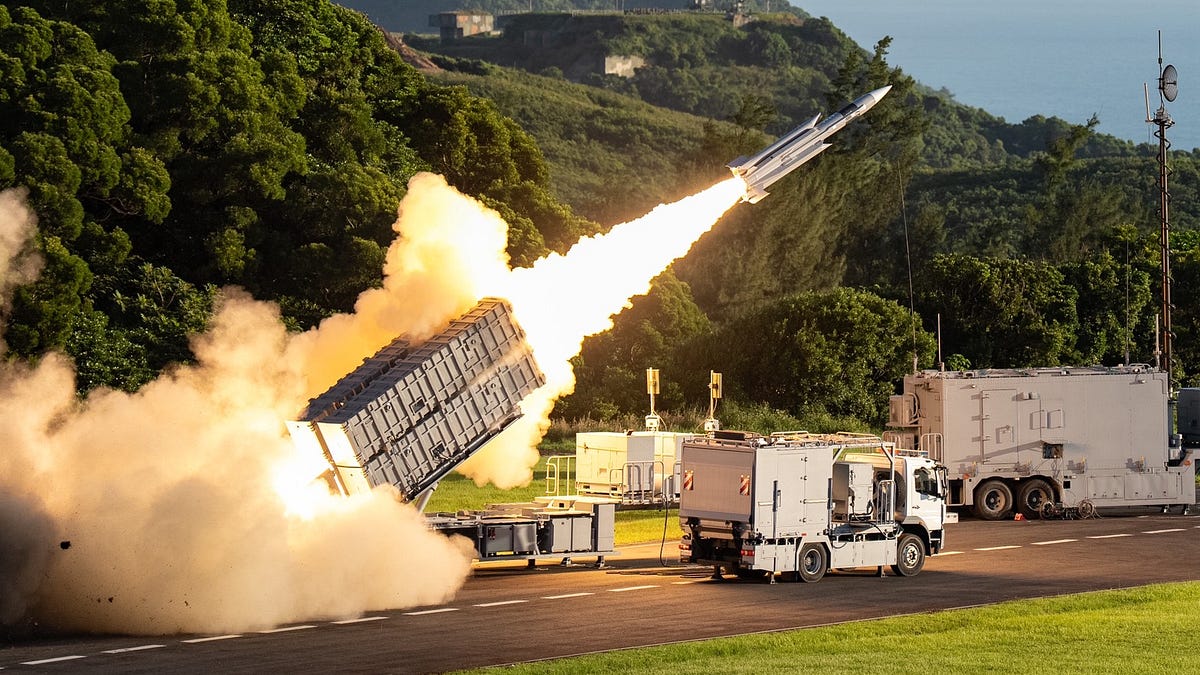
Exercise Keen Sword Opens Near Taiwan. Exercise Keen Sword, which is a large US-Japan biennial military exercise, is being conducted from 19 to 29 October. Defense News reported ahead of the exercise that the US Marine Corps would deploy its Navy-Marine Expeditionary Ship Interdiction System (NMESIS) anti-ship system and MADIS air defence system to Yonaguni, an island 110 kilometres from Taiwan. HIMARS vehicles would also be deployed to Camp Ishigaki.
During the exercise, Japan’s Ground Self-Defense Force will train with Type-25 missiles. There are two variants: the Type 25 surface-to-ship missile with reported range of 1000 kilometres, and the Type 25 Hyper Velocity Gliding Projectile with a range of 300-500 kilometres. A Naval News article in March this year noted that:
The Type 25 HGP introduces a new class of hypersonic weapon into JGSDF service. Designed for remote island defense, it travels at extremely high speeds along unpredictable trajectories, making interception more difficult. The initial variant deployed at Camp Fuji has a range of several hundred kilometres and will be used primarily for training and doctrine development, with longer-range versions under development.
The Type 25 HGP introduces a new class of hypersonic weapon into JGSDF service. Designed for remote island defense, it travels at extremely high speeds along unpredictable trajectories, making interception more difficult. The initial variant deployed at Camp Fuji has a range of several hundred kilometres and will be used primarily for training and doctrine development, with longer-range versions under development.
This exercise is built around “ground-based, multi-island, sea-denial operations”, in order to secure the western Pacific’s first island chain. Or, perhaps more accurately, make PLA operations beyond the chain expensive. Unfortunately, Super Typhoon Champi intervened. Stars and Stripes reports that commanders have scaled back or cancelled portions of an exercise.
Taiwan’s Joint Journey Considered. A critical element of modern warfighting capacity is the ability to integrate land, air, sea, subsea, space, cyber and information operations into a unified operational and strategic effort. This is not an easy capability to develop. It is something the allies worked very hard to perfect during the Second World War, and that many nations have continued developing in the past few decades.
In the 2010s, China took large steps towards joint operations by creating joint theatre commands, which now have overall authority for operations in specific areas (such as the South China Sea or around Taiwan). They also have permanently allocated air, land and sea forces.
In a new article , Tristan Tang and Rion Wu have examined the Taiwanese military command and control arrangements and proposed that Taiwan also needs to focus on the development of its capacity to plan and execute joint operations. As they note in their report:
In recent years, experts have paid considerable attention to the Taiwan military’s efforts toward decentralization, but in practice, joint command and control is the key to whether Taiwan’s combat capability can be improved.
In recent years, experts have paid considerable attention to the Taiwan military’s efforts toward decentralization, but in practice, joint command and control is the key to whether Taiwan’s combat capability can be improved.
One important driver for this push for greater joint capability has been the increased role and capabilities of the Navy and Coast Guard, and the establishment of the new Navy Coastal Operations Command. Another driver has been the re-tasking of Marines from expeditionary amphibious operations to a more prominent role as a strategic reserve to be employed in land based, urban defensive operations. Perhaps most importantly, Taiwan’s military strategy has shifted from past concepts of defeating the enemy on the opposite shore or seeking a decisive battle in the littoral area to carrying out an erosion strategy and sustained operations in and around Taiwan.
This is an important article and provides a useful update on the status of Taiwan’s military command and control. It is a subject that requires attention from both government and the military. As it notes , “Taiwan has far fewer resources compared with China, so joint operations capability is key to allowing Taiwan’s combat power to be used more efficiently. This is also a key area of Taiwan-U.S. military cooperation.” It will be interesting to watch the development of joint capabilities in Taiwan.
China’s Continued Pressure Against Taiwan. The AEI and ISW China-Taiwan update of 20 October describes a Taiwanese Coast Guard report that on 18 October, 12 China Coast Guard and research ships and four fishing boats harassed Taiwanese vessels or crossed its boundaries. Taiwan called this “hybrid warfare”. The Chinese tracking and research ship Beidiao 996 entered the contiguous zone southwest of Taiwan’s southern tip and left only after 12 warning broadcasts, and two coast guard ships patrolled restricted waters around Pratas from 16 to 18 October. As the update notes:
The PRC likely coordinated coast guard, research, and maritime militia vessels to intrude on Taiwan’s maritime jurisdiction and harass Taiwanese fishing boats at several locations simultaneously. The PRC is likely experimenting with using a variety of vessels to threaten Taiwan from multiple directions to erode Taiwan’s maritime control and practice for a blockade or other contingencies.
The PRC likely coordinated coast guard, research, and maritime militia vessels to intrude on Taiwan’s maritime jurisdiction and harass Taiwanese fishing boats at several locations simultaneously. The PRC is likely experimenting with using a variety of vessels to threaten Taiwan from multiple directions to erode Taiwan’s maritime control and practice for a blockade or other contingencies.
Exercise Han Kuang 42 Debrief . This year’s exercise in Taiwan featured a live-fire phase, mobilised twice as many reserve brigades as 2025 did and debuted an anti-decapitation drill that evacuated President Lai Ching-te to the Hengshan Command Post. Han Kuang this year was also the first exercise for the new Coastal Combat Command and saw the large-scale rehearsal of many elements of the national mobilization plan under the All-Out Defence Mobilisation Agency . The Taiwan Security Monitor has released a new online resource the exercise, with maps and other visualisations, that is available at this link .
It’s time to explore this week’s recommended readings.
This week’s recommendations include a report on how China is observing and learning from Russia’s war against Ukraine, a report that examines and rebuts the Russian information campaign around its “inevitable victory” in Ukraine, and a great piece on the risks of placing too much faith in advanced technologies in modern war. There are also good articles on deception and Russia’s strategy of attrition against Ukraine and the West.
As always, if you only have time to read one of my recommendations, the first is my pick of the week.
1. Watching Beijing Watch Moscow
This article published by The Jamestown Foundation brings together several recent articles that examine how China, the CCP and the PLA are observing and learning from Russia’s war against Ukraine. Assembled in a single, downloadable report, it explores issues such as autonomous systems, financial aspects of the war, space operations and the importance of unmanned surface vessels. The report is available at this link .
2. Challenging Russia’s Myth of Inevitable Victory
One of the inventions that Russia has relied upon throughout its full-scale invasion of Ukraine since February 2022 has been its myth inevitable victory. Combining old stories the Great Patriotic War and Putin’s delusional ideas of Imperium, Russia has used these to bolster morale at and attempt to reduce support for Ukraine. As Russia’s military performance has demonstrated, this is very much a myth, and Putin now relies on the whims of an aging US president in the hope of gaining something that can be sold as victory to his people. This is a very useful report from the Institute for the Study of War and can be read at this link .
In this piece by Mara Karlin published in Foreign Affairs , the author explores the phenomenon of the “technology trap”, where policy makers and strategists “develop a misplaced sense of certainty how innovations will change war and what warfare will look like in the future, while not paying enough attention to the unchanging fundamentals of war.” It is partially a response to the advocates of the transparent battlefield and current misconceptions the role of tech in modern war. Good tech will never replace good strategy and strategic thinking. It can be read here .
4. Russia’s Attrition Strategy Against Ukraine
As a complementary piece to the earlier one on Russia’s “inevitable victory”, this new article by Tewfik Hamel and published by Parameters examines Russia’s attritional strategy and theory of victory for its war against Ukraine. The author posits that the Russia-Ukraine War has shifted from its early days to a coercive strategy of attrition that is designed to exhaust Ukraine, fracture Western cohesion, and force political recognition of Russia’s claims to status and strategic depth. This is a good contemporary examination of Russian strategy, narratives and strategic culture, and is available at this link .
5. Deception in Mass Autonomous Warfare
War on the Rocks continues to publish a stream of articles examining the war in Ukraine. In this latest piece, Edouard Maurin explores how to deceive the enemy in a battlespace where one’s actions and movements are far more visible to the adversary. Deception is central to restoring maneuver because, as the author describes, “tunnels and deeper fortification buy time but do not restore freedom of action on the surface. Extreme lethality on the surface need not become fate.” The full article is available here .
The full story
This article is one source in a clustered incident — the cluster page carries the summary, timeline and every other outlet covering it.
