 Back Cyberkendra
Critical GoAhead Flaw Accepts Revoked mTLS Certificates
GoAhead, the embedded web server behind the management pages of routers, printers, firewalls, and industrial controllers, has patched three TLS flaws. They can let revoked client certificates through, accept overlong certificate chains, and expose some encrypted sessions to passive decryption.
Sébastien Féry of FoxIO found the issues and published a technical write-up on Monday. The most serious, CVE-2026-115881 (CVSS 9.1), affects GoAhead 3.4.5 through 6.1.0 when built with the OpenSSL-compatible backend. A LibreSSL-specific chain-depth bypass is tracked as CVE-2026-115884 (CVSS 7.4). An Mbed TLS Diffie-Hellman bug is rated 5.9 and has no CVE.
All three are fixed in GoAhead 6.1.1 . Developer EmbedThis shipped it to device builders on August 2 and published the advisories on October 12. CVE identifiers have been requested but were not yet live in the NVD database as of Tuesday.
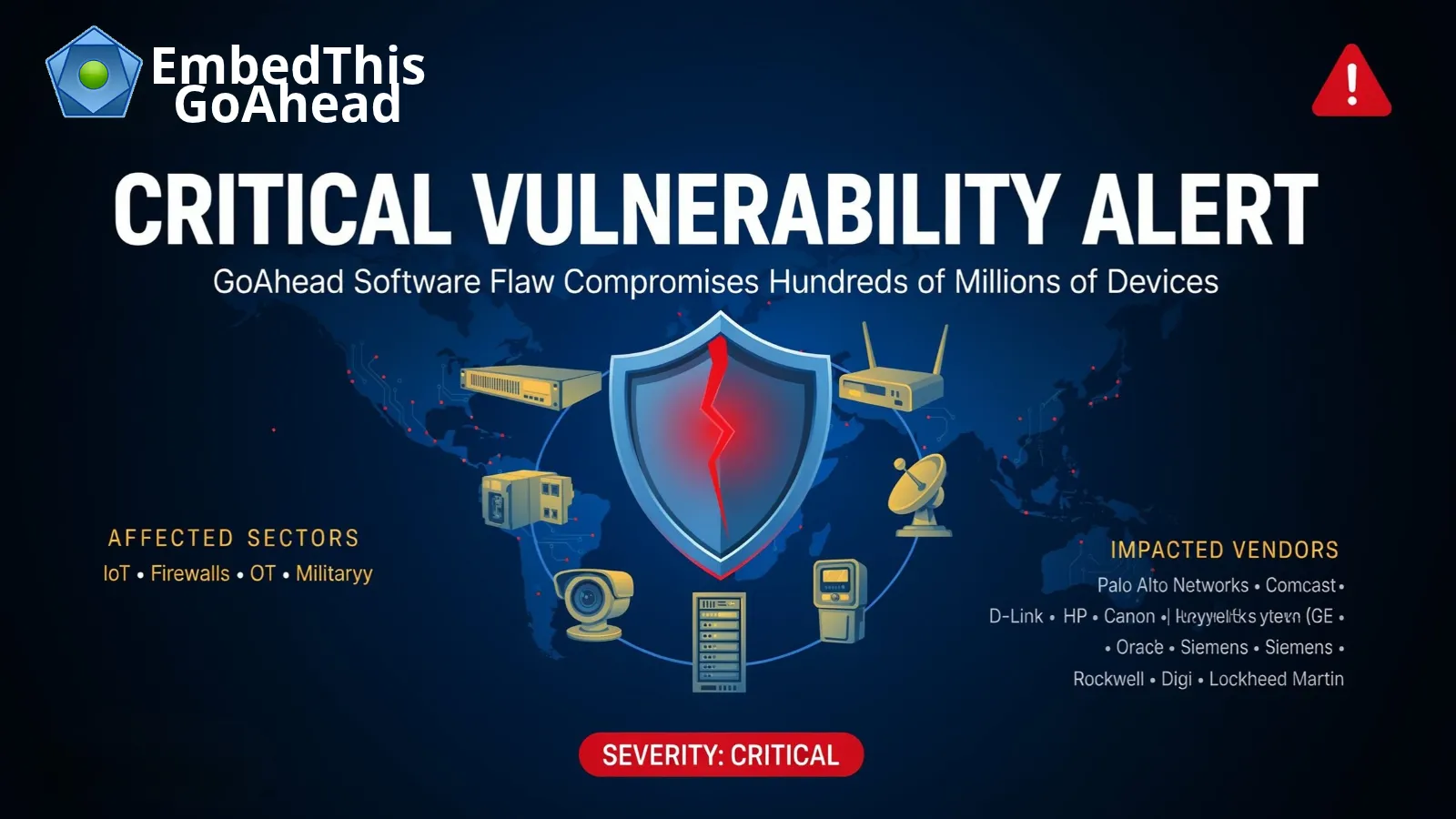
GoAhead runs on hundreds of millions of devices. FoxIO co-founder and CTO John Althouse announced the research on X . He named Palo Alto Networks, Comcast, D-Link, HP, Canon, Honeywell, GE, Oracle, Siemens, Rockwell, Digi, Lockheed Martin and Boeing among companies whose products use the server. None of those vendors has been shown to ship an affected configuration, and none has issued an advisory referencing the flaws as of Wednesday.
Althouse also pointed out that an upstream GoAhead patch does not put fixed firmware on devices. Each manufacturer has to rebuild and ship it.
How do the three GoAhead TLS flaws work?
The critical bug is a missing flag. An operator can configure a Certificate Revocation List (CRL), a file naming certificates that should no longer be trusted. GoAhead’s OpenSSL backend loads that file into the certificate store. It never sets X509_V_FLAG_CRL_CHECK , the flag OpenSSL needs before it consults the list. OpenSSL therefore returns success on every handshake without checking revocation. Loading the file succeeds, so the server prints no warning at startup.
In FoxIO’s test on GoAhead 6.1.0 with OpenSSL 3.6.2, a revoked client certificate signed by a trusted CA completed the mutual TLS handshake with issuer verification switched on. Revoking a certificate is how an organization cuts off a stolen or retired device. On affected builds, that device keeps its access.
The advisory notes that the default GoAhead build enables neither mutual TLS nor a CRL, so only deliberately hardened deployments are exposed. The attacker also needs a certificate that a trusted CA once issued. Mbed TLS builds handle revocation through a separate code path and are not affected.
The Mbed TLS bug is a length typo that entered the code in 2018. GoAhead configures the 2048-bit RFC 3526 Diffie-Hellman group. When it did, it passed the size of the one-byte generator as the size of the 256-byte prime. Mbed TLS read only the prime’s first byte, 0xFF, and advertised a modulus of 255 in TLS 1.2 DHE_RSA handshakes. With that modulus, the shared secret can take only eight values. Anyone who recorded the traffic can try each one offline and decrypt the session. Féry’s proof of concept recovered the secret on the fifth attempt.
That attack needs a client willing to accept the broken parameters. OpenSSL, current Go and Java TLS stacks, and mainstream browsers reject a modulus that small and fall back to a stronger key exchange. Custom and embedded clients without a minimum-size check will complete the session. TLS 1.3 and ECDHE connections are unaffected. The advisory covers GoAhead 4.0.2 through 6.1.0.
The third flaw affects only builds linked against LibreSSL 3.2.x or 3.3.2 through 3.3.6. Those builds must also require client certificates with issuer checking turned off. LibreSSL’s legacy verifier stops building an overlong chain without recording a depth error. GoAhead instead receives an “unable to get local issuer” error, which it tolerates when issuer checking is disabled.
In testing, a 17-certificate chain rooted in an attacker-controlled CA got past GoAhead’s 10-certificate limit and reached a protected resource. OpenSSL, BoringSSL, AWS-LC and LibreSSL 4.x reject the chain.
“None of these defects prevents the affected handshake from completing,” Féry said.
What else does GoAhead 6.1.1 fix?
The TLS bugs are three of 11 advisories closed in 6.1.1. The release came out of a full in-house source audit that also fixed 31 internally found defects.
The TLS bugs are three of 11 advisories closed in 6.1.1. The release came out of a full in-house source audit that also fixed 31 internally found defects.
Two other advisories are rated critical. The first, GOAHEAD-SA-2026-0001, affects HTTP Basic and form login. Anyone who knows a valid username can sign in with any password if that user’s password is stored as a Blowfish (BF1) hash, a format GoAhead added in 6.1.0. A researcher’s disclosure shows that the code computed the correct password comparison and then never used the result.
The second, GOAHEAD-SA-2026-0007, is a Windows command injection. In that flaw, .bat CGI scripts ran through cmd.exe with request data on the command line. The remaining advisories cover three HTTP request-smuggling variants, two CGI injection issues, a Digest authentication nonce that leaked the server’s master secret, and session fixation.
A further 174 Medium and Low findings remain open and risk-accepted. GoAhead is now in maintenance mode, with new projects steered toward the Ioto device agent.
A further 174 Medium and Low findings remain open and risk-accepted. GoAhead is now in maintenance mode, with new projects steered toward the Ioto device agent.
How can defenders find vulnerable GoAhead devices?
Device makers choose the TLS backend and verification settings when they compile firmware, so an owner cannot tell from the outside which flaws apply. FoxIO published JA4Scan fingerprints that map GoAhead 6.1.x servers to OpenSSL, LibreSSL and Mbed TLS backends. It also published proof-of-concept code . A fingerprint identifies a build, not a confirmed vulnerable server.
For the Mbed TLS bug, FoxIO advises checking JA4S server fingerprints from GoAhead devices for DHE_RSA cipher suites. Examples include 0x009F and 0xCCAA, which are TLS_DHE_RSA_WITH_CHACHA20_POLY1305_SHA256. A match such as t120100_009f_1ca028f07214 suggests a session negotiated through the broken key exchange.
GoAhead 6.1.1 is a drop-in replacement for 6.1.0. After upgrading, active sessions should be invalidated or the server restarted, and BF1-stored passwords rotated. The CRL advisory offers no interim workaround.
GoAhead 6.1.1 is a drop-in replacement for 6.1.0. After upgrading, active sessions should be invalidated or the server restarted, and BF1-stored passwords rotated. The CRL advisory offers no interim workaround.
Mbed TLS builds that cannot be upgraded yet can disable finite-field DHE suites or move to OpenSSL. LibreSSL builds can enable issuer verification with a trusted CA bundle, or move to LibreSSL 4.x or OpenSSL. As of October 27, no exploitation of the flaws had been reported.
Join the conversation. Ask questions, solutions, and help others.
Be the first to start the discussion!
The full story
This article is one source in a clustered incident — the cluster page carries the summary, timeline and every other outlet covering it.
