 Back Dexpose
Cyber Crime in India: Statistics, Cases & How to Report (2026 Guide)
India added over 930 million internet users to the global grid in less than a decade. That connectivity brought opportunity, and it brought predators.
Cybercrime in India is no longer a niche problem confined to tech companies or government networks. It reaches ordinary people: a factory worker in Surat who loses his savings to a fake KYC call, a college student in Delhi whose photos are weaponized for extortion, a small business owner in Chennai whose customer database surfaces on the dark web before she even knows she was breached.
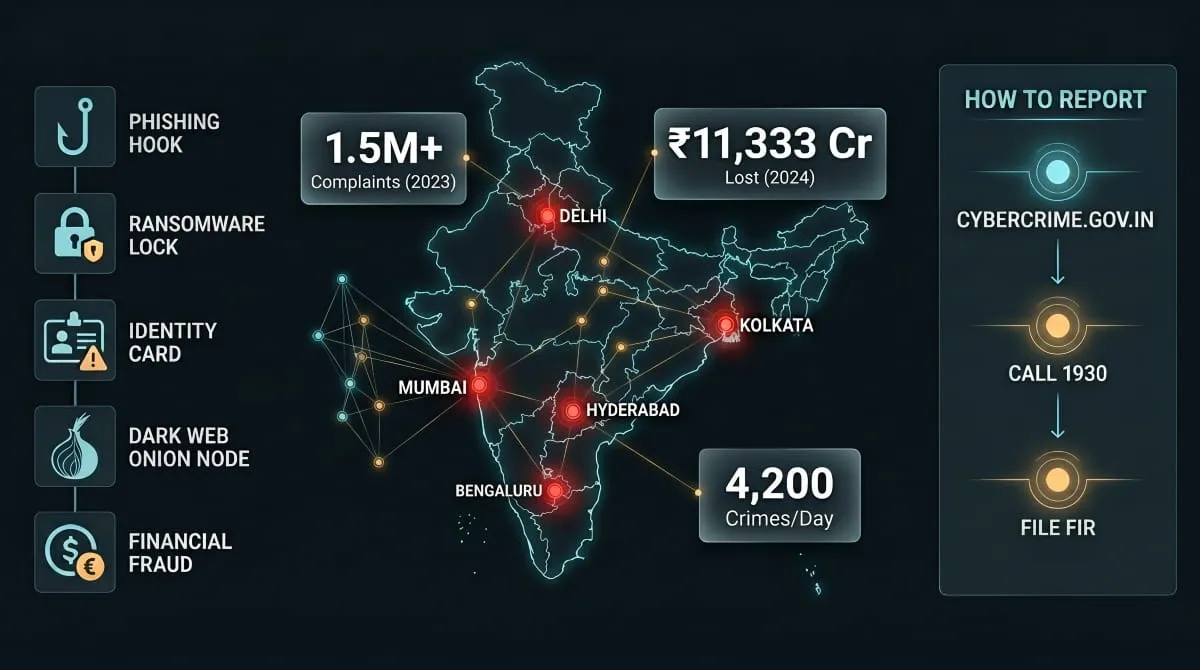
The numbers make it hard to look away. Indian authorities received over 1.5 million cybercrime complaints in 2023 alone, nearly double the year’s total. Financial fraud accounts for the bulk of cases, but the threat surface keeps widening: identity theft, ransomware, phishing, sextortion, and dark web data leaks are now everyday headlines, not edge cases.
Yet for most people, the response is confusion. Where do you report? Who investigates? What does Indian law actually say? What punishment does a cyber criminal face, and does anyone ever get it?
This guide answers all of it. Whether you’ve just been targeted, want to understand India’s cybercrime laws, or are trying to protect yourself before something goes wrong, you’ll find everything you need here, including how to file a complaint on the National Cyber Crime Reporting Portal , how the 1930 helpline works, real case studies, current 2025 statistics, and the prevention steps that actually matter.
Cybercrime doesn’t happen in a vacuum. It happens in your inbox, on your phone, inside your bank account. But before understanding how to fight it, you need to understand how India defines it, and what legal machinery exists to prosecute it.
India does not have a single statutory definition of “cyber crime” codified in a single law. Instead, the term broadly covers any criminal act in which a computer, network, or digital device is either the tool used to commit the offence or the target of the offence itself.
In practical terms, this includes hacking into someone’s email account, stealing financial credentials through phishing, publishing someone’s private images without consent, running online fraud schemes, launching ransomware attacks against businesses, and trafficking stolen data on the dark web . The common thread is digital means; the crime could not exist or could not reach its victim without technology.
What makes Indian cybercrime law particularly important to understand is that it doesn’t exist in isolation. Two primary legislations work in tandem to govern it.
The Information Technology Act, 2000 (IT Act) is India’s foundational cyber law, the first attempt to create a legal framework for electronic commerce, digital records, and online offences. Over two decades later, it remains the primary statute under which most cybercrime cases are filed.
Several sections of the IT Act carry direct relevance to everyday cyber offences:
The Indian Penal Code (IPC) operates alongside the IT Act. Older provisions covering cheating (Section 420), criminal intimidation (Section 507), defamation (Section 499), and extortion (Section 383) are regularly applied to cybercrime cases where the IT Act doesn’t fully address the nature of the offence. In many FIRs, you’ll see both IT Act sections and IPC sections invoked together.
India’s journey with cyber law began in 2000 , when the IT Act was passed primarily to enable e-commerce and give legal recognition to digital signatures and electronic contracts. Cybercrime provisions were present but thin; the internet was still nascent, and lawmakers weren’t fully anticipating what was coming.
The 2013 amendments to the IPC, passed in the wake of the Delhi gang rape case, added Section 354D, specifically criminalizing cyberstalking, a recognition that digital harassment was a distinct and serious offence warranting its own legal definition.
More recently, the Digital Personal Data Protection Act, 2023 (DPDP Act) , marks India’s most significant shift in data law since 2000. While not a cybercrime statute per se, it imposes obligations on organizations that handle personal data and establishes accountability structures that directly affect how data breaches and privacy violations are handled legally.
India’s cybercrime legal framework is still evolving. Courts continue to interpret existing provisions against new categories of offence, deepfake abuse, AI-generated fraud, dark web data markets, that no legislature had the foresight to name explicitly. That gap between the law as written and the threats as they exist today is precisely why awareness matters.
India’s cyber threat landscape isn’t monolithic. It’s a sprawling ecosystem of overlapping attack types, each targeting a different vulnerability, your money, your identity, your privacy, or your organization’s infrastructure. Understanding the categories isn’t an academic exercise. It’s the first step toward recognizing an attack before it completes.
If there is one category of cybercrime that affects more Indians than any other, it’s financial fraud. The scale is staggering. In 2023, Indians lost over ₹7,000 crore to online financial fraud, and that figure does not account for reported cases.
The methods are constantly mutating. Fake KYC verification calls impersonate bank officials and pressure victims into sharing OTPs. Investment scams, often running through WhatsApp groups and Telegram channels, promise guaranteed returns and vanish once enough money is pooled. “Digital arrest” scams, where fraudsters impersonate CBI or ED officers via video call and demand immediate payment to avoid fabricated arrest warrants, have become one of the fastest-growing fraud categories in 2024 and 2025.
Part-time job scams, fake e-commerce platforms, lottery fraud, and UPI manipulation round out a category that targets everyone from retired government employees to first-time smartphone users in Tier 3 cities. The common thread is urgency and authority, manufactured pressure designed to bypass rational judgment.
Identity theft in India sits at the intersection of cybercrime and data negligence. It occurs when someone obtains your personal information, Aadhaar number, PAN details, bank credentials, or login data, and uses it to impersonate you, open fraudulent accounts, or access financial services in your name.
The supply chain for stolen identities runs deeper than most people realize. Large-scale data breaches at organizations, hospitals, edtech platforms, insurance companies, and telecom providers expose millions of records at once. That data flows into dark web marketplaces where it’s bought and sold in bulk. By the time an individual discovers their identity has been compromised, the data may have already changed hands multiple times.
India has seen a significant spike in identity theft cases linked to breaches. The 2023 CoWIN data leak, alleged breaches of ICMR records, and multiple telecom data exposure incidents collectively put the personal details of hundreds of millions of Indian citizens at risk. The damage is rarely immediate; it compounds quietly over months as stolen data gets weaponized in layered fraud schemes.
These three terms describe the same fundamental attack executed across different channels, and India ranks among the most targeted countries globally for all three.
Phishing is the email-based variant. A fraudulent message impersonates a bank, government portal, e-commerce platform, or employer and directs the recipient to a fake website designed to harvest login credentials or payment details. The sophistication has increased dramatically; modern phishing emails are grammatically polished, visually convincing, and often personalized using data harvested from prior breaches.
Vishing (voice phishing) moves the attack to phone calls. Fraudsters impersonate bank customer service representatives, TRAI officials, or government agencies. The script is practiced, the urgency is manufactured, and the target, often elderly or less digitally literate, is walked through, handing over OTPs or remote access to their devices.
Smishing (SMS phishing) exploits the trust most Indians still place in text messages. A link embedded in what appears to be a bank alert, delivery notification, or government scheme message redirects users to credential-harvesting pages or silently installs malware when clicked.
What makes these attacks particularly effective in India is the combination of a large population of relatively new internet users, high trust in official-sounding communications, and the rapid proliferation of UPI-linked bank accounts that create a direct path from deception to financial loss.
India’s cybercrime data has consistently reflected a troubling volume of cases involving cyberstalking, online harassment, and image-based abuse, and consistent underreporting means the real numbers are considerably higher than what reaches police stations.
Cyberstalking, as defined under Section 354D of the IPC, covers repeated attempts to a person online despite clear disinterest, as well as monitoring someone’s internet activity to foster fear. In practice, cases range from relentless social media messaging by former partners to coordinated harassment campaigns against public figures, journalists, and activists.
Non-consensual intimate image sharing, colloquially known as “revenge porn”, is addressed under Section 66E of the IT Act and increasingly under the DPDP Act, but enforcement remains inconsistent. Young women and female professionals are disproportionately targeted, and the psychological toll frequently exceeds what any legal proceeding can adequately address.
Online harassment in India also takes organized forms: hate campaigns, doxxing (publishing someone’s private information publicly), and impersonation accounts designed to damage reputation. Social media platforms are the primary arena, and their delayed response mechanisms often allow harm to spread far before content is removed.
While financial fraud targets individuals, ransomware and malware attacks tend to target organizations, and the consequences scale accordingly. Hospitals, municipal corporations, logistics companies, and financial institutions have all been hit by ransomware attacks that encrypted critical data and demanded payment for its release.
CERT-In reported a significant increase in ransomware incidents against Indian critical infrastructure between 2022 and 2024. The 2022 ransomware attack on the All India Institute of Medical Sciences (AIIMS) in Delhi remains the most high-profile example. It paralyzed patient care systems for weeks, affecting millions of records and exposing the fragility of cybersecurity infrastructure in essential services.
Malware, a broader category that includes spyware, trojans, keyloggers, and infostealers, is often the precursor to larger attacks. Infostealer malware specifically is designed to silently extract saved passwords, browser cookies, and financial credentials from infected devices. These logs are then sold on dark web forums , feeding the same data pipeline that enables downstream identity theft and financial fraud.
For Indian businesses, particularly SMEs that lack dedicated security teams, malware infections frequently go undetected for months, giving attackers extended dwell time to map internal systems, escalate privileges, and exfiltrate sensitive data before anyone notices.
The dark web serves as the backend infrastructure for a significant portion of India’s cybercrime ecosystem. It’s where stolen data is sold, fraud toolkits are distributed, and criminal networks coordinate at scale, largely invisible to conventional law enforcement and inaccessible through standard browsers.
Indian data appears on dark web marketplaces with disturbing regularity. Breach databases containing Aadhaar-linked records, leaked banking credentials, corporate email archives, and medical records have all been documented in dark web listings targeting Indian organizations and individuals. In many cases, the affected party has no idea their data is being traded because the original breach occurred years earlier or because the organization that held their data never publicly disclosed the incident.
Dark web forums also serve as distribution channels for malware-as-a-service, phishing kits tailored to mimic Indian banking portals, and tutorials on executing UPI fraud and SIM-swap attacks at scale. The barrier to entry for would-be cyber criminals has dropped sharply as ready-made attack infrastructure becomes commoditized and commercially available.
For individuals and organizations concerned their exposure, proactive dark web monitoring and scanning for leaked credentials , email addresses, or corporate data are now recognized as best practices rather than optional extras. Waiting for visible damage before checking is, increasingly, too late.
Numbers have a way of making abstract threats concrete. India’s cybercrime data doesn’t just describe a problem; it maps the scale of a crisis that has been accelerating year over year, outpacing both law enforcement capacity and public awareness. Here is what the latest available data actually shows.
In 2023, the National Cyber Crime Reporting Portal (NCRB) recorded over 1.5 million complaints, translating to roughly 4,200 per day . That figure represents reported cases only. Cybercrime in India is widely acknowledged to be severely underreported, with a large proportion of victims either unaware of how to file a complaint, doubtful that anything will come of it, or simply too embarrassed to report fraud they feel they should have avoided.
The Ministry of Affairs data for 2024 indicates the trajectory has not slowed. Complaint volumes through the 1930 helpline and the national portal continued to rise in the first three quarters of 2024, with financial fraud complaints constituting the overwhelming majority of incoming reports.
To put the daily figure in perspective: by the time you finish reading this section, dozens of Indians will have filed, or chosen not to file, a cybercrime complaint.
India’s cybercrime burden is not evenly distributed. According to NCRB data, Telangana, Uttar Pradesh, Karnataka, and Rajasthan consistently rank among the states with the highest absolute volumes of reported cybercrime cases.
Telangana, and Hyderabad specifically, has recorded some of the highest cybercrime complaint rates among Indian cities, driven by its large tech workforce, high digital payment adoption, and significant concentration of corporate targets. Karnataka, to Bengaluru’s tech ecosystem, follows a similar pattern: high digital activity directly correlates with greater exposure.
Rajasthan warrants separate attention for a different reason. The Mewat region, spanning parts of Rajasthan and Haryana, has become synonymous with what investigators call “cyber crime hotspots” or “jamtara-style” fraud networks: loosely organized but highly effective phone-based scam operations targeting victims across the country. The term “Jamtara” itself, borrowed from the Jharkhand district made famous by the Netflix series, has entered common usage as shorthand for organized rural cyber fraud infrastructure.
Notably, higher reported rates in more urbanized states also reflect greater awareness of reporting mechanisms, meaning the gap between actual incidence and reported cases may be even wider in states with lower digital literacy.
The financial damage from cybercrime in India has reached a scale that demands serious policy attention. According to the Indian Cyber Crime Coordination Centre (I4C), Indians lost approximately ₹11,333 crore to cyber fraud in the first nine months of 2024 alone, a figure that dwarfs annual totals and signals a rapid escalation.
Investment scams and trading fraud accounted for the single largest of financial losses, followed by digital arrest scams and loan app-related fraud. The average loss per victim in investment fraud cases significantly exceeds that of other fraud categories, as victims are often manipulated over weeks or months into transferring increasingly large sums before the deception becomes apparent.
For context, the financial losses from cybercrime in India now rival the GDP of several smaller nations. Recovery rates remain low; once money moves through layered accounts, cryptocurrency wallets, or cross-border transfers, tracing and reclaiming it is operationally difficult, even when the case is eventually investigated.
The National Crime Records Bureau’s data provides the most authoritative longitudinal view of cybercrime in India, and several trends from the latest reporting period stand out.
Complaint volume is growing faster than case registration. A significant gap exists between the number of complaints received and the number of FIRs filed, reflecting both resource constraints at state cybercrime cells and procedural hurdles that discourage formal case registration.
The demographic profile of victims is broadening. Earlier data skewed toward urban, educated, and financially active victims. More recent reports show increasing victimization among senior citizens, rural populations, and first-generation smartphone users, groups with less familiarity with digital fraud patterns and fewer support systems when targeted.
Cyber crimes against women continue to be undercounted. Offences involving cyberstalking, image-based abuse, and online harassment remain among the most underreported categories, partly due to social stigma and partly due to the perception that digital harassment is less “serious” than physical crime, a perception that law enforcement and advocacy groups are actively working to correct.
Finally, the data consistently point to one structural reality: the gap between cybercrime sophistication and institutional response capacity is widening. More attacks, more complex attack chains, more organized criminal networks, against a backdrop of cyber cells that are understaffed, underequipped, and still developing the technical expertise needed to investigate modern cyber offences at scale.
Case studies do what statistics cannot. They show the human cost of cybercrime, the decisions made, the vulnerabilities exploited, and the damage that follows. India has produced some of the most significant cybercrime cases in Asia over the past two decades, ranging from coordinated dark web data operations to large-scale financial fraud that dismantled life savings overnight.
In November 2022, the All India Institute of Medical Sciences in New Delhi suffered one of the most damaging cyber attacks ever recorded against Indian public infrastructure. A ransomware group, believed to have Chinese state-linked affiliations (though never formally attributed), encrypted the hospital’s servers, taking down its patient management system, appointment scheduling, billing infrastructure, and laboratory result systems simultaneously.
For nearly two weeks, one of India’s largest and most critical hospitals was forced to operate on paper. An estimated 1.3 terabytes of data, including patient records, research data, and staff credentials, may have been compromised. The attackers demanded a ransom reportedly valued at ₹200 crore in cryptocurrency. The Indian government did not confirm whether any payment was made.
The attack exposed a systemic vulnerability: institutions that hold some of the most sensitive personal data in the country were operating on IT infrastructure with minimal cybersecurity investment.
Jamtara, a district in Jharkhand, became so synonymous with organized phone fraud that it entered the national vocabulary and eventually became the subject of a Netflix series. Over the course of multiple police investigations spanning 2015 to 2022, authorities dismantled what was effectively a cottage industry of vishing operations, with hundreds of individuals, many in their early twenties with minimal formal education, running coordinated impersonation fraud schemes from rural locations.
Victims across India were called by individuals impersonating bank representatives, prompted to OTPs, and systematically drained of savings. What made the Jamtara network significant beyond its scale was its organizational structure: role division, geographic distribution, money mule networks, and rapid SIM cycling, which made tracing individual perpetrators genuinely difficult.
In August 2018, Cosmos Cooperative Bank in Pune lost approximately ₹94 crore in one of the most technically sophisticated banking cyber attacks India had seen. Attackers, linked by investigators to the North Korea-affiliated Lazarus Group, compromised the bank’s ATM server and simultaneously conducted over 12,000 transactions across 28 countries using cloned debit cards. The operation ran over two weekends, exploiting gaps in real-time monitoring. A separate SWIFT-based transfer of ₹13.92 crore to a Hong Kong-based entity was made through compromised banking credentials.
The case demonstrated that Indian financial infrastructure was being targeted by nation-state-level threat actors, not just opportunistic domestic fraudsters.
Earlier but foundational: in 2005, a Pune-based call centre employee, Nadeem Kashmiri, sold customer account data belonging to Citibank clients to a UK-based fraudster. The case resulted in one of India’s first significant cybercrime convictions under the IT Act. It marked an early recognition that insider threats in India’s booming outsourcing sector represented a genuine, underappreciated risk.
In 2024, the Indian Cyber Crime Coordination Centre and multiple state police forces began dismantling a sprawling network responsible for “digital arrest” scams, a fraud category that Prime Minister Narendra Modi addressed in his Mann Ki Baat broadcast in October 2024, marking the first time the scheme had received national-level political attention.
Victims, frequently senior citizens and retired professionals, were contacted by individuals posing as officials from the CBI, Narcotics Control Bureau, or TRAI. They were placed under fabricated “digital arrest,” held on extended video calls for hours or days, and psychologically manipulated into transferring large sums to avoid non-existent criminal proceedings. Multiple arrests were made across Delhi, Uttar Pradesh, and Gujarat, with some operations traced to overseas criminal networks operating from Southeast Asia.
The Mahadev Book case implicated not only cybercriminals but also politicians, celebrities, and law enforcement officials across multiple Indian states. The operation, run primarily from Dubai, managed a network of illegal online betting platforms that processed thousands of crores in transactions through layers of shell accounts, cryptocurrency, and hawala networks. Enforcement Directorate investigations in 2023 and 2024 resulted in multiple arrests and asset seizures, while the case exposed how cyber-enabled financial crime in India now operates with significant institutional protection.
In June 2023, a Telegram bot began offering public access to what appeared to be personal data, names, Aadhaar numbers, phone numbers, and vaccination records of Indian citizens drawn from the CoWIN vaccination portal. The government disputed the scale of the breach, but the episode raised fundamental questions the security architecture protecting India’s largest biometric and health data infrastructure. The incident was emblematic of a broader pattern: massive centralized data collection combined with inadequate security controls creates high-value targets with catastrophic breach potential.
Financial cybercrime in India has produced cases on a scale that places the country among the most severely affected globally. Beyond the headline cases above, several patterns recur across major financial fraud investigations.
Loan app fraud, where predatory digital lending applications accessed contacts and private photos from victims’ phones and used them as blackmail leverage when borrowers couldn’t repay, led to multiple suicides across Telangana, Karnataka, and Maharashtra between 2021 and 2023, prompting RBI intervention and eventually leading to criminal cases against Chinese-linked app operators.
Taken together, these cases are not isolated incidents. They are a diagnostic.
They reveal that India’s cybercrime problem is both domestic and international. A nation-state group executed the Cosmos Bank heist. The digital arrest networks are run from overseas. The investment scam infrastructure is based in Southeast Asia. Yet the victims are overwhelmingly Indian, and the institutional response is still primarily calibrated for domestic, individual perpetrators.
They reveal that data is the upstream vulnerability. Nearly every major financial fraud case, whether it involves impersonation, targeted phishing, or identity theft, begins with access to personal data. The leaked CoWIN records, the stolen banking credentials, the dark web databases of Indian user information: these are not side effects of cybercrime. They are the raw material it runs on.
And they reveal that the gap between attack sophistication and defensive readiness is structural, not incidental. Until organizations, public and private, treat cybersecurity investment as essential infrastructure rather than optional overhead, and until individuals understand that their data has real market value to criminal networks, the case list will keep growing.
Also Read: IoT Hacking Statistics 2026 | Global Trends and Key Insights
The full story
This article is one source in a clustered incident — the cluster page carries the summary, timeline and every other outlet covering it.
