 Back link.springer.com
Cyber defense in OCPP for EV charging security risks
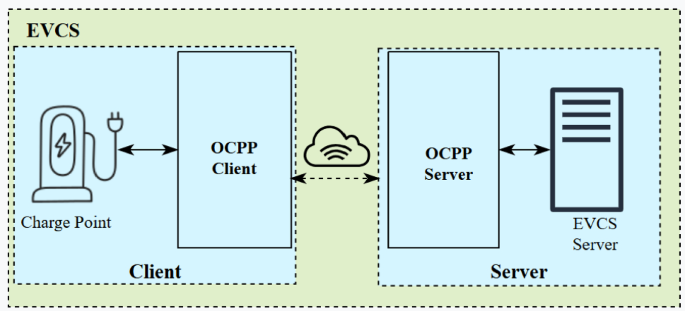
The rise of Electric Vehicle Charging Station (EVCS) globally is closely linked to the increasing adoption of EVs [ 1 ]. Facilitating this growth is OCPP [ 2 ], a communication standard designed to enhance interactions between EVCS and central management system [ 3 ]. Fig. 1 illustrates how OCPP facilitates seamless communication between the OCPP client and the OCPP server. This protocol supports essential functionalities such as remote operations, reservation handling, and smart charging capabilities, crucial for efficient EV charging [ 4 , 5 ]. OCPP accommodates both SOAP/XML and WebSockets/JSON protocols, ensuring robust and flexible communication [ 6 ]. SOAP/XML provides compatibility with older systems, ensuring clear and structured messaging, while WebSockets/JSON enables faster, real-time interactions by maintaining open connections and minimizing delays. Despite the availability of OCPP new release with advanced features, OCPP cyber risks remains critical and it is widely adopted due to its ease of implementation, user-friendly interface, and extensive existing infrastructure [ 7 ].
In particular, OCPP has critical cyber security vulnerabilities [ 8 ]. For example, practical exploits involving unencrypted WebSocket communication within OCPP have demonstrated how attackers could terminate charging sessions, execute remote code, and deploy malicious firmware on Electric Vehicle Supply Equipment [ 6 ]. Saiflow have identified improper handling of multiple connections from a single Charge Point (CP) [ 9 ], potentially exposing charging infrastructure to DoS attacks. The investigation carried by them also uncovered inadequate authentication mechanisms within OCPP [ 9 ], leaving systems vulnerable to unauthorized access and potential exploitation by malicious actors. Flaws in the management of reservation IDs have been found [ 10 ], highlighting risks such as fraudulent transactions and misuse of charging stations within OCPP networks. Additionally, there is no authentication or multi-factor authentication done before the CP is connected to the Charge Point Server (CS) [ 11 ], making it possible for attackers to hijack connections using stolen user credentials and reservation IDs. Moreover, Weaknesses in the implementation of Transport Layer Security (TLS) make OCPP vulnerable to Man-in-the-Middle (MitM) attacks, allowing attackers to intercept and alter data during transmission [ 12 ]. Thus, insecure backend communication, firmware theft, and unauthorized access to EV data further compromise the confidentiality and integrity of charging transactions [ 11 , 13 ].These tangible threats underscore the need for immediate security enhancements.
Mitigating these risks is essential to ensure the secure and reliable operation of EV charging infrastructure. As electric mobility becomes increasingly vital in the global effort to reduce carbon emissions and combat climate change [ 14 ], the security of charging networks becomes paramount. Unaddressed vulnerabilities could lead to operational disruptions, financial losses, and erosion of user trust in EV technologies [ 15 ]. This paper aims to provide a thorough analysis of the identified security risks in OCPP and propose effective enhancements and mitigation strategies to fortify the protocol against potential threats. By improving the security measures within OCPP, the aim is to support the continued growth and acceptance of electric mobility solutions while safeguarding against cyber threats. The key contribution of this paper can be summarized as follows:
1. Identify critical security threats in OCPP using the STRIDE (Spoofing, Tampering, Repudiation, Information disclosure, Denial of service (DoS), Elevation of Privilege) model.
Identify critical security threats in OCPP using the STRIDE (Spoofing, Tampering, Repudiation, Information disclosure, Denial of service (DoS), Elevation of Privilege) model.
2. Analyze each identified threats and map it to possible attacks using an attack tree.
Analyze each identified threats and map it to possible attacks using an attack tree.
3. Assess the potential security risks of each attack using the DREAD (Damage Potential, Reproducibility, Exploitability, Affected Users, Discover ability) model.
Assess the potential security risks of each attack using the DREAD (Damage Potential, Reproducibility, Exploitability, Affected Users, Discover ability) model.
4. Mitigate the identified threats by proposing and implementing practical solutions to enhance OCPP security.
Mitigate the identified threats by proposing and implementing practical solutions to enhance OCPP security.
5. A comparative analysis is made using both the current state of the art and data generated from the model. The enhanced OCPP shows superior performance and security over the OCPP.
A comparative analysis is made using both the current state of the art and data generated from the model. The enhanced OCPP shows superior performance and security over the OCPP.
The structure of the paper is as follows: Section 2 provides the research background. Section 3 outlines the proposed security framework methodology, which includes the identification and analysis of OCPP threats using the STRIDE model, their evaluation through the DREAD model, and the proposal of mitigation strategies via enhanced communication processes. Section 4 presents the result analysis, encompassing the experimental setup with server log analysis, implementation cost, and performance impact. Section 5 offers a comparison with state-of-the-art approaches, while Section 6 presents a comparative data evaluation of the improved OCPP against its version. Finally, Section 7 concludes the study and proposes directions for future research. Table 1 provides the nomenclature for key terms and acronyms used throughout the paper.
This section provides an overview of the OCPP transaction flow, followed by an analysis of vulnerabilities identified by researchers using the STRIDE model.
The OCPP facilitates communication between CP and CS in the EV charging infrastructure. This protocol enables essential information exchange for managing and monitoring charging sessions across diverse charging stations. Messages in OCPP follow a request-response model as shown in Fig. 2 , where CP initiate requests to CS for operations like starting or stopping charging sessions, retrieving status information, and reporting diagnostics. These messages ensure effective management and monitoring of EV charging sessions. Following are the key message request and response which form the core of the OCPP protocol:
1. Connect Request and Response: The Connect request is initiated by the CP to establish a communication link with the CS. This message ensures that the CP is recognized and can communicate with the CS. The corresponding response from the CS confirms the establishment of the connection and provides any necessary configuration parameters.
Connect Request and Response: The Connect request is initiated by the CP to establish a communication link with the CS. This message ensures that the CP is recognized and can communicate with the CS. The corresponding response from the CS confirms the establishment of the connection and provides any necessary configuration parameters.
2. Authorize Request and Response: Before a charging session can begin, the CP sends an Authorize request to the CS to verify the credentials of the user. The CS processes this request to ensure that the user is permitted to use the charging service. The Authorize response from the CS includes the authorization status, indicating whether the charging session can proceed.
Authorize Request and Response: Before a charging session can begin, the CP sends an Authorize request to the CS to verify the credentials of the user. The CS processes this request to ensure that the user is permitted to use the charging service. The Authorize response from the CS includes the authorization status, indicating whether the charging session can proceed.
3. Start Transaction Request and Response: Once authorization is successful, the CP sends a Start Transaction request to the CS to initiate the charging session. This request includes details such as the user ID and the connector used. The CS responds with a Start Transaction response, which includes a unique transaction ID and the status of the request, confirming that the charging session has started.
Start Transaction Request and Response: Once authorization is successful, the CP sends a Start Transaction request to the CS to initiate the charging session. This request includes details such as the user ID and the connector used. The CS responds with a Start Transaction response, which includes a unique transaction ID and the status of the request, confirming that the charging session has started.
4. Stop Transaction Request and Response: To end a charging session, the CP sends a Stop Transaction request to the CS. This request contains the transaction ID, user ID, timestamp and meter reading. The CS processes this request and sends back a Stop Transaction response, confirming the end of the charging session and providing final transaction details.
Stop Transaction Request and Response: To end a charging session, the CP sends a Stop Transaction request to the CS. This request contains the transaction ID, user ID, timestamp and meter reading. The CS processes this request and sends back a Stop Transaction response, confirming the end of the charging session and providing final transaction details.
5. Meter Values Request and Response: During an ongoing charging session, the CP periodically sends Meter Values requests to the CS to report the current meter readings. This allows the CS to monitor the energy consumption in real-time. The CS responds with a Meter Values response, acknowledging the receipt of the meter data.
Meter Values Request and Response: During an ongoing charging session, the CP periodically sends Meter Values requests to the CS to report the current meter readings. This allows the CS to monitor the energy consumption in real-time. The CS responds with a Meter Values response, acknowledging the receipt of the meter data.
6. Disconnect Request and Response: If the communication between the CP and CS needs to be terminated, a Disconnect request is sent by the CP. This message informs the CS that the CP will no longer be available for communication. The CS responds with a Disconnect response, confirming that the disconnection process has been acknowledged and completed.
Disconnect Request and Response: If the communication between the CP and CS needs to be terminated, a Disconnect request is sent by the CP. This message informs the CS that the CP will no longer be available for communication. The CS responds with a Disconnect response, confirming that the disconnection process has been acknowledged and completed.
2.2 Vulnerability analysis in ev charging system
The STRIDE model, developed by Microsoft, is a widely used threat classification framework designed to identify security risks across six key categories [ 16 ]. Each category corresponds to a specific type of security threat, allowing for a comprehensive assessment of potential vulnerabilities within EVCS [ 17 ]. In this analysis, the STRIDE model has been used to categorize and group vulnerabilities discovered by various authors in their respective works on EVs, EVCS, and communication protocols like OCPP. The research highlights vulnerabilities identified by these authors, mapping them to the relevant STRIDE categories as shown in Table 2 . By using this structured approach, the goal is to provide a comprehensive understanding of the threats affecting EV charging infrastructure and to propose strategies for mitigating these security risks.
Koscher et al. [ 18 ] provided foundational insights into the security vulnerabilities of Electronic Control Units (ECUs) in vehicles. Their research highlighted the risks of spoofing, where attackers could impersonate legitimate vehicle components, and tampering, where malicious alterations to system data could occur. Additionally, they identified the potential for DoS attacks, which could disrupt vehicle operations by overwhelming ECUs. The study also discussed the risks of elevation of privilege, where attackers could gain unauthorized access to higher-level system controls, and repudiation, where actions taken by attackers could not be traced or attributed back to them. These findings set the stage for subsequent studies on improving the security of ECUs in automotive systems. Rouf et al. [ 19 ] built on this knowledge by examining the Tire Pressure Monitoring System and identifying how attackers could exploit authentication weaknesses to inject spoofed messages,leading to tampering and data manipulation. They also identified the risk of repudiation, where attackers could deny their involvement, and information disclosure, where sensitive data could be accessed. Additionally, they pointed out the potential for DoS attacks, which could disrupt the Tire Pressure Monitoring System by overwhelming it with malicious messages. Their work emphasized the significant threats to automotive systems and the need for enhanced security. Similarly, Checkoway et al. [ 20 ] expanded on the vulnerabilities presented by Koscher et al.,addressing spoofing, tampering, and Information Disclosure risks through insecure interfaces and unprotected firmware updates. They emphasized the need for robust security in third-party components, highlighting the potential for Repudiation, Privilege Escalation, and DoS attacks. Their emphasis on the need for robust security in third-party components echoed the concerns raised in Rouf et al.’s work. Woo et al. [ 21 ] analyzed Controller Area Network (CAN) vulnerabilities, highlighting how malicious applications could impersonate legitimate ones to execute spoofing attacks. Their research also covered tampering and privilege escalation risks, demonstrating how attackers could manipulate vehicle communication. Repudiation and DoS threats were identified, along with the possibility of Information Disclosure through compromised systems. Their findings, along with Manderna et al.’s [ 22 ] focus on vehicular network intrusion detection, emphasize the systemic risks EVs face as they adopt increasingly complex communication protocols.
Jafarnejad et al. [ 23 ] analyzed vulnerabilities in the Sevcon Gen4 controller, identifying risks such as Spoofing, where attackers could impersonate legitimate controllers, and Tampering, where malicious actors could alter the data transmitted by the controller. The study also highlighted Repudiation, where attackers could deny their malicious actions, and DoS, which could disrupt the controller’s functionality, leaving the system inoperable. Similarly, Garcia et al. [ 24 ] focused on the security of Remote Keyless Entry systems, demonstrating how weak authentication mechanisms could lead to Spoofing through remote cloning, Tampering with communication between the key fob and the vehicle, and Repudiation, where attackers could deny their involvement in malicious activities. The study also pointed out DoS attacks that could disable keyless entry systems. Mazloom et al. [ 25 ] analyzed vulnerabilities in the MirrorLink protocol for In-Vehicle Infotainment systems. They identified Spoofing, where attackers could impersonate devices, Tampering, where data could be altered during communication, Information Disclosure, where sensitive data could be leaked, and Elevation of Privilege, where attackers could gain unauthorized control over the infotainment system. Karthik et al. [ 26 ] discussed the risks in automotive software update systems, emphasizing Spoofing through disguised malicious updates, Tampering with update files, Information Disclosure regarding sensitive data, and DoS, which could hinder the update process, rendering ECUs inoperable. Currie et al. [ 27 ] examined vulnerabilities in the CAN bus, revealing how Spoofing could be used to impersonate CAN devices and Tampering with data could occur during transmission. They also highlighted the issue of Repudiation, where the origin of malicious messages could be denied, and DoS attacks that could target vehicle functions. Lastly, Luo et al. [ 28 ] focused on wireless telematics systems in connected vehicles, showing that Spoofing could involve malicious actors impersonating vehicle systems, Tampering could occur through data alterations, Information Disclosure could lead to sensitive vehicle data exposure, and Elevation of Privilege could allow attackers to gain unauthorized control over the vehicle’s telematics system through malware.
Jouvray et al. [ 29 ] were among the first to identify vulnerabilities within the ISO/IEC 15118 and Power Line Communication protocols, which are critical for EV charging. Their research emphasized Spoofing, specifically through contract reuse, where attackers could impersonate legitimate users or entities, and Tampering, where they could modify charging configurations. They also highlighted Information Disclosure, where sensitive data could be exposed due to weak security measures, laying the groundwork for understanding the security challenges in EVCS. Additionally, Jouvray et al. pointed out Repudiation risks, where attackers could deny their actions, and Elevation of Privilege, which could enable unauthorized access to higher system privileges, underscoring the need for secure architecture in EVCS systems. Schneider Electric’s analysis [ 30 ] expanded on these concerns by examining their EVLink Parking EVCS. They identified Spoofing risks due to hard-coded credentials, which attackers could exploit to gain unauthorized access to the system. Their study also revealed Tampering vulnerabilities through code injection, and Information Disclosure via SQL injection attacks, which could expose sensitive data through software vulnerabilities. Circontrol’s CirCarLife report [ 31 ] reinforced these findings, specifically addressing Spoofing through an authentication bypass (CVE-2018-17918) and Information Disclosure through another vulnerability (CVE-2018-17922) that exposed sensitive credentials in plaintext.
P. van Aubel et al. [ 32 ] proposed a cryptographic solution to address vulnerabilities in EV charging systems, focusing on Spoofing, Tampering, and Information Disclosure. Their approach involved implementing digital signatures, encryption, and authentication trees to mitigate these risks. They emphasized the importance of using proper recipient and signer identifiers to prevent attackers from impersonating legitimate entities, altering data, or exposing sensitive information. Antoun et al. [ 33 ], using the STRIDE framework, analyzed public EV charging vulnerabilities and reinforced earlier findings. They identified Spoofing where attackers impersonated legitimate entities to steal information, Tampering through unauthorized changes to messages, and Repudiation risks where compromised systems could deny payment actions. They also pointed out Information Disclosure vulnerabilities that allowed attackers to access sensitive data, alongside DoS attacks, which could overwhelm network services, and Elevation of Privilege scenarios where attackers gained unauthorized control over infrastructure. Acharya et al. [ 34 ] focused on vulnerabilities in EV charging infrastructure, highlighting Spoofing of charging commands and Tampering with EVCS servers via malware installation. Their research underscored the risk of these attacks leading to significant disruptions to the electric grid, showing the interconnectedness of EV charging systems and grid infrastructure. Finally, Girdhar et al. [ 35 ] focused on extreme fast charging systems, identifying similar Spoofing, Tampering, and Repudiation threats, emphasizing the critical need for robust security measures in the evolving EV charging infrastructure.
Carryl et al. [ 36 ] examined grid networks in the context of EV charging, revealing vulnerabilities related to Spoofing, Information Disclosure, and DoS. They demonstrated how malicious actors could impersonate legitimate entities to manipulate data and overload the grid. Their study highlighted that insufficient security measures for transmitted data could lead to Information Disclosure, exposing sensitive data to unauthorized access. Additionally, they identified DoS risks, where fake requests could overwhelm the system, compromising the grid’s stability. Baker et al. [ 37 ] reinforced these findings by identifying similar vulnerabilities, particularly Spoofing and Information Disclosure, within EV charging infrastructure. Their research emphasized how weak encryption and unprotected communication channels could facilitate unauthorized access, allowing attackers to manipulate charging processes. Like Carryl et al., they raised concerns DoS vulnerabilities, where attackers could flood the network with fake requests, threatening the operational integrity of EVCS. Sayed et al. [ 38 ] expanded on these vulnerabilities by focusing on Spoofing, Tampering, and Elevation of Privilege risks within EV systems. Their research demonstrated how attackers could manipulate charging requests and grid operations, highlighting the interconnected risks between EVs and EVCS. By emphasizing these vulnerabilities, Sayed et al. showcased the potential for serious disruptions in charging infrastructure and overall grid management.
Rubio et al. [ 12 ] took a proactive approach in mitigating OCPP risks by focusing on cryptographic solutions aimed at addressing Spoofing, Tampering, and Information Disclosure vulnerabilities. Their exploration of secret-sharing schemes enhanced the security of communications between CPs and CSs, effectively reducing risks associated with unauthorized access and data manipulation. Alcaraz et al. [ 10 ] examined vulnerabilities specific to OCPP, revealing how attackers could intercept and alter communications between CPs and CSs. Their findings highlighted Spoofing and Tampering risks, alongside significant concerns regarding Information Disclosure and DoS attacks, which could disrupt the functionality of charging stations. Garofalaki et al. [ 8 ] applied the STRIDE framework to analyze security risks within EV charging infrastructure, identifying similar Spoofing vulnerabilities stemming from weak authentication practices, particularly in older OCPP versions. Their study also uncovered Tampering risks, particularly through Address Resolution Protocol (ARP) spoofing, and highlighted Information Disclosure due to poor encryption practices. They echoed the concerns raised by Alcaraz et al. regarding DoS and Elevation of Privilege vulnerabilities, underscoring the systemic issues faced by EV charging systems.
Gebauer et al. [ 13 ] further mapped OCPP vulnerabilities to the STRIDE framework, emphasizing the critical risks of Spoofing by malicious OCPP servers and Tampering with data. Their work highlighted significant Information Disclosure risks posed by malicious code infiltrating the system, alongside persistent concerns regarding DoS attacks and Elevation of Privilege scenarios, indicating a pressing need for enhanced security measures across the protocol. Johnson et al. [ 6 ] built upon these findings by identifying specific vulnerabilities in OCPP, mapping them to the STRIDE framework. Their research revealed Spoofing risks stemming from weak authentication mechanisms, Tampering threats evident during MitMattacks, and Repudiation issues due to inadequate logging. They also pointed out the critical risks of Information Disclosure due to unencrypted communications and the potential for DoS attacks that could overwhelm Central System Management Systems with fake requests. Additionally, they noted the Elevation of Privilege risk associated with the Log4Shell vulnerability. Finally, Sarieddine et al. [ 11 ] investigated backend vulnerabilities within OCPP, identifying improper authentication as a means for attackers to spoof legitimate connections. Their analysis also revealed Tampering through phantom EVCS hijacking connections, Repudiation issues stemming from untraceable actions, and Information Disclosure risks due to session fixation. They highlighted the dangers of unrestricted authentication attempts leading to potential DoS attacks, alongside Elevation of Privilege risks related to single-factor authentication vulnerabilities.
While studies have analyzed vulnerabilities in EVs, EVCS, and OCPP, this work specifically focuses on OCPP. The approach is distinct in that it aims to enhance the security of older versions of OCPP, which are the most widely adopted in existing EVCS infrastructure. Unlike newer OCPP versions, which introduce security improvements but require hardware upgrades due to a lack of backward compatibility, this work strengthens the security of older OCPP versions without necessitating costly infrastructure changes. This allows charge stations to mitigate vulnerabilities while continuing to operate with their current hardware, bridging the gap between security advancements and real-world deployment challenges.
2.3 Overview of common attacks in evcs and their impacts
Recent studies have highlighted various cyber-attacks that can be maliciously executed to exploit vulnerabilities in EVCS systems, particularly those using the OCPP. These attacks can cause significant disruptions in both the charging infrastructure and the power grid, leading to financial losses, system instability, and grid failures.
One common attack is the MITM attack , where an attacker intercepts communication between the EVCS and the central server. By doing so, the attacker can manipulate critical data, such as energy consumption figures, to steal electricity or alter billing information. Such attacks can result in economic losses for charging service providers and disrupt the accuracy of energy usage records. This issue is particularly relevant in OCPP-based systems, where encrypted communication is essential for secure data exchange [ 10 ]. Data-driven cyber-attacks are another threat, where attackers exploit the data exchanged between Plug-in Electric Vehicles and the EVCS to cause disruptions. These attacks can manipulate charging data or overload the grid, affecting energy markets and creating inefficiencies in power distribution. For example, by injecting incorrect charging data, attackers can alter the load profile and affect the energy consumption of EVs, leading to misaligned charging schedules and grid instability [ 34 ].The EV botnet attack is another emerging threat. In this attack, a large number of compromised EVCS devices are used to launch coordinated attacks on the power grid. This can result in a Distributed DoS attack or cause massive surges in demand across the grid, overwhelming power distribution systems and causing widespread power outages. The creation of an EV botnet can lead to significant strain on the electrical infrastructure, as demonstrated in studies involving IEEE 33-bus and 39-bus models [ 39 ].
Dynamic load alteration attacks manipulate the charging behavior of multiple EVs, causing sudden fluctuations in the grid’s load. These fluctuations can destabilize the grid, resulting in frequency and voltage instability. This type of attack can compromise the operational stability of the power system and lead to cascading failures if the grid cannot handle the sudden changes in demand [ 40 ]. Similarly, attacks on load demand manipulation directly affect the load profile by altering the energy usage patterns at EVCS locations. These actions can lead to inefficiencies in energy distribution and negatively impact the power system’s stability. By controlling the demand at multiple locations, attackers can influence the overall load on the grid, creating potential risks for power outages or system imbalances [ 41 ]. Frequency-related attacks can occur when attackers manipulate the charging profiles or operation of EVs, pushing the grid frequency outside safe operational limits. This can lead to grid instability, triggering frequency drops below critical thresholds or causing surges that threaten the integrity of the grid. Such disturbances can cause load shedding, blackouts, or equipment damage [ 42 ]. Finally, coordinated charging attacks involve controlling a large number of charging stations to impose abnormal loads on the grid. When charging actions are synchronized maliciously, it can lead to excessive energy consumption in a short time, placing significant strain on local transformers and substations. This type of attack can cause widespread disruptions in power distribution networks and potentially lead to cascading failures [ 43 ].
These attacks can have profound economic and operational impacts. They can compromise the reliability of the grid, increase power losses, and cause financial damage to both utility providers and EVCS operators. Researchers have found that such vulnerabilities can severely affect the performance of distribution networks, making it critical to improve security protocols, such as enhancing the OCPP encryption and adopting better session management practices, to mitigate these risks.
3 Proposed iaam security framework: methodology
In this section, we propose the Identify, Analyze, Assess, Mitigate (IAAM) framework as shown in Fig. 3 to enhance the security of OCPP. This framework introduces a structured approach within the EV charging ecosystem, ensuring that the OCPP protocol is more resilient against potential threats.
1. Identify: The first phase involves the systematic identification of security vulnerabilities within the OCPP protocol. Utilizing the STRIDE framework, potential threats are classified. This step ensures that no threat category is overlooked during the security evaluation process.
Identify: The first phase involves the systematic identification of security vulnerabilities within the OCPP protocol. Utilizing the STRIDE framework, potential threats are classified. This step ensures that no threat category is overlooked during the security evaluation process.
2. Analyze: Once vulnerabilities are identified, the step is to analyze them using an attack tree model. This analysis maps out potential attack pathways, highlighting how adversaries could exploit weaknesses in OCPP. The attack tree structure facilitates a clear visualization of each vulnerability’s root cause and possible escalation paths.
Analyze: Once vulnerabilities are identified, the step is to analyze them using an attack tree model. This analysis maps out potential attack pathways, highlighting how adversaries could exploit weaknesses in OCPP. The attack tree structure facilitates a clear visualization of each vulnerability’s root cause and possible escalation paths.
3. Assess: After analyzing vulnerabilities, the framework assesses the severity and risk of each threat using the DREAD model. This phase evaluates the potential damage, reproducibility, exploitability, affected users, and discoverability of each vulnerability, resulting in a prioritized list of risks to address.
Assess: After analyzing vulnerabilities, the framework assesses the severity and risk of each threat using the DREAD model. This phase evaluates the potential damage, reproducibility, exploitability, affected users, and discoverability of each vulnerability, resulting in a prioritized list of risks to address.
4. Mitigate: The final step is to propose mitigation strategies aimed at upgrading the OCPP protocol. The proposed mitigation strategies are designed to address both immediate vulnerabilities and long-term system resilience, ensuring a secure EV charging ecosystem.
Mitigate: The final step is to propose mitigation strategies aimed at upgrading the OCPP protocol. The proposed mitigation strategies are designed to address both immediate vulnerabilities and long-term system resilience, ensuring a secure EV charging ecosystem.
The IAAM model ensures a comprehensive security approach for OCPP, offering a continuous cycle of vulnerability management and system improvement.
3.1 Identify Threat: STRIDE
Based on the vulnerabilities identified by the researchers, threats have been classified and categorized using the STRIDE framework, with a primary focus on the OCPP as a threat actor, as presented in Table 3 . Understanding these following threats is crucial for developing effective security measures to mitigate vulnerabilities in OCPP:
Th1: Cloning Attack : Attackers clone a Charge Point, enabling unauthorized access to EVs or EVCS. This can lead to unauthorized charging, data manipulation, or even control over an EV.
Th2: Identity Theft : This threat targets the Backend Server, where attackers steal or reuse credentials from OCPP communications. This allows them to impersonate legitimate entities, gaining unauthorized access to system functionalities.
Th3: Replay Attack : Attackers exploit the Communication Channel by capturing and resending OCPP messages (e.g., Start Transaction requests). This allows them to initiate unauthorized charging sessions or disrupt legitimate operations.
Th4: Data Tampering : Attackers modify OCPP Communication Messages exchanged between EVs and EVCS, leading to erroneous transactions, incorrect billing, or altered charging parameters.
Th5: Firmware Injection : Targeting the Charge Point Firmware, attackers exploit vulnerabilities in OCPP to inject unauthorized firmware updates via the communication channel. This can compromise the integrity of the charging station.
Th6: Payment Fraud : This threat affects Transaction Records, where compromised EVCS or OCPP systems manipulate transaction details, causing financial discrepancies, unauthorized billing, or denial of legitimate payments.
Th7: Data Breach : Weak encryption or inadequate security in User Data storage and transmission can expose sensitive vehicle or user information. Although TLS 1.1 is used, it is considered less secure, making it a potential attack vector.
Th8: DoS : Attackers flood the Charging Infrastructure with excessive connection requests through the OCPP interface, causing disruptions in service availability and preventing legitimate users from charging.
Th9: Privilege Escalation : Due to the lack of authentication during the Access Control System boot notification, attackers can bypass security controls and gain unauthorized high-level privileges, leading to system misuse.
EVCS have become critical components in the infrastructure supporting the transition to electric mobility. These systems rely on the OCPP for backend communications, facilitating interactions between CP and CS. The Table 4 provides an analysis of identified attacks mapped to STRIDE threats. This table helps to categories the attacks map to STRIDE Categories as shown in Table 5 . The attacks underscore the potential vulnerabilities that can be exploited through various threat vectors within the OCPP ecosystem. Each identified attack is mapped to corresponding STRIDE threat categories, illustrating the specific security vulnerabilities present.
Additionally, Fig. 4 presents an attack tree that demonstrates the flow of threats leading to each of the attcks identified in OCPP, further clarifying how these vulnerabilities can be exploited in real-world scenarios.
A1: Data Sniffing begins with Th7: Data Breach, where attackers employ packet sniffing techniques to intercept sensitive information transmitted over OCPP communication channels. This can lead to unauthorized access to user details, charging reservation information, or CP details.
A2: CP Cloning starts with Th7: Data Breach, allowing attackers unauthorized access, which leads to Th1: Cloning Attack. Here, attackers clone a CP, facilitating unauthorized access to EVCS. This further escalates to Th2: Identity Theft, enabling attackers to impersonate legitimate CPs by reusing stolen CP credentials. Additionally, this could lead to Th4: Data Tampering, where the attacker may manipulate communication data.
A3: Duplicate Connections begin with Th7: Data Breach, leading to unauthorized access. This situation escalates to Th2: Identity Theft and Th3: Replay Attack, allowing multiple unauthorized connections for the same CP. Furthermore, it may also involve Th4: Data Tampering, enabling the impersonation of valid entities by capturing and re-sending legitimate OCPP messages.
A4: Duplicate Booking starts with Th7: Data Breach, leading to unauthorized access, which allows for Th2: Identity Theft. Attackers exploit valid credentials to create unauthorized connections, progressing into Th3: Replay Attack, where reused booking IDs facilitate multiple reservations for the same CP. This scenario also entails Th4: Data Tampering, where attackers may alter the transaction data associated with the booking.
A5: Conflicting Meter Values begin with Th7: Data Breach, allowing unauthorized access. This can escalate to Th2: Identity Theft, enabling unauthorized connections, and further lead to Th3: Replay Attack, facilitating the exploitation of booking IDs. Additionally, Th6: Payment Fraud may occur due to inconsistencies in meter values, causing financial discrepancies for both consumers and service providers.
A6: Flooding Requests starts with the intention to disrupt services. This attack begins with unauthorized access i.e. Th7This can culminate in Th8: DoS, where attackers flood the EVCS with connection requests, disrupting normal operations and denying legitimate access.
A7: The Injection Attack begins with Th7: Data Breach, where attackers gain unauthorized access to the system. This leads to Th2: Identity Theft, enabling attackers to impersonate legitimate entities and establish unauthorized connections within the EVCS. Following this, Th4: Data Tampering occurs, where attackers manipulate the data exchanged between EVs and the charging station, potentially altering transaction details. This further escalates to Th5: Firmware Injection, allowing attackers to modify the system through unauthorized firmware updates, compromising its functionality. Lastly, Th9: Privilege Escalation occurs, granting attackers unauthorized access to privileged actions within the EVCS, ultimately resulting in a successful Injection Attack (A7).
These attacks arise from identified vulnerabilities, as outlined in the Table 6 . The vulnerabilities in OCPP represent critical weaknesses that can be exploited by attackers to disrupt EV charging systems and compromise user data. These vulnerabilities include:
1. Weak TLS Encryption: OCPP utilizes TLS 1.2, which has known vulnerabilities that make it susceptible to downgrade attacks and data sniffing. Attackers can exploit these weaknesses to intercept sensitive information, such as CP identifiers and reservation data, during OCPP communication, potentially allowing them to impersonate legitimate entities or conduct further attacks.
Weak TLS Encryption: OCPP utilizes TLS 1.2, which has known vulnerabilities that make it susceptible to downgrade attacks and data sniffing. Attackers can exploit these weaknesses to intercept sensitive information, such as CP identifiers and reservation data, during OCPP communication, potentially allowing them to impersonate legitimate entities or conduct further attacks.
2. Weak Authentication: The OCPP protocol does not enforce user authentication before a CP and CS establish a connection using the BootNotification message. This lack of authentication means that anyone can attempt to connect to a CS, increasing the risk of unauthorized access and potential malicious activities.
Weak Authentication: The OCPP protocol does not enforce user authentication before a CP and CS establish a connection using the BootNotification message. This lack of authentication means that anyone can attempt to connect to a CS, increasing the risk of unauthorized access and potential malicious activities.
3. Weak Session Management: OCPP lacks sufficient mechanisms to prevent duplicate connections using the same credentials or identifiers. This vulnerability allows attackers to establish multiple unauthorized sessions, which can compromise the integrity of the charging process and lead to confusion or resource misallocation.
Weak Session Management: OCPP lacks sufficient mechanisms to prevent duplicate connections using the same credentials or identifiers. This vulnerability allows attackers to establish multiple unauthorized sessions, which can compromise the integrity of the charging process and lead to confusion or resource misallocation.
4. Weak Message Handling: Because users are not authenticated before connecting to the CS, attackers can initiate multiple Connect.Request messages without any verification. This ability to flood the system with connection requests can overwhelm the CS and degrade its performance, leading to DoS conditions.
Weak Message Handling: Because users are not authenticated before connecting to the CS, attackers can initiate multiple Connect.Request messages without any verification. This ability to flood the system with connection requests can overwhelm the CS and degrade its performance, leading to DoS conditions.
5. Firmware Manipulation: The vulnerabilities present in the firmware update process of OCPP enable attackers to inject unauthorized firmware. This can result in data tampering or manipulation of the system’s operations, allowing attackers to control communications between EVs and CS, further jeopardizing the overall security and functionality of the EV ecosystem.
Firmware Manipulation: The vulnerabilities present in the firmware update process of OCPP enable attackers to inject unauthorized firmware. This can result in data tampering or manipulation of the system’s operations, allowing attackers to control communications between EVs and CS, further jeopardizing the overall security and functionality of the EV ecosystem.
These vulnerabilities highlight the urgent need for improved security measures within OCPP to protect against potential attacks and ensure the integrity and reliability of EVCS. The attack workflow is illustrated in Fig. 5 related to multiple vulnerabilities present in the OCPP protocol. Each of these vulnerabilities can be exploited by a malicious client (referred to as Phantom CP) acting alongside a legitimate client (referred to as Legitimate CP). For this attack workflow, it is assumed that due to weak TLS encryption, A1: Data Sniffing has occurred. The attacker intercepts sensitive information from the CP, such as CP identifiers and credentials, during OCPP communication. With this information, the attacker proceeds to carry out A2: CP Cloning, creating a phantom CP to impersonate the legitimate CP.
Attack workflow for A3: Duplicate Connections- In this scenario, an attacker gains access to the same Charge Point Identifier (CP ID) that is already being used by a legitimate charging station (Chargebox 1). This could happen through various means, such as intercepting the CP ID via unsecured network traffic or through social engineering. The attacker then uses this CP ID to establish a second, parallel connection to the backend system using a phantom chargebox (Chargebox 2). The OCPP protocol does not have sufficient mechanisms to verify or block duplicate connections with the same CP ID. As a result, both the legitimate chargebox and the phantom chargebox maintain active sessions with the server. This allows the attacker to either monitor the communication or potentially interfere with the legitimate chargebox’s operations.
Attack workflow for A4: Duplicate Booking- In this case, the attacker manages to obtain the reservation ID that was issued to a legitimate user for a specific charging session. This could be done by eavesdropping on communication between the chargebox and the backend system or by gaining unauthorized access to the system. Armed with the reservation ID, the attacker can either use the same CP ID or a different one (depending on the attacker’s objective). By submitting this reservation ID in the system, the phantom chargebox bypasses normal authorization procedures. The system is unable to distinguish between the legitimate user and the attacker, thereby allowing both to initiate charging sessions, potentially leading to improper resource allocation or session control.
Attack workflow for A5: Conflict in Meter Values- After the attacker uses a duplicate reservation ID, a potential side effect is the reporting of conflicting meter values from multiple chargeboxes for the same transaction or reservation. For instance, while the legitimate chargebox (Chargebox 1) may be reporting valid meter readings during an ongoing session, the phantom chargebox (Chargebox 2) might report different, conflicting values for the same transaction. These inconsistencies could arise because both chargeboxes are treated as valid by the backend due to the duplicate reservation ID. This misalignment of meter readings could introduce errors in energy consumption data, leading to confusion or irregularities in session reporting and billing.
Attack workflow for A6: Flooding Requests- In this type of attack, an attacker (either using a phantom chargebox or by compromising a legitimate one) floods the OCPP backend with an excessive number of requests or messages. For instance, an attacker could send an unlimited number of Connect.Request or BootNotification messages without waiting for the server to respond. This flood of requests could exhaust the backend’s resources, overwhelming it with message processing tasks. Although this doesn’t directly harm individual users, the increased message volume could lead to a degraded performance of the backend system, ultimately affecting the ability of legitimate users to manage their charging sessions.
Attack workflow for A7: Injection Attack- In this scenario, the attacker (using a phantom CP or by compromising a legitimate CP) injects malicious scripts into the OCPP communication. These scripts exploit vulnerabilities in the firmware update process to gain unauthorized access to firmware controls. Once access is granted, the attacker can manipulate the firmware to tamper with data exchanged between the EV and EVCS. This could lead to unauthorized control over the EV charging process, manipulation of energy consumption data, or even disruption of the entire EVCS operation. The tampered firmware may also create persistent vulnerabilities that allow the attacker to maintain control over the system.
3.3 Assess Threat:DREAD
DREAD is a security risk assessment model used to evaluate and prioritize threats by categorizing them into five distinct factors [ 45 , 46 ].
The Table 7 summarizes how each attack maps to the DREAD categories, providing insights into their potential damage, reproducibility, exploitability, affected users, and discoverability in relation to OCPP.Each category is scored on a scale of 1 to 10, where the scores reflect the severity of the threat posed by the attack.To standardize the assessment, scores are interpreted as follows given by [ 45 , 46 ]:
High: Scores ranging from 8 to 10 indicate a significant threat, suggesting that the attack has the potential for severe damage, is easily reproducible, highly exploitable, affects a large number of users, and is easily discoverable.
High: Scores ranging from 8 to 10 indicate a significant threat, suggesting that the attack has the potential for severe damage, is easily reproducible, highly exploitable, affects a large number of users, and is easily discoverable.
Medium: Scores from 5 to 7 suggest a moderate threat level. These attacks may have a limited impact or may be more difficult to reproduce, exploit, or discover.
Medium: Scores from 5 to 7 suggest a moderate threat level. These attacks may have a limited impact or may be more difficult to reproduce, exploit, or discover.
Low: Scores from 1 to 4 reflect a minimal threat, indicating that the attack is unlikely to cause significant damage, is difficult to reproduce, exploit, or is not easily discoverable.
Low: Scores from 1 to 4 reflect a minimal threat, indicating that the attack is unlikely to cause significant damage, is difficult to reproduce, exploit, or is not easily discoverable.
The DREAD model offers a structured approach to evaluate the impact (as shown in Equation 1 ) and likelihood (as shown in Equation 2 ) of different attacks, which can be particularly useful for assessing risks (as shown in Equation 3 ) in EVCS as mentioned by [ 45 ].
Each attack identified in OCPP is evaluated using the DREAD categories are assigned a score. These scores help determine the impact and likelihood of each attack, which aids in identifying the overall risk as shown in Table 8 .The cumulative scores help in identifying high-risk vulnerabilities which can cause major disruptions.Below is the analysis of the outcomes achieved from this assessment:
A1: Data Sniffing scores a high risk (8.0), indicating the exposure of sensitive information due to weak encryption. The exploitability is moderate (6), but the ease of discovery (9) makes it highly dangerous.
A2: CP Cloning has a high risk (8.2), primarily due to its high damage potential (9) and ease of exploitability (8). The attack affects multiple users and can easily be replicated.
A3: Duplicate Connection is rated with medium risk (7.1). Though it is highly reproducible (9), the affected users and damage are comparatively moderate, lowering its overall risk.
A4: Duplicate Booking has medium risk (7.2). The attack is reproducible (8) but less impactful (8), making it less severe than other attacks.
A5: Conflicting Meter Values has a medium risk (6.8). While the impact on billing is significant (8), exploitability (6) and discoverability (4) are re...
The full story
This article is one source in a clustered incident — the cluster page carries the summary, timeline and every other outlet covering it.
