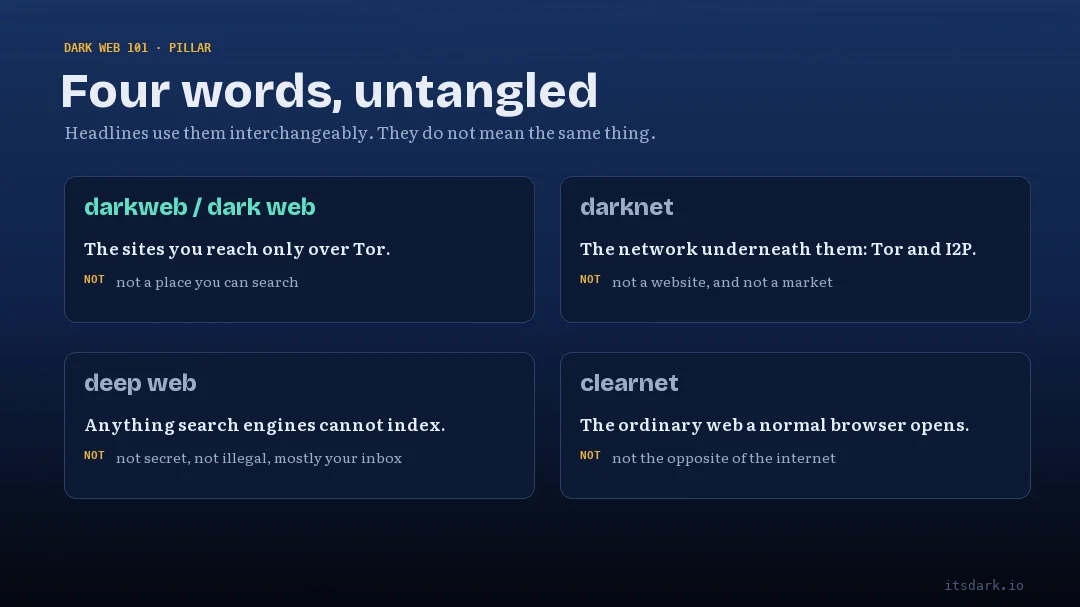
Three spellings, three terms, and a habit of using all of them for the same thing. The words are not interchangeable, and the reason they get mixed up has less to do with technology than with the history of the adjective “dark”.
The question, and why it has no tidy answer
People for “darkweb” as one word. They for “dark web” as two. They for “darknet” and get results both. Then they write to whoever runs the site and ask which is correct.
There is an answer, but it is not the answer most people expect. All three forms exist. All three are used by serious writers. Two of them name different things, and one of them is a misspelling that has become so common that it now functions as a term in its own right.
The confusion is not a sign that people are careless. It is a sign that the vocabulary grew up in four different communities at four different times, and nobody has ever held a meeting to reconcile them. Network engineers used one word. Copyright lawyers used another. Intelligence researchers used a third. Crime reporters, arriving last and writing fastest, used whatever was in the headline that morning.
This piece is the words themselves, meaning where each came from, what each one claims, why the boundaries between them have eroded, and how to write them without adding to the mess. For short definitions of every term, keep the Dark Web Glossary open in another tab.
Three words, three different kinds of claim
Start with the definitions, stated precisely, because the imprecision is the whole subject.
The deep web is every page a engine cannot or will not index. Your inbox. Your bank. A paywalled article. A library catalogue that builds a result page from a database when you . A company intranet. The claim here is indexing. It says nothing who can reach the content, who runs it, or whether it is legal. Most of it is dull, private and entirely lawful.
The dark web is the set of sites reachable only through an anonymity overlay, chiefly Tor . The claim here is reachability. It says you need specific software and a specific kind of address. Some of those sites are newsrooms. Some are whistleblowing drop boxes. Some are marketplaces for illegal goods. The term describes the delivery mechanism, not the contents.
A darknet is a network whose membership is not publicly listed and whose traffic does not follow default internet routing. The claim here is topology. Tor is a darknet. I2P is a darknet. Freenet (now Hyphanet ) in its friend-to-friend mode is a darknet. So, in a completely different sense, is a block of unused, monitored IP address space inside a bank’s own network. The term has nothing inherently to do with crime, and in network operations it usually means the opposite.
Three words, three categories. Indexing, reachability, topology.
Now watch what happens in ordinary usage. A headline says “dark web” and shows a picture of a padlock. A blog post says “darknet” and means Tor. A product page sells “darkweb monitoring” and means a database of leaked credentials. A policy paper says “the dark web” and means criminal marketplaces. Every one of those sentences is using a word from one category to make a claim from another.
The “dark” problem, an adjective with two registers
The deepest source of the confusion is not technical. It is lexical. The word “dark” has been doing neutral work in English technical and financial vocabulary for decades, and almost nobody notices.
Consider dark fibre . A telecoms company lays more cable than it immediately lights. The unlit strands are dark fibre, meaning installed, owned, lawful and simply not in use. The word “dark” here means unlit, not sinister. Companies buy and sell dark fibre. It appears in balance sheets.
Consider dark pools . A dark pool is a private trading venue where orders are not displayed before execution. In the United States they are regulated, typically operating as alternative trading systems overseen by the SEC, and used by large institutions that do not want to move the market by revealing their intentions. The word “dark” means “without pre-trade transparency”. Nothing a dark pool is illegal. The opacity is the product.
Consider dark launches . In software engineering, a dark launch is a feature shipped to production but hidden from users, so the team can test its performance under real load before announcing it. The word “dark” means “live but not visible”.
Consider dark traffic . In web analytics, dark traffic is traffic that arrives without a referrer, so the analytics tool cannot say where it came from. Again, opaque, not criminal.
The pattern is consistent. In technical and financial English, “dark” marks something that is present but not visible to the default observer. It is a word observability. It is morally neutral and frequently describes infrastructure that regulated industries run on purpose.
That is the register in which network engineers originally used “darknet”. An unused, monitored block of address space was dark because nothing legitimate was lit up inside it. A closed distribution network was dark because outsiders could not see in. The word described visibility, not legality.
Then the crime coverage arrived and imported the other register, the literary one, where dark means evil, hidden, forbidden, the basement, the thing under the bed. The same four letters, carrying a completely different meaning, landed on top of the technical usage and stuck.
This is not a trivial observation. It explains why the confusion feels so natural. When someone reads “dark web”, both registers activate at once. The technical reader hears “not indexed by default”. The ordinary reader hears “bad things happen here”. Neither is wrong the word. They are wrong each other.
Where “darknet” came from
The etymology of “darknet” is more contested than the internet generally admits, and it is worth separating what is documented from what is merely repeated.
What is documented. In November 2002, four researchers at Microsoft (Peter Biddle, Paul England, Marcus Peinado and Bryan Willman) presented a paper at the ACM Workshop on Digital Rights Management in Washington, DC, titled “The Darknet and the Future of Content Distribution”. Their subject was piracy, meaning Napster, Gnutella, FastTrack, Freenet, Direct Connect, and the economics of perfect digital copies spreading through networks with no centre.
They defined the darknet as a collection of networks used to distribute content, often in violation of copyright. Their analysis was distribution topology and enforcement economics. Anonymity was barely mentioned, because anonymity was not the problem they were studying. The problem was that copying had become free and distribution had become frictionless.
That paper is the reason the word entered mainstream technology writing. Every later use inherits something from it, even when the later use is Tor.
What is repeated but poorly documented. A widely circulated claim holds that “darknet” was coined in the 1970s to describe networks deliberately isolated from ARPANET for security reasons. You will find this in encyclopaedia entries , in conference slides and in a great many blog posts. The underlying documentation is thin. It is the kind of claim that survives because it sounds plausible, fits the mood of the word, and nobody has gone to the archive to check.
The honest position is that the first well-documented use in a technical context is the 2002 paper, and that earlier uses may exist but are not established.
What the word meant to engineers. Separately from both, network operators have used “darknet” for decades to mean a monitored block of unused address space. This is the sense in which CAIDA’s Network Telescope , which observes a large block of unused addresses, is a darknet. This is the sense in which a security team’s “darknet sensor” is a defensive tool. It is one of the longest-standing working uses of the term in operational practice, and it is the one furthest from anything the public now associates with the word.
Three origins, three subjects. Piracy, isolation and intrusion detection. None of them is the dark web. We go through all four modern senses of the word in What Is a Darknet?
Where “deep web” came from
The deep web has a cleaner paper trail, and it starts before the web was widely used.
In 1994, a researcher named Jill Ellsworth used the phrase “invisible web” to describe sites that were not registered with any engine. This is the standard attribution in the literature, and it is worth noting how early it is. In 1994, the commercial web was barely a year old, the Mosaic browser had been out for only a year, and the first web engines were still being written. The observation that engines would systematically miss things was made before there was much of a web to miss.
In 2001, Michael Bergman of BrightPlanet published “The Deep Web: Surfacing Hidden Value” in the Journal of Electronic Publishing. Bergman is generally credited with popularising “deep web”, and often with coining it. He preferred “deep” to “invisible” on the grounds that the content was not invisible at all. You could see it perfectly well. A engine just could not fetch it. His metaphor was fishing. A net dragged across the surface catches what floats, and everything below the waterline slips underneath.
Bergman’s paper also produced the numbers that still circulate, a deep web estimated at 400 to 550 times the size of the surface web, 7,500 terabytes against 19, and roughly 550 billion documents against a billion indexed. Crucially, the paper found that 95 per cent of deep web content was publicly accessible with no fees or subscriptions. Bergman’s deep web was not a criminal basement. It was government statistics, patent records, scientific databases and library catalogues.
Bergman himself later retreated from the 500-times figure. In a 2007 blog post he wrote that he had backed off the original claim and begun talking a range from a few times to perhaps 100 times the size of the indexed web. We cover what the deep web actually contains in What Is the Deep Web?
So by 2002, the vocabulary had two terms with clear, technical, non-criminal meanings. The deep web was indexing. The darknet was distribution topology or unused address space. Neither meant Tor, because Tor had only just been released and was not yet a public network.
Where “dark web” came from
This is the murkiest of the three, and it is the one worth being most careful .
The phrase “dark web” does not appear in Bergman’s 2001 paper. It does not appear in the 2002 Microsoft paper. It is not a term from the original Tor design documents, which talk onion routing, hidden services and anonymity.
The earliest documented clusters of the phrase are in security and intelligence research from the 2000s. A research group at the University of Arizona’s Artificial Intelligence Lab, led by Hsinchun Chen, started a project explicitly called the Dark Web project in 2002. Funded by US federal agencies, it built portals to collect and analyse extremist and jihadist forum content. The framing there was content that was hard to find and not indexed, a dark web of extremist material, rather than Tor specifically. This is a genuinely early use, and it is a use by researchers, not journalists.
That history is worth knowing because it complicates the popular story. The popular story is that “dark web” was invented by the press to describe Silk Road. That is not quite right. The phrase existed in research contexts first, applied to unindexed extremist content. What the press did was take a phrase from one domain and apply it to a different one, at speed, at scale.
The inflection point is well documented. Silk Road opened in early 2011. On 1 June 2011, Gawker published an article by Adrian Chen that brought the marketplace to a mass audience. In October 2013, the FBI arrested Ross Ulbricht and seized the site, and the coverage went global. A jury convicted him in February 2015 on charges including distributing narcotics, conspiracy to commit computer hacking and money laundering. (How those cases played out legally is covered in Is the Dark Web Illegal? )
Those four dates are the hinge. Before 2011, “dark web” was a niche research phrase. Between 2011 and 2013, it became a news category. After 2013, it became the default word for anything on Tor, regardless of what was on it.
Once a word becomes a news category, it stops being a technical term. News categories are shaped by headline length, picture availability and reader recognition, not by precision. “Dark web” won that competition because it is far shorter than “encrypted anonymity network” and because the adjective does an enormous amount of emotional work for free.
Five mechanisms of confusion
The drift from three technical terms to one fuzzy one did not happen by accident. There are identifiable mechanisms, and naming them makes the pattern easier to resist.
1. The adjective colonises. “Dark” is the common element. Because two of the three terms begin with the same adjective, and the third sounds like it belongs on the same scale, readers infer that they must be degrees of the same thing, surface, then deep, then dark, like floors of a building. The inference is wrong but almost irresistible. It is reinforced by the fact that “deep” and “dark” are both spatial-metaphorical adjectives, so they seem to belong to the same scale.
2. Metonymy, or the network standing in for the content. This is the most common error and the most forgivable. People say “the dark web” when they mean “illegal marketplaces on the dark web”. That is a normal linguistic move. We say “the press” when we mean journalists and “Wall Street” when we mean financial institutions. But in this case the metonymy is doing real damage, because it makes an infrastructure term sound like a moral category. The same shift happened in the 2002 paper, where a distribution topology became a word for piracy.
3. The iceberg diagram’s visual grammar. The iceberg graphic is the single most effective piece of misinformation in this whole area, and it works through design rather than text. The tip is small and labelled with logos. The mass below is dark and labelled with rumour. The visual logic says the further from the surface, the worse it gets. That is exactly backwards in terms of risk. The deeper you go into private infrastructure, the more security is protecting it. But the diagram is memorable and the truth is not. We take the iceberg apart in What Is the Deep Web? and Dark Web Myths vs Reality .
4. Headline and compression. “Dark web” fits in a headline. “Anonymity overlay network” does not. Once a phrase becomes the standard headline term, sub-editors standardise it, and once it is standardised in headlines it becomes standardised in copy. optimisation then locks it in, because “dark web” is a high-volume query and “darknet” is a lower-volume one. Writers who want traffic use the term with traffic.
5. Nobody owns the vocabulary. There is no standards body for this. The Tor Project has made style choices over the years and has been inconsistent itself. Academic security venues have their own conventions. Law enforcement agencies use their own. Newspapers use theirs. When nobody owns a word, the loudest and most frequent user defines it, and for the last decade that has been crime journalism.
The spelling question
Now the part people actually for. Is it “darkweb”, “dark web” or “dark net”?
“Dark web” (two words, lowercase) is the standard form in edited prose. It is a compound noun, and English open compounds are the norm when the phrase is still felt as two ideas. Most newspapers, magazines and broadcasters write it this way. It is the safe default, and if you write it in a style guide and never revisit the question, you will not be wrong.
“Darknet” (one word) is the standard form for the network, not the content. It is a closed compound, and closed compounds are normal when a phrase has become a single technical object. English does this constantly. “Web site” became “website”, “electronic mail” became “email” and “on line” became “online”. “Darknet” has closed because the technical community treats it as one thing.
“Dark net” (two words) appears in older networking literature and in some British writing. It is not wrong, but it is dated. If you use it, be aware that most readers will read it as a variant of “darknet” and wonder why you split it.
“Darkweb” (one word, no space) is the interesting case. It is not standard in edited prose, but it is extremely common in queries, domain names, product names and writing by non-native speakers. It exists because URLs cannot contain spaces without encoding, because character limits punish spaces, and because compound nouns in English have a long-term tendency to close up. “Darkweb” is what “dark web” will probably become if the phrase survives long enough, in the same way “website” replaced “web site” in a single decade.
The current position is simple. In edited writing, use “dark web” and “darknet” as two distinct words for two distinct things. Do not use “darkweb” in body copy. If you are naming a product, a domain or a term, “darkweb” may be the form your audience types, and that is a marketing decision rather than a grammatical one.
A note on capitalisation. Headlines often capitalise it as “Dark Web”, which makes it look like a brand. It is not a brand. Body copy should be lowercase.
What the three registers actually do
Here is a practical way to see the difference. The same sentence, rewritten three times, makes three different claims.
“The dark web is huge.” This is a claim reachability, and it is nearly meaningless, because the dark web’s size is not measurable and the number people have in mind usually comes from Bergman’s 2001 deep web estimate. The sentence conflates indexing with reachability.
“The deep web is huge.” This is a claim indexing, and it is defensible, though imprecise. Most of the web is unindexed and most of it is private.
“Darknets are small.” This is a claim topology, and it is roughly true for the anonymity overlays. Tor has around 9,000 relays and three million daily users according to Tor Metrics , I2P has tens of thousands of routers , and Freenet a few thousand nodes. All of them are tiny to the public web.
Notice that the three sentences are not describing the same object at different sizes. They are describing different things. This is the test to apply whenever you read a claim “the dark web”. Ask which claim is being made. Is the writer talking what engines can index, what software you need, or how a network routes? Usually the writer has not decided, and neither has the reader.
The translation problem
English does not own these words, and other languages have made different choices, which throws the English confusion into relief.
German uses “Darknet” as a loanword, and uses it for both the network and the criminal marketplaces. This is a genuine source of confusion in German-language coverage, because the German word inherits the closed-compound form and the English crime connotation at the same time.
French has “dark web” as a loanword alongside “web profond” for the deep web. “Darknet” is also used, usually in the network sense. French regulatory writing tends to prefer descriptive phrases over loanwords, which has the side effect of keeping the categories somewhat clearer.
Spanish uses “internet profunda” or “web profunda” for the deep web, and generally borrows “dark web” and “darknet” unchanged, inheriting the English confusion along with the words.
Russian uses “даркнет” (darknet) as the dominant term for the whole phenomenon, which means Russian-language coverage routinely uses a network term for what English would call the dark web. This is not a translation error. It is a different default.
The pattern is that languages which borrowed “darknet” as their default term have a harder time distinguishing network from content, and languages which borrowed “dark web” inherit the English press’s conflation of reachability with criminality. Nobody has a clean vocabulary, because the underlying concepts were named by different communities and the names were exported separately.
Why it matters beyond pedantry
It would be reasonable to ask whether any of this matters. Words drift. People understand each other. Insisting on the distinction can look like a hobby.
Three reasons it does matter.
Legal and policy drafting. When a parliament writes “the dark web”, it has to decide what it is regulating. If the term means “sites reachable via Tor”, then regulating it means regulating an overlay protocol, which is a very different thing from regulating marketplaces. Drafters who inherit a fuzzy term write fuzzy law. The United Kingdom’s Online Safety Act 2023 and the European Union’s digital regulations, such as the Digital Services Act , have had to work hard to specify whether they mean content, services, protocols or networks. Getting the vocabulary right is the first step in getting the scope right.
Accurate journalism. News stories still describe things as “the dark web” that are simply behind a login, or imply that using Tor is illegal. Those mistakes are avoidable. The distinction between deep web, dark web and darknet is not hard to state, and stating it takes one clause.
Public understanding. The most consequential effect is on how people think their own privacy. If “dark web” means “the place where crime happens”, then a reader who wants to protect their email has no vocabulary for what they are doing. They are not on the dark web. They are using the deep web, which is where their bank and their doctor already are. The vocabulary failure makes ordinary privacy feel transgressive. The EFF’s Surveillance Self-Defense guides are a good antidote.
A working style guide
If you write this, here is a set of rules that will keep you accurate without making you tedious.
When you mean “illegal marketplaces”, say “illegal marketplaces”. It is longer, but it is the thing you mean, and it does not smuggle in a claim a network.
Do not use “the dark web” as a mass noun for a place. “On the dark web” is acceptable shorthand in a headline. In body copy, prefer “on an onion service ” or “on Tor” when that is what you mean.
When you cite the iceberg statistic, say where it comes from and note that its author later revised it. The 400-to-550-times figure is from 2001, it measured the deep web rather than the dark web, and Bergman himself backed away from it.
Is it “darkweb” or “dark web”?
Two words in edited prose. “Darkweb” is common in queries, domain names and product branding, and it may eventually become standard through the usual process of compounds closing up, but it is not standard now.
Is “darknet” the same as “dark web”?
No. A darknet is a network with unlisted membership and non-default routing. The dark web is the set of sites reachable through one kind of darknet. Every dark web site is on a darknet. Most darknet traffic is not dark web traffic.
Is the dark web part of the deep web?
Yes, in the sense that engines do not index onion services. But “deep web” describes an indexing property and “dark web” describes a reachability property, so the relationship is a technical overlap rather than a nesting of categories. Our one-diagram comparison shows how they fit together.
Why do people say “the dark web” when they mean criminals?
Because metonymy is normal and because crime coverage standardised the phrase between 2011 and 2013. The network became the stand-in for the worst things on it.
Who invented the word “darknet”?
The first well-documented technical use is a 2002 paper by Biddle, England, Peinado and Willman at an ACM workshop. A claim that the word dates to 1970s ARPANET isolation is widely repeated but poorly documented.
Who invented “deep web”?
Jill Ellsworth used “invisible web” in 1994. Michael Bergman popularised “deep web” in a 2001 paper, and is often credited with coining it.
Who invented “dark web”?
It is not clearly attributable. The phrase appears in security and intelligence research from 2002 onwards, including a University of Arizona project that used it as a name. It entered mass usage through coverage of Silk Road after 2011.
Why does the word “dark” cause so much confusion?
Because it has two registers. In technical and financial English, “dark” means not visible to the default observer, as in dark fibre, dark pools and dark launches. In literary English it means evil. Both registers activate when people read “dark web”.
Should I capitalise it?
No. Lowercase in body copy. Headline capitalisation makes it look like a brand, which it is not.
Does the distinction matter in other languages?
Yes, and differently. German uses “Darknet” for both network and content. Russian uses “даркнет” as the dominant term for the whole phenomenon. French keeps “dark web” as a loanword alongside “web profond”. Each language has inherited a different slice of the English confusion.
Peter Biddle, Paul England, Marcus Peinado and Bryan Willman, “The Darknet and the Future of Content Distribution”, ACM Workshop on Digital Rights Management, 2002
Michael K. Bergman, “The Deep Web: Surfacing Hidden Value” , Journal of Electronic Publishing, 2001
Michael K. Bergman, “The Murky Depths of the ‘Deep Web'” , 2007
Jill Ellsworth, “invisible web”, 1994, the standard attribution in the information-retrieval literature ( summary on Wikipedia )
Hsinchun Chen, “Security Informatics: The Dark Web Experience” , AAAS, 2012, and the University of Arizona Dark Web Terrorism Research project
David Goldschlag, Michael Reed and Paul Syverson, “Hiding Routing Information”, 1996
David Chaum, “Untraceable Electronic Mail, Return Addresses, and Digital Pseudonyms” , Communications of the ACM, 1981
Tor Project, onion services overview and Tor Metrics
I2P Project, technical documentation , and Hoang et al., An Empirical Study of the I2P Anonymity Network , 2018
Hyphanet (formerly Freenet), documentation on opennet and darknet modes
CAIDA, UCSD Network Telescope
Adrian Chen, “The Underground Website Where You Can Buy Any Drug Imaginable”, Gawker, 1 June 2011
US Department of Justice statements on the seizure of Silk Road (October 2013) and the conviction of Ross Ulbricht (February 2015)
SEC rules on alternative trading systems, which include dark pools ( overview on Wikipedia )
UK Online Safety Act 2023 and the EU Digital Services Act
Electronic Frontier Foundation, Surveillance Self-Defense
The full story
This article is one source in a clustered incident — the cluster page carries the summary, timeline and every other outlet covering it.
