 Back Ftlsomalia
EUCAP Somalia Trains Puntland Officials on International Port Security Standards
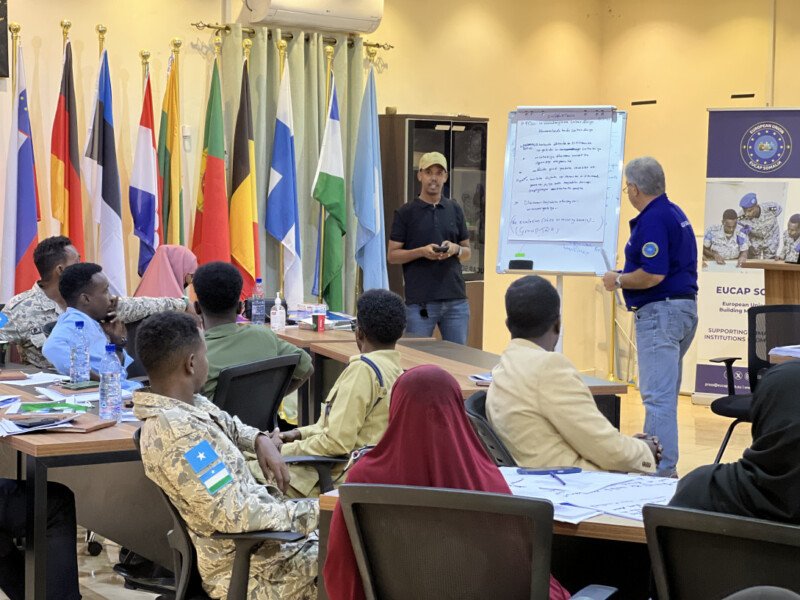
BOSSASO , EUCAP Somalia’s Puntland Field Office delivered a five-day training on the International Ship and Port Facility Security Code from November 15 to 19, bringing together participants from maritime, port security, and government institutions in Puntland to strengthen the implementation of international port security standards at Bossaso Port.
The training covered government responsibilities under the ISPS Code, Port Facility Security Assessments, Port Facility Security Plans, security levels, and operational security measures. A one-day tabletop exercise allowed participants to apply their knowledge to practical port security scenarios, and the programme concluded with a certificate handover ceremony.
“The training has strengthened my understanding of international port security standards, particularly the importance of identifying security threats and vulnerabilities, assessing risks, and implementing appropriate and coordinated countermeasures to protect port facilities and ensure safe port operations,” said Mohamed, a participant from the Bossaso Port Maritime Police Unit.
The Strategic Importance of Bossaso Port
Bossaso Port is Puntland’s economic lifeline and a critical gateway for imports serving not only the region but parts of central Somalia. The port has been managed by DP World for nearly a decade, though the relationship has been marked by repeated disputes over fees, modernisation promises, and operational disruptions.
The port’s security is inseparable from the broader maritime threats facing Puntland’s coastline. Piracy has resurged off the region’s waters since April 2026, with at least 15 attacks reported this year, the highest since 2013. Puntland’s Maritime Police Force has conducted multiple rescue operations, freeing the Sibu 1 in September after a 48-hour operation that rescued 20 crew members, as FTL Somalia reported .
The piracy resurgence has been attributed in part to the diversion of international naval assets to the Red Sea, creating a security vacuum that pirate groups have exploited. Pirates have converted hijacked vessels into motherships to extend their range, and more than 90 seafarers remain held hostage across multiple vessels, according to the International Maritime Organization.
EUCAP Somalia’s Broader Maritime Role
The ISPS training is part of EUCAP Somalia’s wider mandate to strengthen Somalia’s maritime security, police capabilities, and rule of law. The mission has been extended until February 28, 2027, and has been instrumental in building the capacity of Somali maritime authorities.
In July 2025, UNTMIS and EUCAP Somalia jointly conducted a ten-day training program on Vessel Traffic Management and Information Systems in Mogadishu, bringing together 16 officers from various Somali maritime institutions to improve maritime domain awareness, vessel monitoring, and inter-agency coordination, as per coverage .
EUCAP Somalia has also donated advanced communication equipment to the Maritime Rescue and Coordination Centre in Mogadishu, enhancing Somalia’s ability to respond to maritime emergencies and coordinate rescues along its coastline.
In June 2026, Minister of Internal Security Abdullahi Sheikh Ismail (Fartaag) met with EUCAP Somalia Head of Mission Kestutis Lancinskas to security collaboration and technical assistance. The minister emphasized the importance of government ownership and coordination of all initiatives directed toward supporting Somalia’s security institutions, as per our reporteing .
The ISPS training also follows a joint maritime capacity-building exercise conducted by EUCAP Somalia and Operation ATALANTA on November 18, involving the Maritime Rescue Coordination Centre and the Somali Police Force’s Coast Guard Department, alongside a visit by the Somali Navy Commander to the ATALANTA flagship, as previosly document by FTL editor .
The ISPS training is a necessary intervention. International port security standards exist for a reason: they provide a framework for assessing vulnerabilities, planning responses, and coordinating among the agencies responsible for protecting a facility that is both an economic asset and a potential target. Bossaso Port, as Puntland’s primary gateway for trade, merits that level of scrutiny.
But training a cohort of officials on ISPS Code standards does not make a port secure. The Code requires functioning institutions, adequate equipment, trained personnel, and sustained inter-agency coordination. It requires a port facility security officer who is empowered to act, a security plan that is regularly exercised, and a government that provides the resources and authority to implement both. Whether Puntland’s institutions can meet those requirements is a question the training does not answer.
The context matters. Bossaso Port has been closed for extended periods due to disputes between DP World and local traders. Armed forces have blockaded the Bosaso-Garowe highway over unpaid salaries. The region faces a 32.4 percent budget shortfall. Piracy is surging offshore. A five-day training on international standards is valuable, but it sits atop a security and governance architecture that is under severe strain. EUCAP Somalia can train officials to assess threats and plan responses. It cannot supply the political stability, the funding, or the institutional coherence that would make those plans executable. The training is a contribution. It is not a solution.
Recommended Reading On ftlsomalia.com
Somalia Maritime Officers Trained on Vessel Traffic Management
Federal Government Reinforces Ownership of Security Initiatives in Meeting with EUCAP Somalia Leadership
ATALANTA, EUTM Somalia Strengthen Ties with Somali Coast Guard Aboard Flagship
Puntland Forces Free Sibu 1 After 48-Hour Operation, Rescue 20 Crew Members
The full story
This article is one source in a clustered incident — the cluster page carries the summary, timeline and every other outlet covering it.
