 Back Atlanticcouncil
Europe must weigh rising Ukraine costs against higher price of Russian victory
Russia’s intensifying bombing campaign is forcing Ukraine to seek tens of billions of dollars in additional funding to keep the country’s wartime economy afloat in 2027. This is creating political headaches for Kyiv’s European partners at a time when many are already facing mounting domestic financial pressures of their own. As Europe debates whether it can afford to continue bankrolling the Ukrainian war effort, the real question is whether it can afford not to.
Ukraine has relied on international financial support since the onset of Russia’s full-scale invasion nearly five years ago. According to a new Bloomberg report published on Monday, this dependency is now deepening as Russian air attacks devastate the Ukrainian economy. “Although imminent economic collapse is unlikely, sustaining the war through 2027 will increasingly depend on timely, reliable, and adequate flows of Western financing,” Bloomberg analysts concluded.
This bleak assessment comes as no surprise. In recent months, Russia has dramatically escalated airstrikes against economic targets across Ukraine as Vladimir Putin seeks to break the deadlock in his faltering invasion. Russia’s bombardment has led to the closure of Ukraine’s Black Sea ports , the shutdown of entire industries , and massive disruption throughout the economy. As businesses count the cost, the National Bank of Ukraine has downgraded its outlook for 2026 and now expects Ukrainian GDP to shrink by 0.4 percent, the first annual decline since the sharp drop that accompanied the start of the full-scale invasion.
Ukrainian President Volodymyr Zelenskyy is sounding the alarm and calling on Kyiv’s European allies to dig deeper. At a recent summit of EU leaders, he stated that Ukraine will need almost $80 billion in additional funding year in order to cover defense spending and ensure national resilience. The race is now on to find this money , with EU leaders looking to non-member states including Japan, Norway, Switzerland, Canada, and Britain to step up their contributions.
The prospect of increased spending on Ukraine’s defense has raised eyebrows in some European capitals amid concerns that populist parties may seek to exploit the issue during upcoming elections. However, the alternative is even more ominous. If Russia succeeds in overrunning an underfunded and exhausted Ukraine, the consequences for Europe will be catastrophic and the price tag of containing the Kremlin will dwarf the current cost of supporting Kyiv.
As the world watches the Russian invasion of Ukraine unfold, UkraineAlert delivers the best Atlantic Council expert insight and analysis on Ukraine twice a week directly to your inbox.
The negative repercussions of a Russian victory in Ukraine would reverberate across Europe and beyond. If the Kremlin is able to establish control over Kyiv or install a puppet regime, this would extinguish Ukrainian statehood and send a massive new wave of refugees flooding into the EU.
Ukrainians are well aware that in the 20 percent of their country currently under Kremlin control, the Russian occupation authorities have instigated a reign of terror marked by mass arrests and the systematic erasure of Ukrainian language, culture, history, and identity. For the second year running, international human rights watchdog Freedom House recently ranked Russian-occupied Ukraine as the least free place on earth. A triumphant Putin would almost certainly impose the same ruthless policies throughout the whole of the country.
With no illusions the grim fate awaiting them, huge numbers of Ukrainians would choose to flee rather than exposing themselves and their families to the horrors of Russian occupation. Zelenskyy recently warned that as many as twenty million Ukrainians could enter the EU if their country falls to Russia. This would represent by far the largest refugee crisis in Europe since the years following World War II, with profound social, economic, and political ramifications for all European countries.
Eurasia Center events
How is Europe responding to hybrid warfare?
The security implications of a Russian victory would be even more troubling. If Putin succeeds in Ukraine, he will control the two largest, most battle-hardened, and technologically sophisticated armies in Europe. He will also take possession of Ukraine’s considerable domestic defense industry and the country’s vast natural resources. This formidable military machine would be poised on the eastern frontier of a Europe that has yet to rearm and can no longer count on the United States for protection. In such uniquely favorable circumstances, it would be reckless to rule out further acts of Russian aggression.
Even if Putin did not immediately seek to press his overwhelming advantage, the transformed security situation in the east would oblige governments across Europe to dramatically increase defense budgets almost overnight. While it is impossible to arrive at a definitive figure, studies and expert analysis indicate that current levels of military spending would need to triple or quadruple to counter the Russian threat. “It will not be billions extra. It will be trillions extra,” NATO Secretary General Mark Rutte warned last year.
These are only the most obvious and immediate costs. A Russian victory in Ukraine would also alter the broader international environment in ways that would fuel insecurity and undermine economic growth around the world for decades to come. Global commerce would fall victim to a surge in trade barriers, logistical obstacles, and armed conflicts, while funding for healthcare, education, and social initiatives would be diverted toward the military and other security-related spending. The era stretching from the end of the Cold War until the early 2020s would soon come to be viewed nostalgically as a brief golden age of progress and prosperity.
Putin’s current strategy is clear. Having failed to achieve victory on the battlefield, he now aims to overcome Ukrainian resistance by destroying the country’s economic foundations, and is counting on Europe to grow tired of filling the financial gap. In the coming weeks, the Kremlin dictator will mobilize Russia’s extensive network of allies, bots, and useful idiots to protest loudly against any additional European support for Ukraine. If he succeeds in deterring Europe, Ukraine will pay a terrible price and the ultimate cost of stopping Russia will only rise.
Peter Dickinson is editor of the Atlantic Council’s UkraineAlert service.
UkraineAlert Oct 27, 2026
UN report: Russian attacks on Ukraine’s power grid are a ‘crime against humanity’
Russia’s bombardment of Ukraine’s civilian power grid qualifies as a crime against humanity, according to a new report by the UN’s Independent International Commission of Inquiry on Ukraine, writes Kateryna Odarchenko.
UkraineAlert Oct 21, 2026
Ukrainians are not fighting for Zelenskyy. They are fighting for national survival.
Trump and Putin both seem to think that removing Ukrainian President Volodymyr Zelenskyy would set the stage for a Kremlin-friendly peace deal, but most Ukrainians see the war as a fight for national survival that does not depend on any one man, writes Peter Dickinson.
UkraineAlert Oct 15, 2026
Ukraine reports more battlefield gains as Putin’s invasion loses momentum
Kyiv has reported further battlefield gains this week as the country’s Operation Vivaldi counteroffensive in eastern Ukraine’s Donetsk region continues to advance, writes David Kirichenko.
The views expressed in UkraineAlert are solely those of the authors and do not necessarily reflect the views of the Atlantic Council, its staff, or its supporters.
UkraineAlert is a comprehensive online publication that provides regular news and analysis on developments in Ukraine’s politics, economy, civil society, and culture.
The Eurasia Center’s mission is to enhance transatlantic cooperation in promoting stability, democratic values, and prosperity in Eurasia, from Eastern Europe and Turkey in the West to the Caucasus, Russia, and Central Asia in the East.
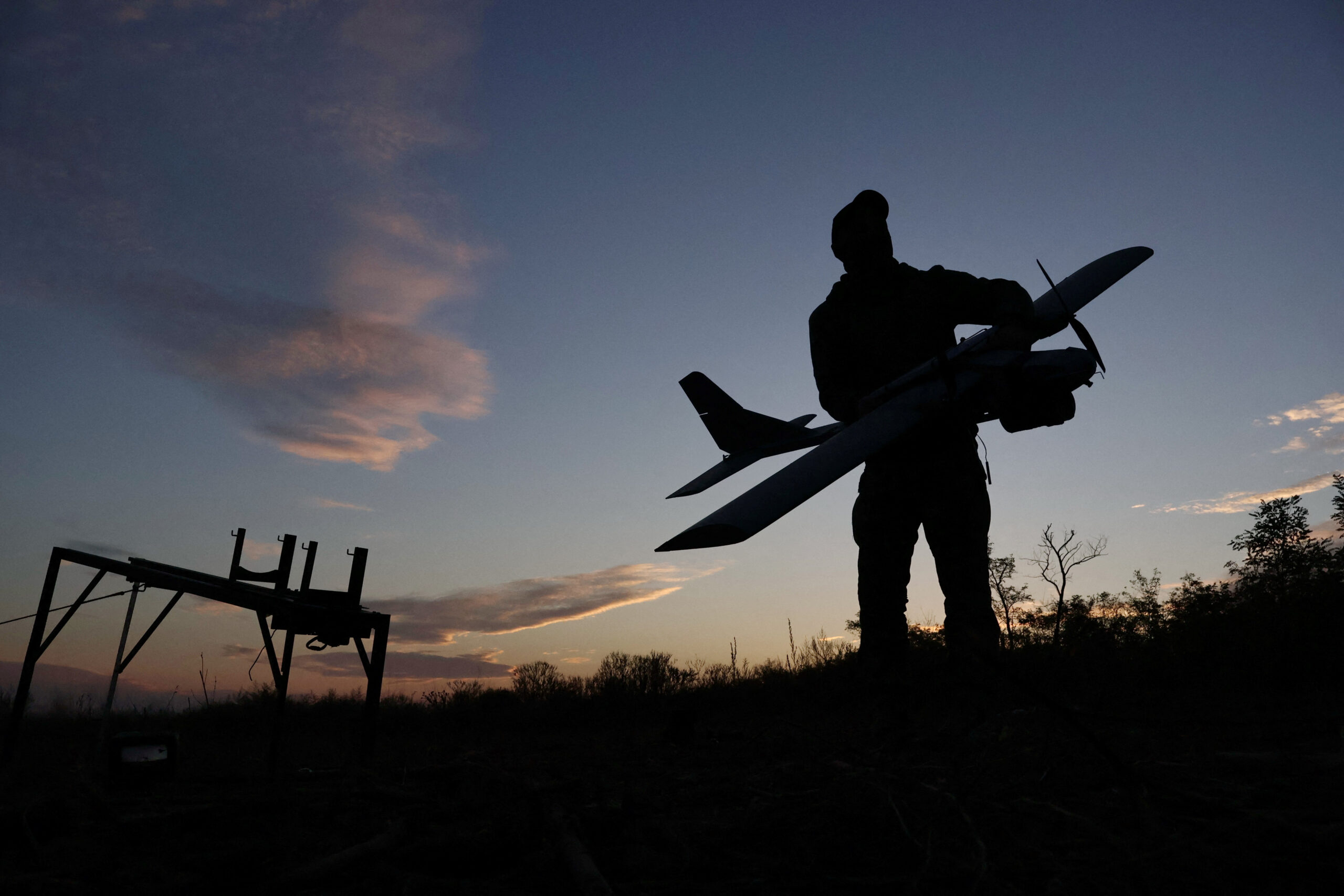
Image: A serviceman of the 65th Separate Mechanized Brigade of the Ukrainian Armed Forces sets up a Darts middle range strike unmanned aerial vehicle before launching it near a frontline, amid Russia's attack on Ukraine, in Zaporizhzhia region, Ukraine. October 7, 2026. (Andriy Andriyenko/Press Service of the 65th Separate Mechanized Brigade of the Ukrainian Armed Forces/Handout via REUTERS)
The full story
This article is one source in a clustered incident — the cluster page carries the summary, timeline and every other outlet covering it.
