 Back Gbhackers
Fortinet2Shell Vulnerability Lets Hackers Execute Code on FortiClient Systems Through Malicious Websites
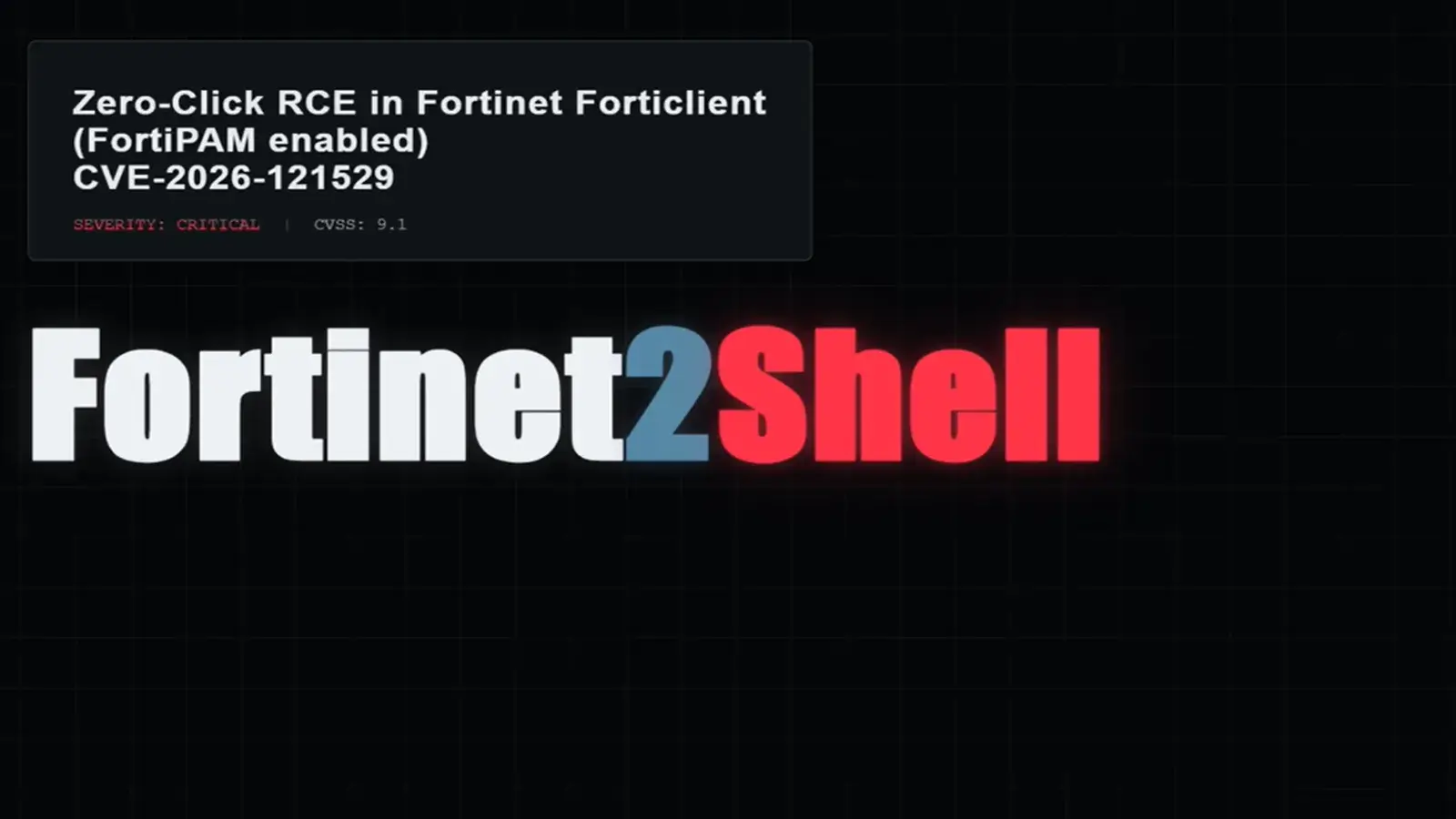
Fortinet has patched a critical flaw in FortiClient that lets attackers run code on a victim’s computer through a malicious website. The bug is tracked as CVE-2026-121529 (advisory FG-IR-26-194).
Researcher Kevin Joensen of Baldur Security reported it and nicknamed it “Fortinet2Shell.” Attackers have targeted Fortinet endpoint tools before, as seen in a FortiClient code execution flaw exploited to deploy EKZ malware .
Fortinet2Shell Vulnerability
Fortinet published the advisory on November 10, 2026. It describes an origin validation error [CWE-346] in a local API endpoint. The flaw affects FortiClient Mac, FortiClient Windows, and FortiClient Windows PAM. Fortinet rates it Critical with a CVSS v3 score of 9.1.
It lists the attack type as unauthenticated and the impact as escalation of privilege. The details are in the Fortinet PSIRT advisory .
The root cause is a CORS misconfiguration. FortiClient runs a local service on the user’s machine, and that service wrongly trusts requests from web pages.
An attacker-controlled site can send requests to this service and run arbitrary code. Joensen says this works reliably on FortiClient with FortiPAM enabled. The victim only has to visit the malicious page. Fortinet notes that exploitation needs user interaction.
Several versions are affected. FortiClient Mac 7.4 is vulnerable from 7.4.0 through 7.4.7. FortiClient Windows 7.4 and FortiClient Windows PAM 7.4 are vulnerable across the same range. FortiClient Windows 7.2 and FortiClient Windows PAM 7.2 are vulnerable from 7.2.0 through 7.2.14. Version 8.0 of all three products is not affected, and neither is FortiClient Mac 7.2. Fortinet says there is no virtual patch, so updating is the only fix.
Administrators should upgrade FortiClient Mac and FortiClient Windows 7.4 to 7.4.8 or above. They should upgrade FortiClient Windows 7.2 to 7.2.15 or above. The same applies to the PAM builds: 7.4.8 for the 7.4 branch and 7.2.15 for the 7.2 branch. Fortinet says the flaw is not known to be exploited. The CVSS v3 vector shows a network attack with low complexity, no privileges required, user interaction required, and a changed scope.
On Windows, Joensen lists two signs of a vulnerable install besides the version check. The first is a service listening on TCP port 9191. The second is a running FortiVRS.exe process. Security teams can hunt for both across their fleet and patch those systems first. Until patching is complete, users should avoid untrusted links. Fortinet has fixed other FortiClient Windows flaws this year, so teams should keep all endpoint agents up to date.
Give your SOC the alert context on the latest threats to stop incidents quickly -> Integrate Threat Intel from 16K SOCs:
Artificial Intelligence
Cyber security Course
Cyber Security Resources
Cybersecurity
Information Gathering
Information Security Risks
Criminal IP Launches New TI Feed App on Splunkbase for Automated Threat Detection
N-able Warns of Critical N-central Zero-Day Vulnerability Actively Exploited by Hackers
BluePhishing Attack Abuses Microsoft Entra OAuth Consent to Create Hidden AI Agent Identities
Windows Active Directory RCE and DoS Vulnerabilities Put Windows Systems at Risk
Researchers Uncover 45 AI Hacking Frameworks, With Hundreds of Attack Consoles Exposed on the Internet
Ivanti Patches Critical SQL Injection Flaw Allowing Remote Code Execution Without Login
The full story
This article is one source in a clustered incident — the cluster page carries the summary, timeline and every other outlet covering it.
