 Back Gbhackers
Hackers Deploy PerfectPioneer RAT and KUKURAT Backdoor to Steal Sensitive Government Data
A China-linked espionage group has spent nine months refining two custom remote access Trojans against Southeast Asian government networks.
Palo Alto Networks’ Unit 42 published its findings on November 16, 2026. The activity dates back to at least July 2025.
Unit 42 tracks the actor as TGR-STA-0049. Other vendors call it REF7707, Earth Alux or Ink Dragon.
That backdoor hides command traffic in Outlook mail drafts through the Microsoft Graph API .
Exploiting unpatched Microsoft Exchange and web servers is the main entry route. Attackers drop web shells there, including ASPXSpy, Godzilla, Bysunue.aspx and Suo5.
Phishing is the secondary route. Victims receive executables with PDF icons from domains that imitate government sites.
Opening one runs the malware and displays a decoy document. One decoy impersonated a Myanmar Union Election Commission notice. In another case, a fake installer ran a genuine GlobalProtect setup to mask the payload.
PerfectPioneer is a Go-based RAT first seen in July 2025, and Unit 42 recovered six variants. The most complete one, newhttp3, supports file transfer, process injection, keylogging, screenshots and SOCKS5 proxying.
It talks to its command server over HTTP/3 on QUIC, which runs over UDP. If that fails, it falls back to HTTP/2. Some firewalls and IDS/IPS engines inspect UDP port 443 less closely than TCP, so this traffic can pass uninspected.
Unit 42 observed that , the group has been active since March 2023 and targets governments in Southeast Asia, South America and Europe. It previously deployed Squidoor, also known as FINALDRAFT.
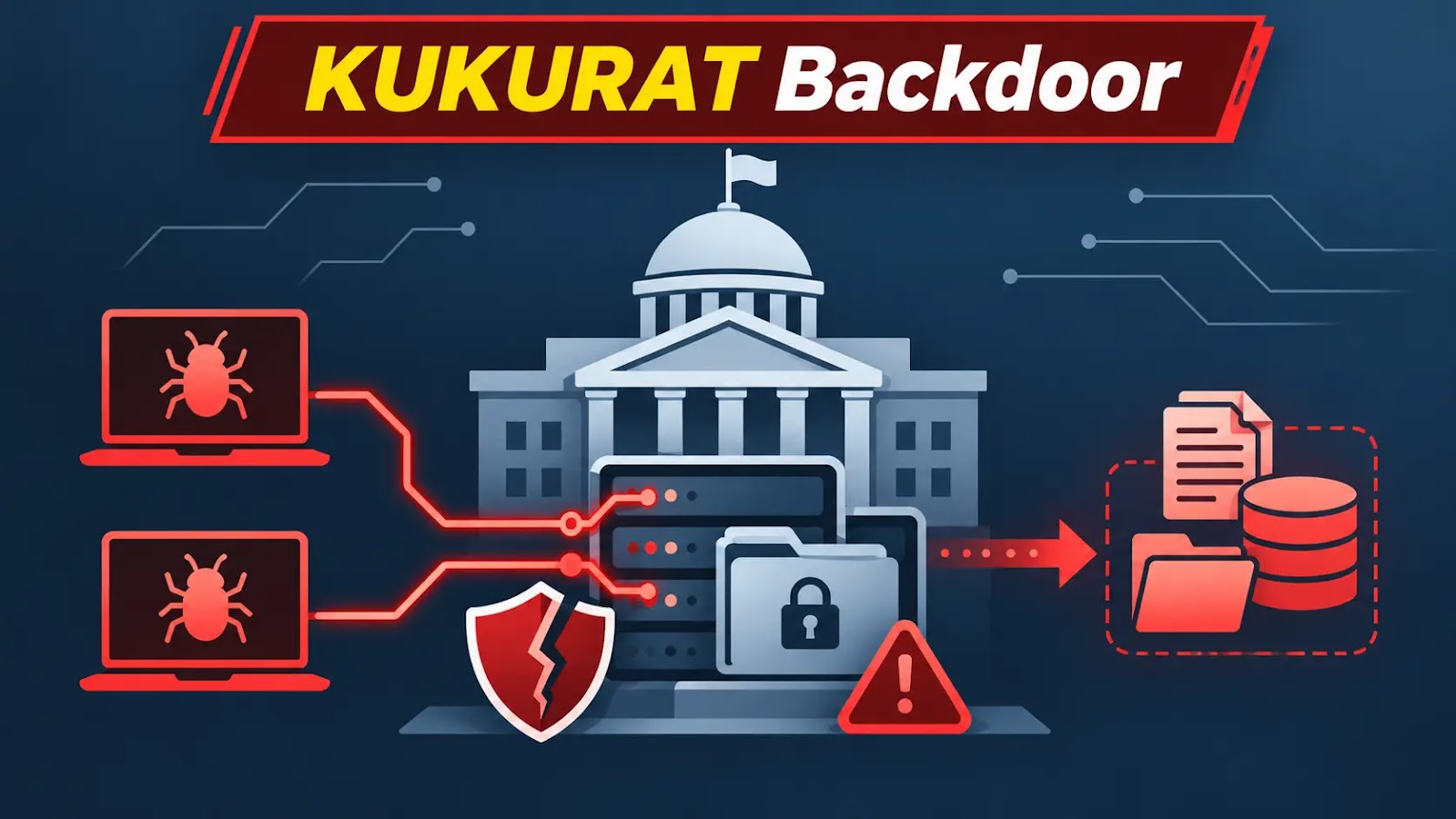
KUKURAT Backdoor Activity
Two variants, Pioneer and rat_http3_cc, include an isDangerousCommand check. It blocks noisy or destructive commands, such as forensics-heavy admin actions, so operators cannot trigger alerts by mistake.
The blocklist includes Linux syntax, which suggests the actor was building a parallel Linux version.
KUKURAT is a C++ successor that appeared in March 2026 on networks already compromised by PerfectPioneer. Its core binary holds almost no attack code.
Functions arrive as DLL modules loaded into memory from the server, which helps it evade static scans. Modules cover keylogging, scanning, SMB brute-forcing, PsExec lateral movement, privilege escalation and Beacon Object Files.
Its heuristic camouflage engine can be toggled per channel. It sends decoy web requests and mimics Chrome crash-recovery registry activity. It also creates and deletes random temporary files.
A watchdog process relaunches the malware if its heartbeat stops for 15 seconds. In one case the watchdog sat in a folder path historically used by Cortex XDR.
After compromising a domain controller, the attackers planted malicious log-on scripts that fetch KUKURAT whenever users authenticate.
They dumped LSASS memory by calling comsvcs.dll through its ordinal, #+000024, rather than by the MiniDump name. They also ran DCSync attacks and used Mimikatz and SharpDPAPI.
The attackers stole PDF, DOCX, XLSX, and PNG files, focusing on international relations and internal politics. On Exchange, they searched for accounts holding the ApplicationImpersonation role.
If none existed, they ran a PowerShell loop that granted a compromised account FullAccess to every mailbox.
Unit 42 advises logging or blocking outbound UDP 443 to force a fallback to inspectable TCP. It also recommends auditing SYSVOL and Group Policy for rogue log-on scripts, and alerting on rundll32 calling comsvcs.dll by ordinal.
Defenders should also review ApplicationImpersonation assignments and flag mass Add-MailboxPermission activity. Palo Alto lists coverage in Advanced WildFire, Advanced URL Filtering, Cortex XDR and XSIAM.
Indicators of Compromise
Note: IP addresses and domains are intentionally defanged (e.g., [.] ) to prevent accidental resolution or hyperlinking. Re-fang only within controlled threat intelligence platforms such as MISP, VirusTotal, or your SIEM.
Stops Cyber threats before impact with 21 min faster MTTR. Integrate ANYRUN’s Sandbox in your SOC .
Artificial Intelligence
Cyber security Course
Cyber Security Resources
Cybersecurity
Information Gathering
Information Security Risks
OPTIMJACK Attack Injects Malicious JavaScript Into CNN, Zoom and Other Major Websites to Steal Data
McDonald’s iOS App Flooded With Suspicious Push Notifications in Possible Cyberattack
Microsoft Warns Hackers Are Exploiting Microsoft 365 Outages to Launch Credential Phishing Attacks
GitLab Patches 37 Security Vulnerabilities Affecting CI/CD Pipelines, GitLab Pages, and MCP Server
Hacker Behind Massive GTA 6 Leak Pleads Guilty to Breaching Rockstar Games
Mozilla Releases Firefox 160 Security Update Fixing 99 Vulnerabilities, Including Sandbox Escape Flaws
The full story
This article is one source in a clustered incident — the cluster page carries the summary, timeline and every other outlet covering it.
