 Back Finance.Biggo
Hackers Don't Need New Exploits to Win With AI | Horizon3 CTO|MTS
Horizon3 CTO Anthony Pillitiere argues that AI-enabled attackers like Jade Puffer exploit existing unpatched vulnerabilities at scale, making accumulated cyber debt a business-impacting availability risk rather than a need for new exploits.
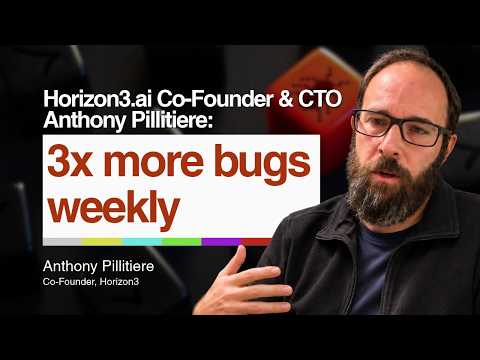
Anthony Pillitiere, co-founder and CTO of Horizon3.ai, argues that AI-armed threat actors are winning with old vulnerabilities and unpatched, internet-facing systems rather than novel exploits, and that most organizations still cannot translate that exposure into business impact. The conversation spends most of its 15 minutes on that argument and on the recent wave of infrastructure outages, which Pillitiere reads as organizations finally paying down technical debt rather than as attacks; the episode's title topic, the claim that attackers don't need new exploits, is the frame for roughly two minutes of the discussion. The rest covers who buys autonomous penetration testing, why individual consumers are a secondary target, and how Pillitiere's 21 years in the Air Force shaped Horizon3's "offense-driven defense" pitch.
Pillitiere speaks from an operator's seat: he spent most of his military career in sensitive units and was deputy chief technology officer at Joint Special Operations Command, where cybersecurity was among his responsibilities, before founding Horizon3 with former Splunk CTO and Greylock CIO (as he describes the role) Snigh. The reader should come away with Horizon3's product framing (NodeZero, continuous autonomous pen testing tied to impact), Pillitiere's specific claims vulnerability volume and agentic threat actors, and a clear sense of which assertions are his forecasts rather than established facts.
Attackers are recycling known weaknesses, not inventing new ones
Pillitiere's core claim is that the current wave of AI-enabled attacks uses nothing new. The first reported agentic threat actor he cites, "Jade Puffer," which he says he heard of in July (2025, by his reference to a "2025 vulnerability"), gained initial access through an externally exposed Jenkins CI/CD server — a system that should never have faced the internet — by exploiting a vulnerability from that same year. The novelty is volume and cost, not technique.
"They have unlimited cyber interns that they get to use however they want and they can throw up a thousand of them. If 999 of them fail, but one of them passes and one of them gets ransomware, then they win."
"They have unlimited cyber interns that they get to use however they want and they can throw up a thousand of them. If 999 of them fail, but one of them passes and one of them gets ransomware, then they win."
He points to the open-source pentesting harness "Artex," which a penetration tester published to speed up offensive workflows and which threat actors then adopted; he says the FBI has issued a flash warning it. His conclusion is that fundamentals — layered defense, asset management, multi-factor authentication — still work, but defenders must now identify emerging threats faster. Horizon3 sells itself as one way to do that.
Vulnerability volume is rising faster than patching capacity
Pillitiere says vulnerabilities added to the National Vulnerability Database (NVD) have run at almost three times the prior weekly rate, and that threat actors weaponize them quickly because organizations do not patch fast enough. He stresses that exploitation itself is not the main event: the question is what happens after initial access and what business disruption follows.
He frames the shift through the CIA triad: availability is the overlap between cybersecurity and IT operations, and leadership is now treating the risk of not fixing systems as higher than the risk of fixing them.
The recent outages look like debt repayment, not intrusion
Asked the string of recent outages that officials said showed no evidence of cyberattack, Pillitiere accepts that account at face value and calls it a positive signal. In his reading, organizations are finally addressing technical and "cyber debt," and the business impact of those fixes is now visible. He says he tried to construct a theory linking the outages to attacks and could not, given statements from the DNI, the FBI, and the affected organizations. The trade-off he describes is explicit: the risk of doing the fixes is now lower than the risk of skipping them.
Autonomous pen testing is sold as continuous, multi-perspective risk assessment
Horizon3's product, NodeZero, is positioned as "autonomous offensive security" — penetration testing that runs as often and from as many perspectives as the customer wants, rather than the scoped, budget-constrained manual engagements aimed at crown jewels. Pillitiere's pitch is that a flat outside-in view is insufficient; flipping the perspective to see the environment as an attacker would, from multiple angles, produces a more granular risk picture tied to impact.
He says the customer base spans hyperscalers with hundreds of millions of daily active users — where the value is assessing a large of the environment at scale and connecting weaknesses across it — down to small businesses. He notes that early investors and outsiders assumed the buyer would be enterprise red teams, and that the company found every organization needs the capability.
Consumers are exposed, but financially motivated attackers prefer organizations
Pillitiere says targeting an individual only pays off if the person is a Jensen Huang or a Mark Zuckerberg; the approaches differ and the rewards are smaller. He concedes real exposure for older and less technical people, using his own mother as an example — he holds all her passwords and does not give them to her — and says she is highly susceptible to scams. But he expects most threat actors, being financially motivated, to pursue the easier, larger payouts that organizations offer.
An Air Force career produced an "offense-driven defense" thesis
Pillitiere spent 21 years in the Air Force, mostly in what he calls "black world" organizations — selectively manned units with highly sensitive missions — and was deputy chief technology officer for Joint Special Operations Command, with cybersecurity among his duties. Building defensible network architectures led him to study what he was defending against. Horizon3, founded in 2019, grew out of his frustration as a leader, IT operator, and defender with two persistent problems: prioritization, and translating risk into business terms.
He identifies two co-founder credentials as differentiators against younger Silicon Valley founders: Snigh's prior roles (CIO at Greylock, CTO of Splunk, and the first CTO of JSOC, where the two met) and the company's hiring of former US government special-operations cyber operators for exploit development and attack content, alongside architects with roughly 20 years of Silicon Valley experience.
The unresolved tension in the episode is between Pillitiere's confidence that the outages are self-inflicted maintenance and his warning that agentic actors are scaling up. Both can be true, but only one is testable in the near term: whether the weekly NVD volume he cites keeps climbing and whether the FBI's warnings harnesses like Artex translate into more post-compromise incidents at organizations that never faced a red team. His forecast that attackers will keep preferring organizations over individuals is a bet on economics, and it will be tested by whether consumer-facing scam volume rises alongside enterprise breach counts. The other item worth tracking is Horizon3's own claim set — hyperscaler customers, unlimited test frequency, impact-tied risk scoring — which the episode presents entirely through its CTO and without independent verification.
Horizon 3 positions autonomous offensive security as a scalable alternative to manual, budget- and scope-constrained pen testing, letting customers run unlimited tests from multiple attacker perspectives and tie findings to business impact.
Despite initial investor skepticism that only enterprises with red teams would buy, Horizon 3 found demand across the market — from hyperscalers with hundreds of millions of daily active users down to small businesses.
Organizations are beginning to treat cyber and tech debt as business-impacting risk, since the cost of not fixing it now exceeds the cost of fixing it — a shift that expands demand for continuous offensive security testing.
Threat actors adopted a pentester-built agentic harness and are now running it at scale, but the attacks exploit known, unpatched externally facing weaknesses rather than novel techniques — meaning the competitive edge goes to defenders who identify and remediate faster.
We've had almost 3x the amount of vulnerabilities added to the NVD on a weekly basis. It is significantly increasing and threat actors are able to take those very very quickly and turn those into weaponization and exploit them because organizations are not patching fast enough.
We've had almost 3x the amount of vulnerabilities added to the NVD on a weekly basis. It is significantly increasing and threat actors are able to take those very very quickly and turn those into weaponization and exploit them because organizations are not patching fast enough.
The breach and the exploitation is not the main effort. You also have to understand what happens after that when there is exploitation. What does that lead to on the inside of the environment?
The breach and the exploitation is not the main effort. You also have to understand what happens after that when there is exploitation. What does that lead to on the inside of the environment?
Organizations and leadership are finally understanding that in cyber security we have the CIA triad... and now they're realizing that we really have to take this under advisement and do these fixes because the risk of not doing something is higher than the risk of doing something.
Organizations and leadership are finally understanding that in cyber security we have the CIA triad... and now they're realizing that we really have to take this under advisement and do these fixes because the risk of not doing something is higher than the risk of doing something.
They have unlimited cyber interns that they get to use however they want and they can throw up a thousand of them. If 999 of them fail, but one of them passes and one of them gets ransomware, then they win.
They have unlimited cyber interns that they get to use however they want and they can throw up a thousand of them. If 999 of them fail, but one of them passes and one of them gets ransomware, then they win.
The foundations of cyber security and the things that we've been talking for many many many years — layers of defense, asset management, understanding your multifactor authentication — all of these things are still fundamental.
The foundations of cyber security and the things that we've been talking for many many many years — layers of defense, asset management, understanding your multifactor authentication — all of these things are still fundamental.
Frontier AI Models Are Shockingly Gullible | Snehal Antani
Exploits Now Beat Patches: Open Source Security in the AI Era - Patrick Smyth, Chainguard
Your AI Isn’t the Problem. Your Infrastructure Is. — Jiachen Jiang, Coder
Democratizing Security for the Agentic Web with Cloudflare CTO Dane Knecht
Turing CEO on Super Intelligence, Open Source, Agents
The New Apex Predator: CrowdStrike CEO George Kurtz on Adversaries Armed With AI Agents
Black October! What Is Happening to the Internet?
The Investor Behind a16z's AI Strategy | Martin Casado
The Lethal Trifecta Is Already on Your Laptops — Michael Patterson, Coder
How to Defend Against AI Hackers, with Wiz’s Ami Luttwak
Shipping AI Into 5 Major Banks Without a 12-Month Compliance Wait — Al Chen, Cisco
HPE Boosts Forecast on Positive Networking Outlook
Horizon3 CTO Anthony Pillitiere argues that AI-enabled attackers like Jade Puffer exploit existing unpatched vulnerabilities at scale, making accumulated cyber debt a business-impacting availability risk rather than a need for new exploits.
Anthony Pillitiere, co-founder and CTO of Horizon3.ai, argues that AI-armed threat actors are winning with old vulnerabilities and unpatched, internet-facing systems rather than novel exploits, and that most organizations still cannot translate that exposure into business impact. The conversation spends most of its 15 minutes on that argument and on the recent wave of infrastructure outages, which Pillitiere reads as organizations finally paying down technical debt rather than as attacks; the episode's title topic, the claim that attackers don't need new exploits, is the frame for roughly two minutes of the discussion. The rest covers who buys autonomous penetration testing, why individual consumers are a secondary target, and how Pillitiere's 21 years in the Air Force shaped Horizon3's "offense-driven defense" pitch.
Pillitiere speaks from an operator's seat: he spent most of his military career in sensitive units and was deputy chief technology officer at Joint Special Operations Command, where cybersecurity was among his responsibilities, before founding Horizon3 with former Splunk CTO and Greylock CIO (as he describes the role) Snigh. The reader should come away with Horizon3's product framing (NodeZero, continuous autonomous pen testing tied to impact), Pillitiere's specific claims vulnerability volume and agentic threat actors, and a clear sense of which assertions are his forecasts rather than established facts.
Attackers are recycling known weaknesses, not inventing new ones
Pillitiere's core claim is that the current wave of AI-enabled attacks uses nothing new. The first reported agentic threat actor he cites, "Jade Puffer," which he says he heard of in July (2025, by his reference to a "2025 vulnerability"), gained initial access through an externally exposed Jenkins CI/CD server — a system that should never have faced the internet — by exploiting a vulnerability from that same year. The novelty is volume and cost, not technique.
"They have unlimited cyber interns that they get to use however they want and they can throw up a thousand of them. If 999 of them fail, but one of them passes and one of them gets ransomware, then they win."
"They have unlimited cyber interns that they get to use however they want and they can throw up a thousand of them. If 999 of them fail, but one of them passes and one of them gets ransomware, then they win."
He points to the open-source pentesting harness "Artex," which a penetration tester published to speed up offensive workflows and which threat actors then adopted; he says the FBI has issued a flash warning it. His conclusion is that fundamentals — layered defense, asset management, multi-factor authentication — still work, but defenders must now identify emerging threats faster. Horizon3 sells itself as one way to do that.
Vulnerability volume is rising faster than patching capacity
Pillitiere says vulnerabilities added to the National Vulnerability Database (NVD) have run at almost three times the prior weekly rate, and that threat actors weaponize them quickly because organizations do not patch fast enough. He stresses that exploitation itself is not the main event: the question is what happens after initial access and what business disruption follows.
He frames the shift through the CIA triad: availability is the overlap between cybersecurity and IT operations, and leadership is now treating the risk of not fixing systems as higher than the risk of fixing them.
The recent outages look like debt repayment, not intrusion
Asked the string of recent outages that officials said showed no evidence of cyberattack, Pillitiere accepts that account at face value and calls it a positive signal. In his reading, organizations are finally addressing technical and "cyber debt," and the business impact of those fixes is now visible. He says he tried to construct a theory linking the outages to attacks and could not, given statements from the DNI, the FBI, and the affected organizations. The trade-off he describes is explicit: the risk of doing the fixes is now lower than the risk of skipping them.
Autonomous pen testing is sold as continuous, multi-perspective risk assessment
Horizon3's product, NodeZero, is positioned as "autonomous offensive security" — penetration testing that runs as often and from as many perspectives as the customer wants, rather than the scoped, budget-constrained manual engagements aimed at crown jewels. Pillitiere's pitch is that a flat outside-in view is insufficient; flipping the perspective to see the environment as an attacker would, from multiple angles, produces a more granular risk picture tied to impact.
He says the customer base spans hyperscalers with hundreds of millions of daily active users — where the value is assessing a large of the environment at scale and connecting weaknesses across it — down to small businesses. He notes that early investors and outsiders assumed the buyer would be enterprise red teams, and that the company found every organization needs the capability.
Consumers are exposed, but financially motivated attackers prefer organizations
Pillitiere says targeting an individual only pays off if the person is a Jensen Huang or a Mark Zuckerberg; the approaches differ and the rewards are smaller. He concedes real exposure for older and less technical people, using his own mother as an example — he holds all her passwords and does not give them to her — and says she is highly susceptible to scams. But he expects most threat actors, being financially motivated, to pursue the easier, larger payouts that organizations offer.
An Air Force career produced an "offense-driven defense" thesis
Pillitiere spent 21 years in the Air Force, mostly in what he calls "black world" organizations — selectively manned units with highly sensitive missions — and was deputy chief technology officer for Joint Special Operations Command, with cybersecurity among his duties. Building defensible network architectures led him to study what he was defending against. Horizon3, founded in 2019, grew out of his frustration as a leader, IT operator, and defender with two persistent problems: prioritization, and translating risk into business terms.
He identifies two co-founder credentials as differentiators against younger Silicon Valley founders: Snigh's prior roles (CIO at Greylock, CTO of Splunk, and the first CTO of JSOC, where the two met) and the company's hiring of former US government special-operations cyber operators for exploit development and attack content, alongside architects with roughly 20 years of Silicon Valley experience.
The unresolved tension in the episode is between Pillitiere's confidence that the outages are self-inflicted maintenance and his warning that agentic actors are scaling up. Both can be true, but only one is testable in the near term: whether the weekly NVD volume he cites keeps climbing and whether the FBI's warnings harnesses like Artex translate into more post-compromise incidents at organizations that never faced a red team. His forecast that attackers will keep preferring organizations over individuals is a bet on economics, and it will be tested by whether consumer-facing scam volume rises alongside enterprise breach counts. The other item worth tracking is Horizon3's own claim set — hyperscaler customers, unlimited test frequency, impact-tied risk scoring — which the episode presents entirely through its CTO and without independent verification.
Horizon 3 positions autonomous offensive security as a scalable alternative to manual, budget- and scope-constrained pen testing, letting customers run unlimited tests from multiple attacker perspectives and tie findings to business impact.
Despite initial investor skepticism that only enterprises with red teams would buy, Horizon 3 found demand across the market — from hyperscalers with hundreds of millions of daily active users down to small businesses.
Organizations are beginning to treat cyber and tech debt as business-impacting risk, since the cost of not fixing it now exceeds the cost of fixing it — a shift that expands demand for continuous offensive security testing.
Threat actors adopted a pentester-built agentic harness and are now running it at scale, but the attacks exploit known, unpatched externally facing weaknesses rather than novel techniques — meaning the competitive edge goes to defenders who identify and remediate faster.
We've had almost 3x the amount of vulnerabilities added to the NVD on a weekly basis. It is significantly increasing and threat actors are able to take those very very quickly and turn those into weaponization and exploit them because organizations are not patching fast enough.
We've had almost 3x the amount of vulnerabilities added to the NVD on a weekly basis. It is significantly increasing and threat actors are able to take those very very quickly and turn those into weaponization and exploit them because organizations are not patching fast enough.
The breach and the exploitation is not the main effort. You also have to understand what happens after that when there is exploitation. What does that lead to on the inside of the environment?
The breach and the exploitation is not the main effort. You also have to understand what happens after that when there is exploitation. What does that lead to on the inside of the environment?
Organizations and leadership are finally understanding that in cyber security we have the CIA triad... and now they're realizing that we really have to take this under advisement and do these fixes because the risk of not doing something is higher than the risk of doing something.
Organizations and leadership are finally understanding that in cyber security we have the CIA triad... and now they're realizing that we really have to take this under advisement and do these fixes because the risk of not doing something is higher than the risk of doing something.
They have unlimited cyber interns that they get to use however they want and they can throw up a thousand of them. If 999 of them fail, but one of them passes and one of them gets ransomware, then they win.
They have unlimited cyber interns that they get to use however they want and they can throw up a thousand of them. If 999 of them fail, but one of them passes and one of them gets ransomware, then they win.
The foundations of cyber security and the things that we've been talking for many many many years — layers of defense, asset management, understanding your multifactor authentication — all of these things are still fundamental.
The foundations of cyber security and the things that we've been talking for many many many years — layers of defense, asset management, understanding your multifactor authentication — all of these things are still fundamental.
Frontier AI Models Are Shockingly Gullible | Snehal Antani
Exploits Now Beat Patches: Open Source Security in the AI Era - Patrick Smyth, Chainguard
Your AI Isn’t the Problem. Your Infrastructure Is. — Jiachen Jiang, Coder
Democratizing Security for the Agentic Web with Cloudflare CTO Dane Knecht
Turing CEO on Super Intelligence, Open Source, Agents
The New Apex Predator: CrowdStrike CEO George Kurtz on Adversaries Armed With AI Agents
Black October! What Is Happening to the Internet?
The Investor Behind a16z's AI Strategy | Martin Casado
The Lethal Trifecta Is Already on Your Laptops — Michael Patterson, Coder
How to Defend Against AI Hackers, with Wiz’s Ami Luttwak
Shipping AI Into 5 Major Banks Without a 12-Month Compliance Wait — Al Chen, Cisco
HPE Boosts Forecast on Positive Networking Outlook
The full story
This article is one source in a clustered incident — the cluster page carries the summary, timeline and every other outlet covering it.
