 Back Rescana
Idunno.AntiCsrf CVE-2026-131914 Deserialization RCE Exploited in the Wild
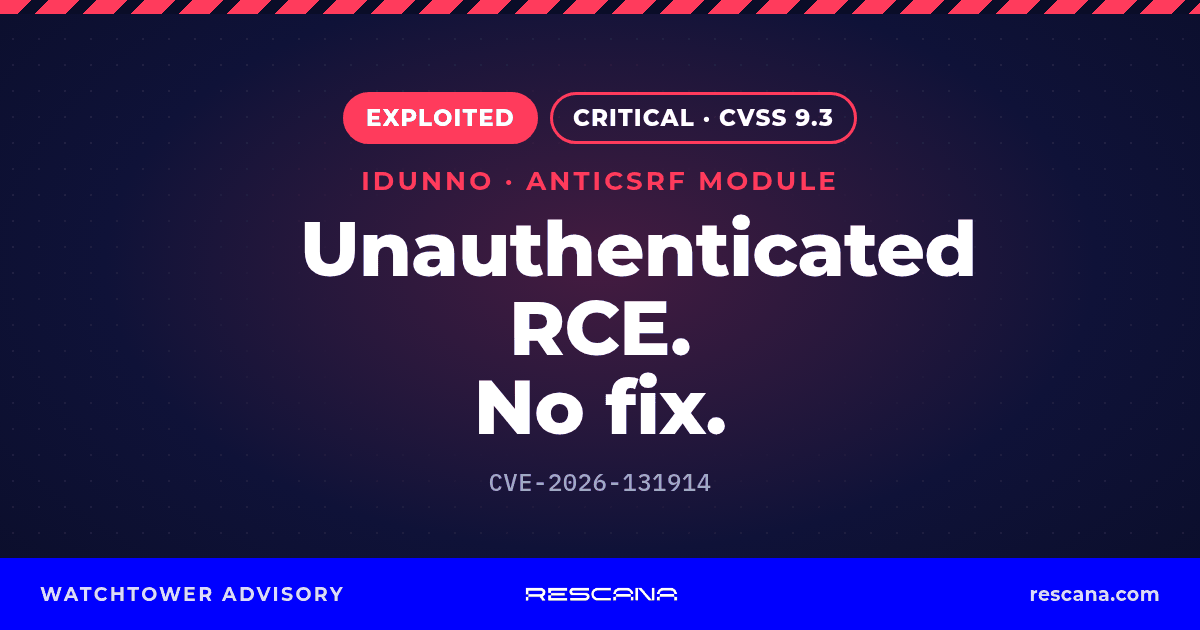
Status: Idunno.AntiCsrf is an abandoned anti-CSRF module for ASP.NET WebForms applications that was published on the now-retired CodePlex site. It has a deserialization flaw, CVE-2026-131914 , that Mandiant says lets a remote attacker run code as the IIS worker process ( w3wp.exe ) with a single HTTP POST request and no prior authentication. Every version through 0.9.1 Beta , the project's last release, is affected. As of 00:34 EST on November 22, 2026 there is no fix . Mandiant is the CVE Numbering Authority (CNA) for the record, and its advisory credits researchers from Google Cloud's FLARE team and Mandiant Incident Response, among others, with the discovery. It says the project has "no active maintainer or official patch available," and tells organizations to stop using the module and replace it. Mandiant's advisory also says "Active exploitation in the wild has been observed." It gives no actor, victim count, dates or indicators for that exploitation. CVE-2026-131914 is not in CISA's Known Exploited Vulnerabilities (KEV) catalog. The catalog version we checked is 2026.11.20 , released at 12:48 EST on November 20, 2026 , with 1,790 entries. Mandiant scores the flaw CVSS 4.0 9.3 (Critical), and NVD has not yet analyzed it. We checked all sources at 00:34 EST on November 22, 2026 .
Idunno.AntiCsrf is a small third-party HTTP module that older WebForms applications load to add double-submit cookie CSRF protection. The flaw sits inside that protection: the module deserializes the CSRF token it receives before it checks whether the token is valid. CVE-2026-131914 matters now because there is nothing to patch. The upstream project is gone, so the only fix is to take the module out of every application that loads it.
What matters for planning:
There is no fix and there will not be one. Mandiant describes Idunno.AntiCsrf as "a defunct open-source project last released as 0.9.1 Beta (official build dated December 2008) on the since-retired CodePlex platform." Its resolution is to remove the module and use a supported anti-CSRF mechanism. We found no fixed version in the CVE record, NVD, the GitHub Advisory Database entry or ENISA's EUVD entry.
Exploitation is reported by Mandiant, not by CISA. Mandiant's advisory says "Active exploitation in the wild has been observed," and the CVSS 4.0 vector in the CVE record carries the exploit maturity value Attacked. CISA has not added the CVE to KEV, and CISA's own Coordinator enrichment in the CVE and NVD records lists exploitation as "none" (more below). We do not resolve that difference. In Rescana's reading, Mandiant's statement is the exploitation evidence here, and CISA's field is CISA's view at the time it was recorded.
A single unauthenticated POST is enough, according to Mandiant. The advisory says exploitation needs no prior authentication and no valid CSRF token, and that the vulnerable code runs before the page's own code does. Any anonymously reachable .aspx page that has not opted out of the module's check is exposed, and so is any page that relies on login checks inside its own page code.
The impact is full server compromise. Mandiant says the result is code execution in the context of the IIS worker process, "resulting in complete compromise of the web application server." If you find signs of exploitation, Mandiant says to rotate the secrets held in Web.config and applicationHost.config , including the machine keys, encryption keys and database credentials.
Nothing public tells you who is behind it or how widely it is used. Mandiant names no actor and no victims. Neither do we.
If you run any ASP.NET WebForms application, find out today whether it loads this module, remove it from every internet-facing application first, replace it with a supported anti-CSRF mechanism, and review the web servers for the signs listed below (Rescana guidance built on Mandiant's published steps). This advisory is a new post, not a follow-up: no live Rescana post covers CVE-2026-131914 or Idunno.AntiCsrf.
Technical Information
The following is Mandiant's and the CVE record's published description, not a reproduction of any exploit. This post gives no payload details and links to no exploit code.
The CVE record, published by Mandiant as CNA, says: "Deserialization of untrusted data in double-submit cookie vs. form field validation in Idunno.AntiCsrf versions through 0.9.1 Beta on ASP.NET allows remote unauthenticated attackers to execute code via object injection." The CVSS 4.0 vector in the record is CVSS:4.0/AV:N/AC:L/AT:N/PR:N/UI:N/VC:H/VI:H/VA:H/SC:N/SI:N/SA:N/E:A , base score 9.3 , severity Critical: network-reachable, low complexity, no attack requirements, no privileges, no user interaction, high impact on confidentiality, integrity and availability of the vulnerable system, and exploit maturity Attacked. Mandiant's advisory labels the vector CVSS-BT. NVD carries that same Mandiant score as its only CVSS metric, marked Secondary, and shows vulnerability status Received (not yet analyzed) when we checked. NVD has not produced a score of its own, and the record has no CVSS 3.x score.
Mandiant's advisory MNDT-2026-0048 explains the mechanism. The module, Idunno.AntiCsrf.AntiCsrfModule , hooks the ASP.NET request pipeline before a WebForms page's own code runs. On a POST to a page that has not opted out, the module reads the CSRF token from the form and deserializes it with a .NET ObjectStateFormatter that has no cryptographic key. Mandiant says that formatter does "zero MAC, signature, encryption, or machineKey validation" and enforces no restrictions on what types it will rebuild. The module compares the result with the cookie only afterward. Because the token is deserialized before it is checked, Mandiant says an attacker does not need a valid token. The advisory describes this as insecure deserialization (CWE-502, "Deserialization of Untrusted Data"; the CVE record also lists CAPEC-586, Object Injection).
Who can reach it. Mandiant says the module runs ahead of the page lifecycle, and that although ASP.NET's pipeline authentication and authorization rules run earlier, "any anonymously reachable .aspx page or any page relying on application-level session checks inside Page_Load" that neither implements ISuppressCsrfCheck nor carries the [SuppressCsrfCheck] attribute exposes the deserialization step on POST, "even if the page contains no" server-side form. In Rescana's reading, an application that denies anonymous users at the ASP.NET or IIS authorization layer narrows the audience to people who can sign in, and does not close the flaw. Most such applications still have at least one anonymous page, such as a forms-authentication login page, so treat them as exposed. We did not test that.
What an attempt looks like. Mandiant describes the module's error handling after the deserialization step: it either redirects (HTTP 302) or raises a PotentialCsrfException , which returns a 302 to the application's error page when custom errors are on, or an HTTP 500 when they are off. In Rescana's reading, that means a probe can look like an ordinary failed CSRF check in the web server log. This is why Mandiant's log guidance points at POST requests to .aspx pages that return 302 or 500, and does not name a specific request pattern.
Scope inside the application. Mandiant describes the vulnerable step on System.Web.UI.Page handlers, meaning WebForms pages. The advisory does not say whether other kinds of handlers in an application that loads the module are affected, and we do not claim they are not. Treat every application that loads the module as affected until you can show otherwise (Rescana guidance).
Related but separate: Sitecore. CISA's KEV catalog lists two older Sitecore flaws, CVE-2019-9874 and CVE-2019-9875 (added March 26, 2025), in the product's own Sitecore.Security.AntiCSRF module, described by CISA as deserialization of a serialized .NET object sent in an HTTP POST parameter. In Rescana's reading, that is the same kind of mistake in a different product. No source we opened says whether the two modules code; they are separate products with separate CVE records. Do not treat a Sitecore fix as covering this CVE, or the reverse.
CISA's enrichment. CISA's Coordinator record in the CVE record and in NVD, timestamped 20:39 EST on November 18, 2026, sets SSVC options to exploitation: none , automatable: yes and technical impact: total . SSVC is CISA's decision framework, and these values are CISA's assessment at that time. They sit to Mandiant's statement that exploitation has been observed. We do not know why they differ and do not speculate; we note that the enrichment was recorded ten minutes after the CVE record was published. FIRST EPSS for CVE-2026-131914 was 0.00614 (percentile 0.50345) on the 2026-11-21 daily score. An EPSS score is not evidence for or against exploitation.
What we could not confirm. Mandiant is the only source for exploitation. It does not say how many systems were hit, in which sectors, by whom, or since when, and it does not say that the incident response work in its disclosure timeline involved the exploitation it reports. Its timeline says only that its FLARE team completed root-cause analysis "during incident response investigation" on November 4, 2026. We have not tested the flaw or any mitigation. None of the sources we opened mentions a public proof of concept; we did not for one, and this post does not link to or describe one.
Affected Product Versions
The sources agree on the product and the version ceiling. No source lists a fixed version, and none can: the project is defunct.
Two practical points, both Rescana's reading. First, the project page captured by the Internet Archive in 2010 tells developers to copy the assembly into an application's bin folder and register it in Web.config . NuGet's service returned no package with the ID Idunno.AntiCsrf when we queried it at 00:34 EST on November 22, 2026, so package-manifest scanners may not list it, and a file is more reliable. Second, a different NuGet package named AntiCSRF, by another author, exists. No source we opened links it to this CVE, and the CVE record covers only the product Idunno AntiCsrf.
December 2008. Mandiant dates the official 0.9.1 Beta build of Idunno.AntiCsrf.dll to December 2008, and describes the project as hosted on CodePlex, which has since been retired.
November 4, 2026. Mandiant says its FLARE team completed root-cause analysis during an incident response investigation (Mandiant gives the date without a time or time zone).
November 11, 2026. Mandiant says its CNA started the CVE assignment "for public awareness," noting the project is defunct and no patch is available.
November 18, 2026, 00:18 EST. The CVE ID CVE-2026-131914 is reserved (CVE record).
November 18, 2026, 20:26 EST. Mandiant's advisory file MNDT-2026-0048 is committed to its public repository. Mandiant lists November 18 as the date the advisory and CVE were published.
November 18, 2026, 20:29 EST. The CVE record is published. ENISA's EUVD lists the same publication time as EUVD-2026-129432.
November 18, 2026, 20:39 EST. CISA's Coordinator SSVC enrichment is added to the CVE record (exploitation none).
November 18, 2026, 21:17 EST. NVD publishes the record with status Received.
November 18, 2026, 22:31 EST. The GitHub Advisory Database publishes GHSA-pj2m-2r8v-h9cp as an unreviewed entry.
November 22, 2026, 00:34 EST. We re-checked Mandiant's advisory, the CVE record, NVD, the GitHub Advisory Database, ENISA's EUVD, CISA's KEV catalog, EPSS and NuGet. Status unchanged: no fix, NVD status Received, not in KEV.
The raw timestamps in the CVE record, NVD and GitHub's API are UTC and fall on November 19 for these events, which is November 18 in EST. All dates and times in this post are EST.
How to Find Your Exposure
The checks below combine Mandiant's published guidance, which we mark, with Rescana guidance. Mandiant, MITRE, NVD and CISA publish no detection signatures for this CVE.
every web server and build artifact for the module. Look for Idunno.AntiCsrf.dll in every IIS web root and bin folder, deployment package, container image, build output and backup. every Web.config and applicationHost.config for Idunno.AntiCsrf , AntiCsrfModule and csrfSettings . Mandiant says to by name because organizations that recompiled or customized the library will have different file hashes. Include applications that a supplier or contractor built for you, which may carry the library without your team knowing (Rescana guidance).
Compare file hashes to Mandiant's list. The three SHA-256 values in the Indicators section identify public builds of the vulnerable DLL. A match shows the vulnerable component is present. A non-match does not clear a file.
source code. Look for references to ISuppressCsrfCheck and SuppressCsrfCheck , which Mandiant lists among the things to remove, and for AntiCsrfModule in project files (Rescana guidance).
Work out which applications are reachable. List which of them face the internet, partners or shared networks, which have pages that allow anonymous access, and which rely on login checks inside page code. Mandiant says those are the pages that expose the flaw (Rescana guidance on the inventory).
Check what the worker process can reach. Mandiant says the code runs in the context of the IIS worker process. Find which account each affected application pool runs as, and what that account can read or write: files, databases, network shares and other servers. That sets the blast radius (Rescana guidance).
Review IIS logs. Mandiant's guidance is to review IIS logs for anomalous POST requests to .aspx endpoints that return HTTP 302 or HTTP 500, with elevated cs-bytes where logged. IIS logs normally do not record request bodies, so a clean log review narrows the and does not prove nothing happened (Rescana's reading). Mandiant gives no start date for exploitation, so use the longest log retention you have (Rescana guidance).
Review the application's own error logs for PotentialCsrfException entries, which the module raises after the deserialization step when it is set to raise exceptions (its default; with detectionResult="Redirect" it redirects instead). Ordinary CSRF failures raise the same exception, so look for bursts, odd sources or exceptions on pages that users rarely post to (Rescana guidance).
Review the host for signs of code execution. Look for unexpected child processes of w3wp.exe (command interpreters, scripting hosts, download tools), new or changed files in web roots, ASP.NET temporary directories and other writable locations, unfamiliar .aspx , .ashx or .dll files, new scheduled tasks, services or local accounts, and outbound connections from the web server to addresses it does not normally . If you have endpoint detection, query process creation events whose parent is w3wp.exe (Rescana guidance).
Plan a compromise assessment for any internet-reachable server that loaded the module. Rescana has no data on how many servers run it or who has used the flaw. Mandiant says environments with evidence of exploitation should rotate the secrets listed in the section and inspect web roots for unauthorized files.
We will add vendor, CISA or Mandiant detection guidance here if it is published.
Workaround and Mitigation
There is no vendor, because the project is defunct. Mandiant's resolution is the starting point. In its words, organizations should discontinue use of the module and "replace it with an actively supported anti-CSRF alternative." Mandiant lists three steps:
Remove Idunno.AntiCsrf. Remove the module entries ( Idunno.AntiCsrf.AntiCsrfModule, Idunno.AntiCsrf ) from the and sections, remove the csrfSettings section declaration from and the csrfSettings element from Web.config , remove any code references to ISuppressCsrfCheck or [SuppressCsrfCheck] , and delete Idunno.AntiCsrf.dll from the application's bin directory.
Adopt a supported anti-CSRF mechanism. Mandiant names System.Web.Helpers.AntiForgery ( AntiForgery.GetHtml() and AntiForgery.Validate() ), ASP.NET WebForms Page.ViewStateUserKey combined with MAC-verified or encrypted ViewState on postback forms, and ASP.NET Core's anti-request forgery support ( IAntiforgery ).
Assess for compromise. Audit Web.config files and bin directories for the module, and review IIS logs as described above. Where there is evidence of exploitation, rotate all secrets stored in Web.config and applicationHost.config , including keys, encryption keys and database credentials, and inspect web roots for unauthorized files.
Rescana guidance beyond Mandiant's list:
Do the internet-facing applications first. On any internet-reachable server, take copies of the web root and logs before you remove the module (see item 4). Removing the module also removes its CSRF protection until the replacement is deployed; accept that gap over the RCE. If an application cannot be changed today, limit who can reach it (a VPN, an allow list or an authenticating gateway in front of it) or take it offline until the module is out. A web application firewall rule is not a substitute for removal: no detection signatures are published, and we have not tested any.
Remove the module, then test the forms. The project page says AntiCSRF was written for applications that do not use ViewState together with a user key, because that approach needs ViewState enabled and a way to identify each user. Check each application's forms after removal and pick the replacement that fits it (Rescana's reading of the project page; not tested by Rescana).
There is no safe configuration workaround. Rescana guidance is to remove the module.
If you suspect compromise, preserve evidence first. Take copies of the web roots, logs and, where you can, memory before you change anything, then rebuild from a known good source and do not clean in place. Rotate the credentials that the application pool account could reach, and treat the secrets in the configuration files as exposed, as Mandiant says (Rescana guidance). Rotating a machine key signs users out and invalidates ViewState, so plan the change.
After changes, repeat the review above and keep a record of what was removed, from which servers, and when.
We will update this advisory if Mandiant revises its advisory, if NVD finishes its analysis, if CISA changes its assessment or adds the CVE to KEV, or if Mandiant or others publish more detail on the exploitation.
Indicators of Compromise
Mandiant publishes no indicators of compromise for CVE-2026-131914: no IP addresses, domains, payload hashes, web shell names or actor names. The only published values are file hashes for the vulnerable library itself. Mandiant's table lists three public builds of Idunno.AntiCsrf.dll . These identify the vulnerable component. They are not indicators that a server was attacked, and a match does not mean it was.
Mandiant's table also lists MD5 and SHA-1 values for the same three builds. Mandiant says copies that were recompiled or customized will have different hashes while keeping the vulnerable step, so for the names Idunno.AntiCsrf and Idunno.AntiCsrf.AntiCsrfModule as well. An empty hash match is not closure.
Signs worth checking (not published indicators): POST requests to .aspx pages that return HTTP 302 or HTTP 500 with unusually large requests, and unauthorized files in web roots (both from Mandiant's guidance); and, as Rescana guidance, unexpected child processes of w3wp.exe , new or changed files in ASP.NET temporary directories, .aspx , .ashx or .dll files that nobody deployed, new scheduled tasks, services or accounts on the web server, and outbound connections from the web server to unfamiliar addresses. We will update this advisory if Mandiant or others publish more.
Third-Party Risk (TPRM) Angle
A library from 2008 that lived on a retired hosting site is the kind of component that sits unnoticed in older line-of-business web applications, customer portals and intranet tools, often built by a contractor and rarely touched since (Rescana's reading). Nobody maintains it, so the supplier cannot "wait for the patch": the only answer is removal. The flaw needs no login on pages that allow anonymous access, so a supplier's user policy does not, on its own, close it (Rescana's reading). Rescana has no data on how many servers run the module or on who has used the flaw.
The suppliers to ask first (Rescana guidance):
Software vendors and outsourced development shops that maintain older ASP.NET WebForms products or portals that touch your data.
Managed hosting and IIS hosting providers that run customers' legacy .NET applications.
Suppliers that run long-lived internal or partner portals on Windows Server, such as logistics, public sector and education portals.
Send these five questions (Rescana guidance):
Does any web application that serves or stores our data load Idunno.AntiCsrf (the CodePlex AntiCSRF module), including applications built by subcontractors?
If so, was the module removed from every server, with what replacement, and on what date? Which build or hash did you find?
Was the application reachable from the internet or partner networks, and did any page allow anonymous access?
What account did the application pool run as, and what could it reach?
Have you reviewed IIS logs, the host and the web root for signs of code execution, and have you rotated the secrets in the configuration files that Mandiant lists? What did you find?
Ask for evidence, not reassurance: the method and date, the files found, the removal date and the replacement control, the log review period and result. Because there is no fix, "we are waiting for the patch" is not an answer to question 2.
What to do internally (Rescana guidance): every IIS server and build artifact for the module today, remove it from internet-facing applications first, replace it with a supported anti-CSRF mechanism, review the hosts for the signs above, rotate secrets where there is evidence of exploitation, and chase the suppliers above. We will update this advisory if Mandiant revises its advisory, if NVD completes its analysis, if CISA changes its assessment or adds the CVE to KEV, or if more detail on the exploitation is published.
Need help working out which suppliers run legacy ASP.NET applications with access to your data? Our team can help you prioritize them and track their answers. Talk to an expert
Mandiant Vulnerability Disclosures: MNDT-2026-0048 : Mandiant's advisory for Idunno.AntiCsrf; description, impact, exploitability including the exploitation statement, details, vulnerable DLL hashes, CVSS 4.0, resolution, credits and disclosure timeline; file committed 20:26 EST, November 18, 2026 and unchanged since; checked 00:34 EST, November 22, 2026.
GitHub Advisory Database: GHSA-pj2m-2r8v-h9cp : unreviewed entry for CVE-2026-131914, severity critical, CWE-502, CVSS 4.0 9.3, no patched version listed, published 22:31 EST, November 18, 2026; checked 00:34 EST, November 22, 2026.
CVE Record: CVE-2026-131914 , read through the CVE API : CNA Mandiant; reserved 00:18 EST and published 20:29 EST, November 18, 2026; CWE-502; CAPEC-586; CVSS 4.0 9.3 with exploit maturity Attacked; affected versions; CISA ADP SSVC at 20:39 EST, November 18, 2026; checked 00:34 EST, November 22, 2026.
NVD API 2.0: CVE-2026-131914 and the NVD detail page (HTML shell only; facts taken from the API): status Received; published and last modified 21:17 EST, November 18, 2026; Mandiant's CVSS 4.0 as the only metric; checked 00:34 EST, November 22, 2026.
ENISA EUVD: EUVD-2026-129432 (page requires JavaScript; facts taken from the EUVD API ): EUVD-2026-129432, assigner Mandiant, CVSS 4.0 9.3, versions through 0.9.1.0 and 0.9.1 Beta, published 20:29 EST, November 18, 2026; checked 00:34 EST, November 22, 2026.
CISA: KEV catalog JSON feed : catalogVersion 2026.11.20, released 12:48 EST, November 20, 2026, 1,790 entries; CVE-2026-131914 not present; the Sitecore entries CVE-2019-9874 and CVE-2019-9875 are present; checked 00:34 EST, November 22, 2026.
FIRST: EPSS API, CVE-2026-131914 : 0.00614, percentile 0.50345, date 2026-11-21; checked 00:34 EST, November 22, 2026.
MITRE CWE-502: Deserialization of Untrusted Data : weakness name; checked 00:34 EST, November 22, 2026.
Internet Archive capture of the AntiCSRF project page on CodePlex (January 29, 2010) : the project's own description, usage and configuration notes; Mandiant links this capture; checked 00:34 EST, November 22, 2026.
NuGet service: query for Idunno.AntiCsrf : zero results; checked 00:34 EST, November 22, 2026.
The full story
This article is one source in a clustered incident — the cluster page carries the summary, timeline and every other outlet covering it.
