 Back Thenationalnews
Iran sustaining attacks in Europe 'despite arrests'
Iran has been able to continue attacks across Europe despite half of them resulting in arrests, a new report warns.
The International Institute for Strategic Studies has looked at the increase in Iranian -backed activity in Europe since the start of air strikes by the US and Israel against Iran on February 28, known as Operation Epic Fury.
Its report, Iranian External Operations in Europe: Adaptation, Intimidation and an Outlook to 2027 , examines 80 such operations.
There have been four incidents a month since February 28, compared to one a month in the period before then, dating back to the October 7, 2023 Hamas-led attack on Israel.
“Iran has sustained its operational activities in Europe despite significant disruption by European authorities,” said the report.
“Of the approximately 80 Iranian incidents recorded, 58 per cent resulted in arrests, compared with 25 per cent of comparable Russian incidents over the same period.”
Most of these were part of an initial surge of 24 incidents in March and April, which were claimed by a group calling itself Harakat Ashab Al Yamin Al Islamia , also known as Ashab Al Yamin, which translates as the Islamic Movement of the Companions of the Right Hand.
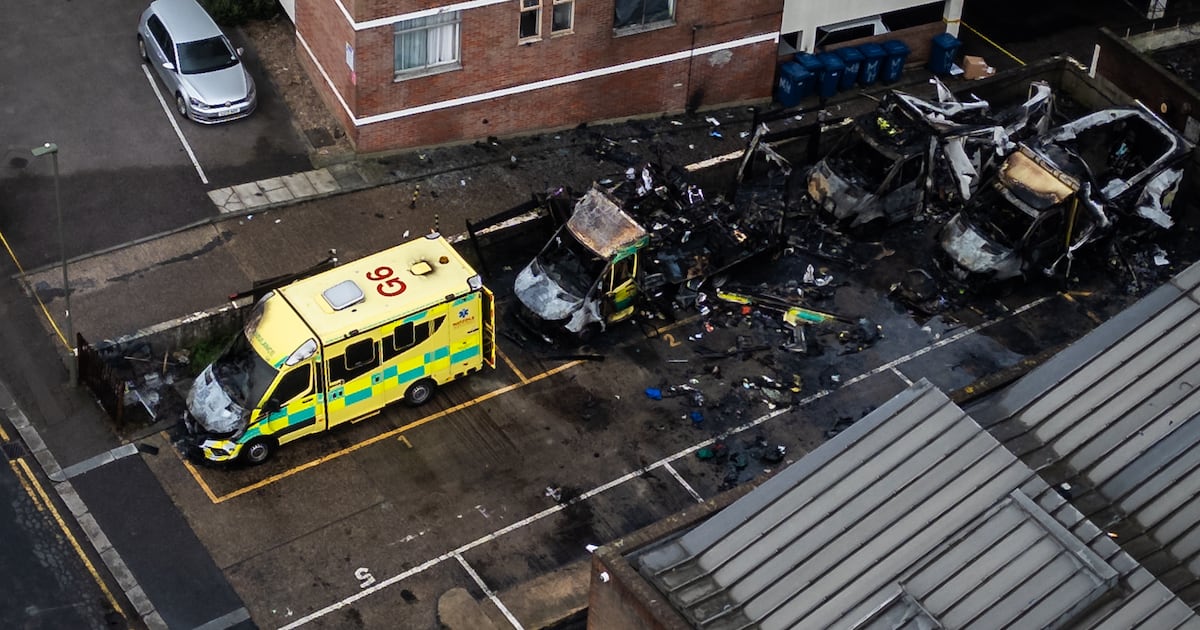
These included arson attacks on ambulances belonging to a Jewish charity, on a synagogue and on Iran International, an opposition-aligned TV station.
The US authorities have charged three men they say orchestrated the terrorist attacks at the behest of Iran’s Islamic Revolutionary Guard Corps.
After this initial spell, activity fell sharply, reflecting both the ceasefire agreed on April 8 and the major disruption of Iran-linked criminal groups by law enforcement.
“Even so, Iran has since roughly maintained its pre-Epic Fury tempo of one to two incidents per month and has also targeted a wider range of US commercial and military interests,” the IISS report said.
Police disrupted an alleged Iran-linked plot to attack RAF Fairford in the UK in September. The three men accused over the Ashab Al Yamin attacks have also been charged with orchestrating the RAF Fairford plot.
The IISS says the continuation of Iranian activity has “likely been achieved by varying the targets of the attacks and those recruited to carry them out”.
The of operations against the Jewish community has increased from 21 per cent before February 28 to 57 per cent afterwards. Previously, half of the plots were directed at journalists and dissidents but that has fallen to 13 per cent.
That means Iran is going for more identifiable targets. “Individuals are harder to locate. Any member of the public could find a local synagogue, but fewer could find a specific journalist or dissident,” the IISS report said.
Iran has also shown a willingness to adapt who it recruits and how, say the report’s authors, Charlie Edwards, senior fellow for strategy and national security, and researchers Tom Field and Georgie Green.
Perpetrators of attacks are Iranian and dual-Iranian nationals and third-country nationals, including Afghans and Pakistanis, as well as individual Azerbaijani, Colombian and Syrian nationals.
Nationals of the country in which the attack took place with no known link to Iran, several of whom have Algerian or Tunisian heritage or dual citizenship, were also used.
Iran has also used serious organised crime groups, notably the Foxtrot and Rumba networks in Sweden and wider Scandinavia.
“These criminal operatives often lack ideological commitment and exhibit poor tradecraft,” the report said.
“For example, in some cases, forensic examination of their mobile devices has enabled law enforcement to identify wider networks.”
Laurence Taylor, the head of counter-terrorism operations for the UK police, told a conference for insurer Pool Re on Thursday that the volume of interference in the UK by Iran and Russia had risen sharply. Some of the proxies mobilised by state agents were unwittingly carrying out cross-border activities, he said.
“Some of these people are neither serious nor particularly intelligent, and they are not very good at what they do,” he said. “Often they don't even know what they are doing is on behalf of a foreign state.
“If somebody gets offered £500 [$655] to do something and they don't know why they will [still] go and do it. Its really hard to manage that from a preventive perspective.
“It's not just policing and national security collaboration that is going to address this – it is a collective effort from society more broadly.”
The IISS warned that Iran could move towards a Russian model, recruiting lone actors and small groups to increase the effectiveness of its attacks.
“Many Russian proxies come from Eastern European states with linguistic or historical ties to Russia,” said the report.
“Iran could similarly seek to recruit from communities with which it has cultural ties.”
The costs of widening threats is borne by the state and British business. Pool Re's chief executive Tom Clementi said the insurance industry was adapting to mass attacks such as alleged state- cyber hacking of supermarket fridges around Europe.
“For businesses across the country, understanding and managing some of the newer risks is no longer a niche concern,” he said. "[There are] a wider range of risks and vulnerabilities, including so so-called grey zone hostilities that have the capacity to disrupt businesses, economies and societies.
“We've seen clearly geopolitical instability, hostile state activity, online radicalisation, the spread of misinformation, and various cyber-related threats.”
IISS said its AI enabled analysis had projected three potential pathways for future risk. First that Iran's targeting mix shifts towards US military, diplomatic and commercial interests, alongside continued threats to Iranian dissidents, Jewish communities and Israeli interests.
Second that Iranian and Russian agencies more deeply co-ordinate hostile activity in the UK but third that while Tehran pulls back from hostile attacks its proxies continue to operate.
