 Back Maltatoday.Mt
Malta's silence as Libya and Turkiye agree contested sea border
It went largely unnoticed in the domestic news cycle and elicited no public reaction from the Maltese Government.
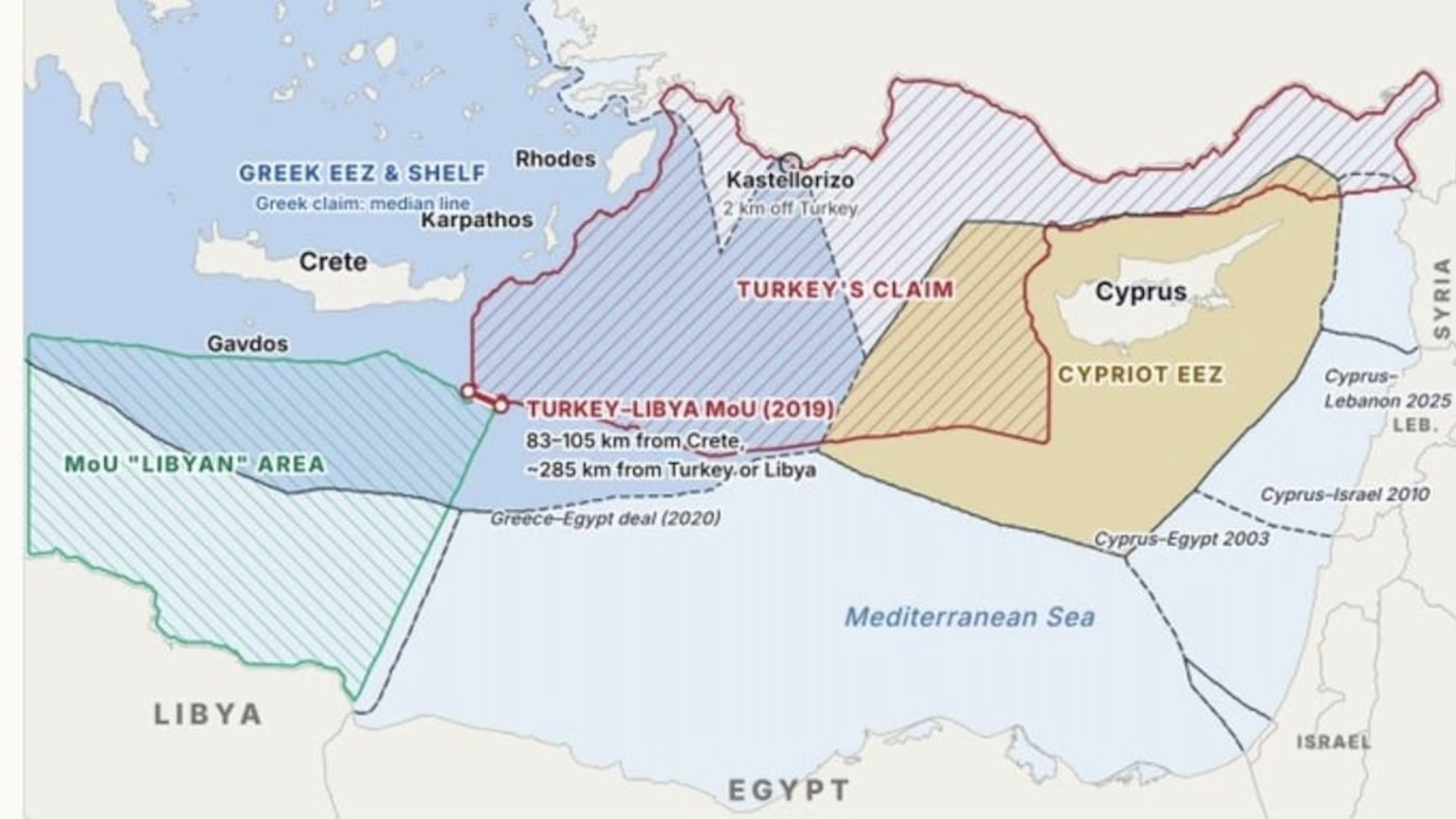
But the approval by Libya’s Benghazi-based parliament of an agreement with Turkiye, delineating their maritime border, has significant geopolitical implications in the Mediterranean basin.
The agreement immediately raised the ire of Greece, Egypt, Cyprus, Israel, and the European Union. They contested the agreement’s legal validity, accusing Libya and Turkiye of disregarding the sovereign rights of other states.
The disputed zone lies in the eastern Mediterranean, to the south of Crete and far away from Malta’s own exclusive economic zone (EEZ). And yet, the bilateral agreement and complete disregard of third-party rights, should be of concern for a small island state with a continental shelf that has historically been the subject of competing maritime claims by its neighbours, including Libya.
According to retired Colonel David ‘dp’ Attard, former deputy commander Armed Forces of Malta, the Libya-Turkiye MOU has strategic implications for Malta’s ambitions to exploit its EEZ.
“The Mediterranean’s relatively confined geography means that the potential maritime entitlements of neighbouring littoral states frequently overlap, making the delimitation of maritime boundaries particularly sensitive,” Attard says.
In 2021, the Maltese parliament approved the law empowering the government to declare Malta’s EEZ in line with the international law of the seas. Finance Minister Clyde Caruana, who piloted the law and introduced further amendments in 2023, had said Malta’s intention was to exploit the vast waters around it.
The EEZ is a maritime zone beyond a country’s territorial waters where a coastal state has special rights to explore, exploit, and manage natural resources such as oil exploration.
The Libya-Turkiye agreement may not have direct implications on Malta’s ambitions but for Attard the significance lies primarily in its wider geopolitical implications and the precedent it sets.
“Bilateral agreements that disregard the maritime entitlements of third states can complicate resource exploration and development, increase uncertainty for investors and create additional sources of regional tension and conflict,” he argues.
Attard notes that Turkiye possesses one of the strongest navies and air forces in the region and is steadily expanding its military reach in Libya. Countering this regional balance of power is the growing Israel-Greece-Cyprus partnership, he adds.
And it’s not just offshore oil and gas exploration that may be at stake here but also the passage of critical infrastructure such as underwater cables and pipelines linking Cyprus, Greece and possibly Israel, that traverse this disputed area.
Within this geopolitical framing it is crucial to understand how the latest Libya-Turkiye agreement came to be.
A 2019 agreement revitalised
It is actually a memorandum of understanding (MOU) Turkiye had initially signed in 2019 with the UN-recognised Libyan administration based in Tripoli. At the time, the agreement was rejected by the rival Libyan administration led by General Khalifa Haftar based in eastern Libya.
The MOU defines the maritime border between Libya and Turkiye in the eastern Mediterranean but it overlaps with Greek, Egyptian and Cypriot claims.
Denounced in 2019 by Greece and other states, the agreement gained major significance last week when the Libyan administration in the east dropped its objections and also approved the deal.
The significance comes from the fact that for years, Haftar and Turkiye did not see eye to eye. In 2019, Turkiye had thwarted Haftar’s attempt to take Tripoli by sending military assistance to the UN-recognised government. Roll forward seven years and Turkiye has warmed up to both of Libya’s rival administrations, gaining a significant foothold in the north African country.
When news of the Benghazi-based parliament’s approval of the MOU filtered through, it was immediately shot down by Greece. The Greek foreign minister described it as “illegal, null and void”, insisting it “infringes upon the sovereign rights of states in the region”. Similar condemnations of the agreement were made by Egypt, Cyprus and the EU.
Indeed, the Libya-Turkiye arrangement effectively overlooks the existence of Crete, the largest of the Greek islands in the eastern Mediterranean.
For Attard, the Greek argument that the agreement disregards the maritime entitlements of its islands, is of interest to Malta. “A bilateral agreement cannot, by itself, extinguish the maritime rights of third states and the Greek argument highlights the challenges faced by islands and island states, as well as the wider implications of maritime delimitation disputes in the Mediterranean,” he says.
The strategic lesson for Malta, Attard argues, is that it must safeguard its own maritime interests consistently and support the principle that bilateral agreements cannot prejudice the lawful rights of third states. “All the while, Malta must ensure that its own EEZ ambitions rest on a clear and defensible legal foundation,” he says.
The Maltese Government has so far not commented publicly the Libya-Turkiye agreement. Questions sent to the Maltese Foreign Ministry by MaltaToday remained unanswered by the time of writing.
If past behaviour is anything to go by, Malta’s position would be represented by the collective voice of the EU, ostensibly so as not to prejudice its relations with either Libya and Turkiye.
Malta enjoys good relations with Libya’s Tripoli administration and has over the past three years warmed up to the Benghazi side as well.
On 13 October, Deputy Prime Minister Ian Borg headed a ministerial delegation that visited Benghazi “to follow progress in talks on the reunification of Libya and explore opportunities for cooperation in various sectors”. A day later, Affairs Minister Glenn Bedingfield was in Tripoli meeting his counterpart to irregular migration and security cooperation.
Malta also enjoys good relations with Turkiye, suffice to say that last week a Turkish delegation led by Deputy Health Minister Şuayip Birinci met with Deputy Prime Minister Ian Borg in Malta with the two countries actively exploring a new healthcare cooperation agreement.
The warm relations Malta has with both countries may explain its reluctance to publicly express its views on the Libya-Turkiye maritime border delineation agreement.
Protecting Malta’s interests
But Attard believes Malta should neither remain silent in the face of developments that may affect its maritime interests nor treat the agreement as an immediate national security crisis.
“Malta’s response should combine legal preparedness, diplomatic engagement and coordination with its European partners,” he says.
Although on paper the geographical coordinates laid down in the Libya-Turkiye MOU do not appear to have an impact on Malta’s maritime interests, Attard believes Malta should still carry out its own checks.
“It should then engage constructively on a bilateral and multilateral level while supporting the basic principle that peaceful settlement of maritime disputes should be made in full respect of international maritime law,” he says.
At EU level, Attard insists, Malta should advocate a consistent approach that safeguards the maritime rights of member states and promote dialogue and regional stability.
“To my mind, one fundamental principle must be clear; agreements between other states cannot, by themselves, and in any way determine or prejudice Malta’s lawful maritime rights,” he says.
Malta has so far been relatively inactive in exploiting its EEZ. According to the Continental Shelf Department, Malta’s continental shelf has been covered by extensive seismic surveys in of oil and gas but tested by only 11 exploratory wells.
The more recent ventures concern a licence granted to oil giant Chevron in May 2026, to carry out desktop studies of available geological data for areas to the south of the islands, and an ongoing tendering process for a floating offshore wind farm to be located outside territorial waters in the south or southeast.
Nonetheless, despite the dearth of activity in its EEZ, Attard insists Malta should protect its maritime interests. “It should be a priority to provide legal certainty for prospective investors and ensure offshore resources can be developed in a stable and predictable environment, without compromising regional stability or Malta’s commitment to international law,” he says.
The full story
This article is one source in a clustered incident — the cluster page carries the summary, timeline and every other outlet covering it.
