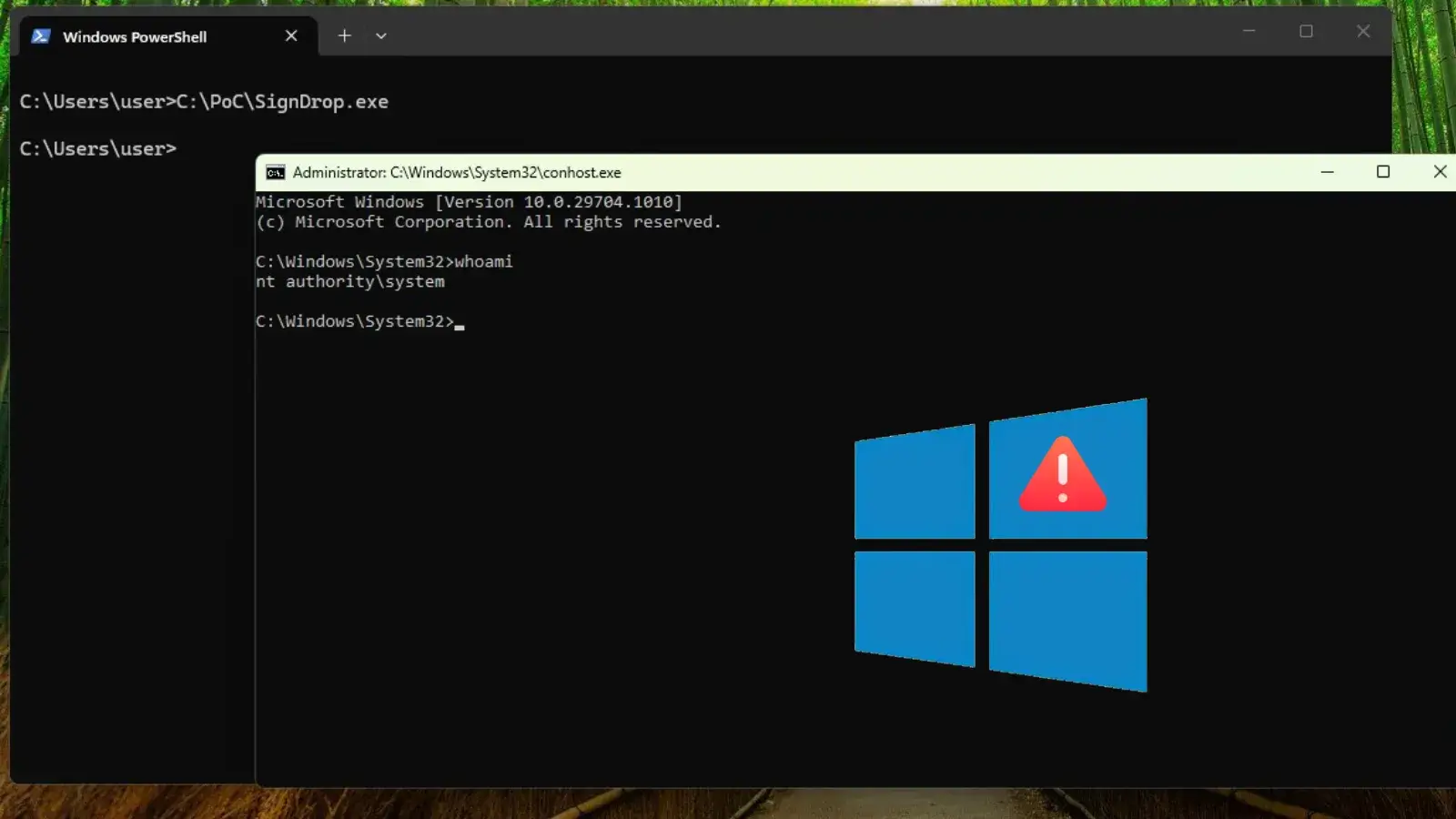
A researcher known as MSNightmare, also called Chaotic Eclipse, has published a working proof of concept for an unpatched Windows zero-day dubbed SignDrop. The exploit turns a standard user account into NT AUTHORITY\SYSTEM by abusing the Common Log File System (CLFS) driver, clfs.sys.
It was released on GitHub on November 10, the same day as Microsoft’s monthly updates. As of November 11, it has no CVE, advisory, or patch. Microsoft has not confirmed the claims, and no in-the-wild exploitation has been reported.
New Windows SignDrop Zero-Day
CLFS has long been a favorite target for privilege escalation. Recent examples include the CVE-2025-29824 zero-day , which was exploited in real attacks before it was patched. Microsoft responded with an authentication mitigation, available in Windows 11 25H2 and Windows Server 2025 updates released on or after October 28, 2025.
The mitigation adds a hash-based message authentication code (HMAC) to CLFS log files, built from the file data and a system-unique key. CLFS refuses to open files that fail the check.
SignDrop abuses that safeguard. When a log is created, CLFS writes a “.cnpf” authentication file to it. An attacker can attach extra containers to the log with the AddLogContainer API, and the driver always opens these associated containers along with the original log.
If an associated container is empty, CLFS signs it whether or not a signature file already exists. This is harmless while the caller is the attacker’s own process, because all file creation uses the caller’s context.
The problem appears when a privileged process opens the log. The researcher coerces Microsoft Defender into opening the container through the ServerMpUpdateEngineSignature call, and uses object manager symbolic links to redirect the path.
CLFS then creates the missing authentication file as SYSTEM, and the file inherits the original file’s DACL, which the attacker controls. Chaining these steps yields a SYSTEM shell.The technique also reaches beyond privilege escalation. Because the file creation appears to come from the antimalware engine’s own process, kernel drivers see it as legitimate.
According to the researcher , this could bypass the self-defense or tamper protection of any antivirus or EDR product. Microsoft’s documentation describes tamper protection as the feature that stops attackers from turning off security controls.
Exposure depends on the CLFS authentication mode in the registry key HKLM\SYSTEM\CurrentControlSet\Services\CLFS\Authentication\Mode. Per Microsoft, 0 means enforced, 1 means learning, 2 means disabled by an administrator and 3 means disabled automatically by the system.
The researcher says values 0 and 1 are vulnerable, while 2 and 3 are not. The exploit was tested on Windows 11 26H2 and Windows Server 2025 builds. The researcher estimates that 80% of Windows installations are exposed, mostly those running longer than 90 days. That figure is an estimate, not a measured count.
The flaw is local, so attackers need existing code execution first. That makes it a natural second stage after phishing or malware, similar to how Play ransomware operators used a CLFS zero-day to escalate privileges.
Defenders should not turn off the CLFS mitigation as a workaround, because that re-exposes the memory-corruption bugs it was built to stop. Instead:
Enforce least privilege on standard accounts.
Monitor for unexpected .cnpf creation by Defender or other privileged processes.
Watch for ERROR_LOG_METADATA_CORRUPT errors.
Teams should also review earlier CLFS privilege escalation flaws for detection ideas and apply Microsoft’s fix as soon as it ships.
Give your SOC the alert context on the latest threats to stop incidents quickly -> Integrate Threat Intel from 16K SOCs :
Divya is a Senior Journalist at GBhackers covering Cyber Attacks, Threats, Breaches, Vulnerabilities and other happenings in the cyber world.
ESET Blocks Over 700,000 Cruciferra Malware Attacks Using Advanced Encryption to Evade Antivirus Detection
ESET says it has blocked more than 700,000 compromise attempts linked to Cruciferra since January…
Global Scam Networks Use AI, Deepfakes, and Crypto to Steal Billions From Victims, FATF Warns
Global scam networks are using artificial intelligence, deepfakes, and cryptocurrency infrastructure to industrialize fraud, inflicting…
Critical MongoDB Use-After-Free Vulnerability Allows Remote Code Execution Without Authentication
MongoDB has patched a critical use-after-free flaw, tracked as CVE-2026-118383 with a CVSS score of…
Google Chrome Fixes 83 Security Flaws, Including 5 Critical Use-After-Free Vulnerabilities
Google released a Chrome desktop security update that addresses 83 vulnerabilities, including five critical use-after-free…
AntiFox AI Agents Linked to AWS Attacks That Exposed Production Secrets and Compromised Web Servers
Attackers are using AntiFox, an agentic AI penetration-testing framework derived from ARTEX, to target internet-facing…
State- Hackers Deploy Up to 8 AI Agents to Target Taiwanese Government Systems
A campaign against Taiwanese government entities used up to eight AI agents with limited human…
The full story
This article is one source in a clustered incident — the cluster page carries the summary, timeline and every other outlet covering it.
