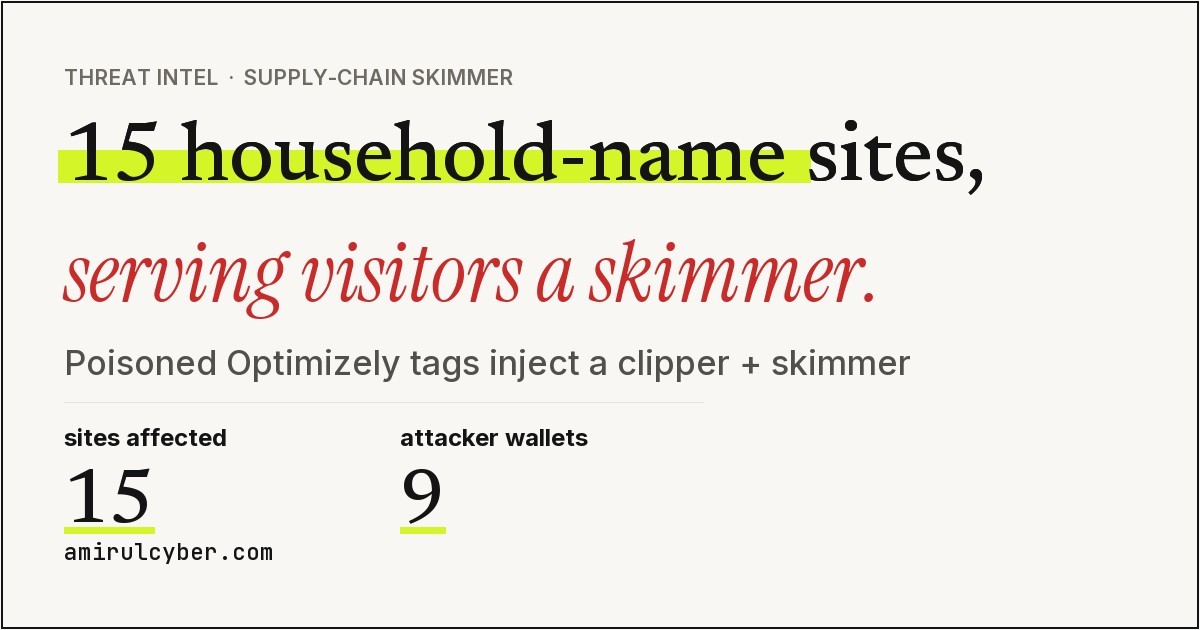
One poisoned tag layer, 15 household-name websites , millions of exposed visitors. Attacker JavaScript injected into Optimizely bundles is serving a crypto-clipper + card-skimmer to visitors of CNN, Zoom, Fox News, BBC, Salesforce, GitLab, American Eagle, Hootsuite and seven more — plus side vectors through a first-party bundle, a Jscrambler-protected script, and one malvertising impression. If your site loads Optimizely, assume your visitors are in the blast radius until you check the bundle.
Risk to a marketing and IT team
If your site loads Optimizely, your visitors are the targets: pasted wallet addresses get swapped before submission, card forms get skimmed, and page URLs plus cookies plus a screenshot leave with every hit. Your origin can be clean while your visitors are robbed — the compromise sits in the tag layer. Three-step check: (1) fetch your served Optimizely bundle and it for 1688360 ; (2) alert on Content-Security-Policy script-src violations naming unknown hosts; (3) verify with a test wallet address on a staging page that what you paste is what gets submitted.
Inside affected Optimizely bundles, directly after the normal experiment code:
and inside that bundle:
That project ID is GitLab’s; ten more project/snippet IDs across unrelated organisations carry the same line. Two affected sites instead blocked it with CSP ( script-src violation, request Failed) — compromised snippet, unexecuted payload.
One self-contained script, four modules:
1. Clipper. Regex plus real checksum validation (double-SHA256, base58check, bech32, cashaddr, TON CRC16) for ETH, TON (friendly + raw), BTC, BCH, LTC, TRX, DOGE and SOL. Rewrites DOM text (50 ms sweep, payment-keyword gated), input / textarea values (including framework models), link/image src / href , copy events, clipboard.writeText/readText , navigator. , and fetch / XHR URLs and bodies. Every swapped original is queued for exfil.
2. Screenshot + cookie exfil. Posts page URL (≤500 chars), cookies (≤8,000), a JPEG screenshot via html2canvas pulled from the same C2, and the matched original addresses to /hit.php .
3. Card skimmer. Luhn plus brand check, MM/YY + 3–4-digit CVV validation, hooks fetch / XHR POST bodies (JSON, FormData , nested objects) and form submits, dedupes per session, exfiltrates via sendBeacon to /card.php .
4. iOS second stage. On iPhone/iPad/iPod only: injects boot.js from two .icu hosts and, on iOS ≤ 18.6, a hidden iframe. The recovered boot.js is obfuscated and under analysis.
Attacker replacement addresses (verbatim from the file header):
15 captured page loads, sorted by traffic. First column is the page domain as observed; second column is the exact page URL that loaded the payload:
Per-row caller evidence lives in the third column: Optimizely bundles on every row except foxnews.com (ad wrapper), ae.com (first-party bundle) and wwws.airfrance.it (Jscrambler-protected script).
Block now (high confidence, safe to block):
served tag-manager bundles for unknown .cc / .icu hosts — catches this loader; misses loader variants on fresh domains.
CSP script-src violation monitoring — two sites survived this way; misses pages without CSP or with permissive policies.
Client-side: alert on html2canvas fetched from a non-site host, sendBeacon to unknown hosts on checkout pages — catches the exfil leg; misses passive skimmers that only read.
Canary wallet address in staging: paste, submit, compare — catches clipper; misses keyword-gated payloads that ignore test pages.
Optimizely experiment JS runs with page privilege — vendor docs on custom code execution — why a tag-layer injection owns every visitor session.
OneTrust auto-blocking and the optanon-category pattern — why consent gating does not sanitise a poisoned tag.
CSP script-src as last line of defence for third-party compromise — the control that saved two of the sites in this report.
The full story
This article is one source in a clustered incident — the cluster page carries the summary, timeline and every other outlet covering it.
