 Back www.precursorsecurity.com
Precursor Security blogpost
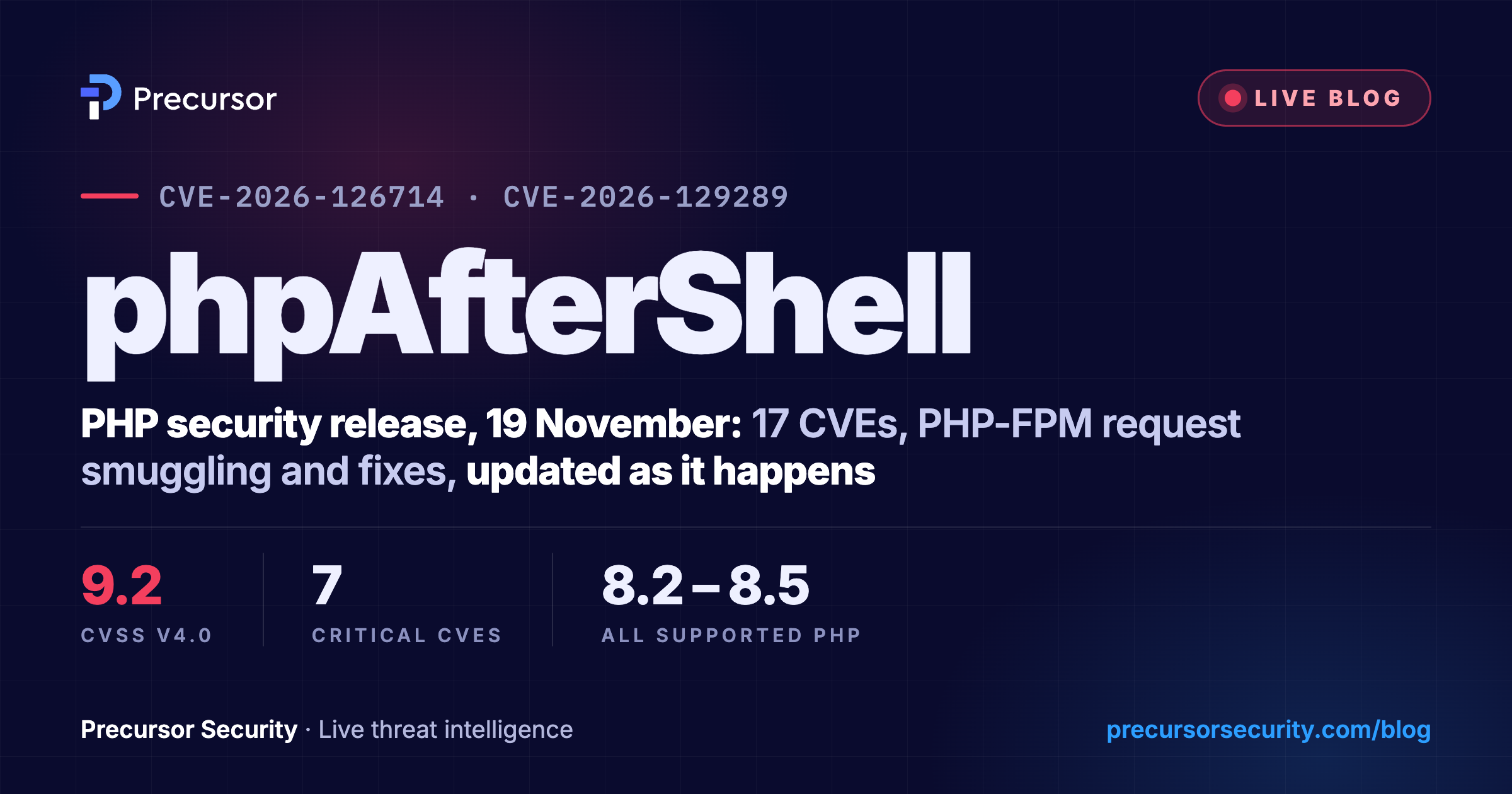
phpAfterShell is the name depthfirst gave to CVE-2026-126714, a critical (CVSS 9.2) flaw in PHP's default file-based session handler. An interrupted session write can leave a mixed file that later deserialises into attacker-chosen objects, which can lead to remote code execution; depthfirst says its full chain uses PHP's own native classes rather than application code. It bypasses October's PHP2Shell fix and was fixed on 19 November 2026.
Which PHP versions fix phpAfterShell and the other CVEs?
PHP 8.5.13, 8.4.28, 8.3.37 and 8.2.36, released on 19 November 2026. Earlier releases in each branch are affected, including the October PHP2Shell releases (8.5.12, 8.4.27, 8.3.36, 8.2.35).
How many vulnerabilities did PHP fix on 19 November 2026?
17 CVEs with PHP security advisories: 17 in PHP 8.5.13, 14 in 8.4.28 and 13 each in 8.3.37 and 8.2.36. Seven are rated critical with a CVSS 4.0 score of 9.2.
What is CVE-2026-129289?
CVE-2026-129289 is a critical PHP-FPM request smuggling flaw. Unread request-body bytes can form a forged FastCGI request on a reused connection, letting an unauthenticated attacker execute PHP code. It needs a front end that keeps backend connections open, such as nginx fastcgi_keep_conn on or Apache enablereuse=on.
Am I affected by the PHP-FPM request smuggling flaw?
You are in scope if you run PHP-FPM or LSAPI behind a front end that reuses backend connections (nginx fastcgi_keep_conn on, Apache mod_proxy_fcgi enablereuse=on, HAProxy FastCGI with kept connections) and an application path opens php://input without reading it fully. Configurations that close the FastCGI connection after each request are not affected by the demonstrated attack.
We patched PHP2Shell in October. Are we protected?
No. The October releases do not contain these fixes, and two of the new critical CVEs (CVE-2026-129481 and CVE-2026-129182) complete the October fix for CVE-2026-109619. Upgrade again.
Is phpAfterShell being exploited?
No exploitation in the wild had been reported as of 19 November 2026, and none of the CVEs were in CISA's Known Exploited Vulnerabilities catalogue. Several advisories include working proof-of-concept chains, so expect that to change.
How do I mitigate phpAfterShell if I cannot upgrade yet?
Set session.upload_progress.enabled = 0 in php.ini and restart PHP if you do not need upload progress, and limit untrusted data stored in sessions. This removes the easiest path but not the flaw, so upgrade as soon as possible.
Are WordPress, Laravel and Drupal sites affected?
Yes, potentially. The flaws are in PHP itself, so any application on an affected PHP version can be in scope depending on its configuration. Frameworks with magic method facades and request handling that opens php://input early are named in the advisories as relevant.
Does storing sessions in Redis protect against phpAfterShell?
Redis, database and other non-file session handlers are not affected by the phpAfterShell file-write defect. CVE-2026-115560 can still apply where session upload progress and mixed serializers a store.
What should I do PHP 8.1 or older?
PHP 8.1 and older are end of life and receive no fixes. Move to a supported branch (8.2 or later) and apply the 19 November release.
My distribution package still shows an old PHP version. Am I patched?
Distributions often backport fixes without changing the upstream version number, so php -v is not proof either way. Check your vendor's security advisory or changelog for the CVE numbers.
Which PHP settings reduce my exposure today?
Turn off FastCGI keep-alive to PHP-FPM, set session.upload_progress.enabled = 0 if unused, set zend.exception_ignore_args = 1 on PHP 8.5, disable catch_workers_output if you do not need it, fix any startup warnings in the PHP error log, and lowercase https and ftps URL schemes in code. None replace the upgrade.
The full story
This article is one source in a clustered incident — the cluster page carries the summary, timeline and every other outlet covering it.
