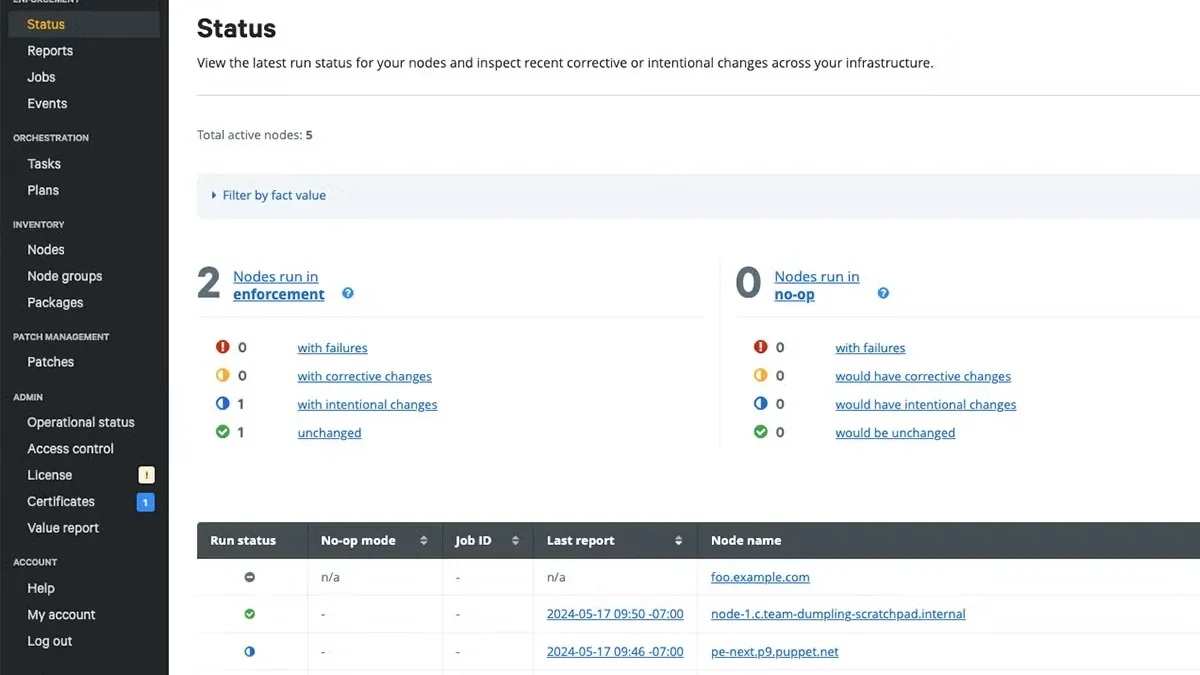
CISA put CVE-2026-115731 on its Known Exploited Vulnerabilities list on November 17, 2026. The bug sits in Perforce Puppet Enterprise, carries a CVSS 4.0 score of 9.4, and lets a client holding a Puppet-CA-signed agent certificate run code on the Puppet Server. U.S. federal civilian agencies have until December 1, 2026 to fix it.
The listing arrives one week after CISA’s six-flaw batch covering Barracuda, Cisco BroadWorks and Outlook , but it differs in kind. Those entries hit email gateways and desktop software. This one hits the machine that tells every other server in a fleet what to become, which is why a single line in a federal catalog deserves a longer look.
The flaw hinges on one setting most Puppet admins never revisit: certificate autosigning. Where signing is open, the “needs a signed certificate” precondition shrinks to almost nothing. Where it is locked down, the bug is still serious but far harder to reach. Which side your servers fall on decides how fast you move.
Don't miss new tech stories on Google
Add Shattered once in the Google app and our stories show up in your news suggestions.
What CISA Added on November 17
CISA’s catalog entry carries the title “Perforce Puppet Enterprise Deserialization of Untrusted Data Vulnerability.” The agency added it because it has evidence of active exploitation, which is the only criterion that gets a flaw onto the KEV list. CISO Brief’s coverage of the addition matches that account, and the entry was the only one CISA added that day.
What the listing leaves out matters just as much. It does not name an attacker, count victims, publish indicators of compromise or say whether ransomware crews use the bug. None of the sources reviewed here fills those gaps. Anyone claiming to know who is behind the exploitation today is guessing.
The remediation deadline of December 1, 2026 gives agencies 14 days from the listing date. CISA describes the catalog as a living list of flaws that pose significant risk to the federal enterprise, and the deadline binds only federal civilian agencies. Everyone else treats it as a strong hint where attackers already are.
How CVE-2026-115731 Works
The flaw lives in the code path where Puppet Server processes reports. Agents send a report after each configuration run, and the server parses it. According to the vendor’s release notes and the CVE record, a crafted report that uses a rich-data type, submitted through a PUT request, makes the server deserialize untrusted data. The result is arbitrary code execution as the Puppet Server service user.
The CVSS 4.0 vector in the CVE record reads as follows in plain English: network reachable, low attack complexity, low privileges required, no user interaction, and high impact on confidentiality, integrity and availability, both on the vulnerable system and on systems downstream of it. Some third-party databases also show a CVSS 3.x score of 9.9, but the official record lists 9.4 under CVSS 4.0.
The low-privileges requirement is the key detail. The attacker needs a CA-signed agent certificate, not an administrator account. In a healthy deployment that is a meaningful barrier, because only machines an operator approved get a certificate. In a deployment with loose signing rules, the barrier may not exist at all.
One crafted report, one shell on the primary server
Once code runs as the service user, the attacker stands on the machine that handles catalog compilation, reports and certificate authority material. VulnPulse’s write-up says the flaw can also expose the certificate-signing key. That claim comes from a single outlet, so treat it as a reason to investigate rather than a confirmed property of every install.
Why Autosigning Decides How Bad This Is
Puppet Server can sign certificate requests automatically. That setting, called autosigning, saves time in cloud environments where nodes appear and vanish by the hour. It also means anyone who can reach the server and send a certificate request may end up with a valid certificate. The sources reviewed here agree on the consequence: weak autosigning can turn a flaw that requires a signed certificate into one that works without authentication.
The remediation guidance in HOL’s fix-and-check-autosign walkthrough puts the autosign review front and center, because the setting decides whether a stranger can reach the bug at all. Perforce itself advised disabling autosigning or enforcing strong validation in autosigning scripts as an interim step, and stressed that temporary mitigations do not replace upgrading.
That distinction mirrors a long-running argument in vulnerability triage. A raw score says little reachability, which is why analysts increasingly weigh exploitation evidence over severity. The trade-off is laid out in a comparison of CVSS versus CISA KEV for prioritization . Here the two signals agree, since a 9.4 and a KEV listing point the same way, but the autosign setting still decides which of your servers sit at the front of the queue.
Affected and Fixed Versions
The CVE record lists three affected Puppet Enterprise ranges, one per active release line. Each has a matching fixed release. Puppet Core, the vendor-supported component underneath, also shipped patches. EndOfLife.ai’s fixed-versions summary lines these up with the lifecycle dates and agrees with the vendor release notes.
The practical rule is simple. If your primary server runs anything older than 2026.0.1, 2025.12.1 or 2023.8.13 in its respective line, it is exposed. Upgrading across lines, say from 2023.8 to 2025, also removes the bug but brings a much larger change window than the same-line patch, so most operators will want the same-line fix first.
Reporting on the vendor fixes stresses that Puppet Server needs a restart so the corrected code loads. An upgraded package on disk protects nothing if the old process still runs. Single-source reporting adds that Puppet Server 9.0.24.1 and a PuppetDB build list the fix too, so check the whole stack rather than one package.
The sibling bug: CVE-2026-115732
Perforce fixed a second flaw in the same releases. CVE-2026-115732 is an authorization bypass. The release notes describe a case where a managed machine could impersonate another machine when certificate names only partially matched approved names. A single-source report puts its severity at CVSS 9.0, so hold that number loosely.
CISA listed only CVE-2026-115731. That does not make the second bug harmless. It means the agency has no exploitation evidence it is willing to cite for it yet. Because both fixes arrived together, patching one patches the other, and defenders gain nothing by treating them separately. Both bugs involve trust decisions around certificates and client-supplied objects, a class that tends to cluster once researchers start reading the same code.
Open-source Puppet and Puppet Core
Not every Puppet user runs the commercial product. Corgea’s research note states that open-source Puppet has no fix for the bug and discusses the OpenVox fork. That is one outlet’s reading, and teams on community builds should check their distribution’s advisories before relying on it. Perforce’s own fixes cover Puppet Core and Puppet Enterprise.
Puppet Core is a Perforce-developed, vendor-supported proprietary product, and the sources list versions 8 and 9 as the supported majors. Puppet Core 7.x reached end of life in April 2025 and gave way to the 8.x line starting at 8.12.0. Anyone still running a seven-series server sits outside every fix listed above and should plan a migration, not a patch.
Timeline: Fixes on November 3, KEV on November 17
Secondary reporting associates the vendor fixes with November 3, 2026. The official release page dates were not independently confirmed in the sources reviewed, so the date carries a hedge. If it holds, defenders had a two-week window between the patch and the moment CISA confirmed exploitation.
The gap between a vendor fix and a KEV listing is the window in which patching is cheap and optional. After the listing, patching is mandatory for federal agencies and urgent for everyone else. Teams that waited for exploitation proof before acting spent those two weeks exposed to a bug with a public fix and a public description.
Why the Puppet Server Is a Prime Target
A configuration management server holds a privileged channel into every node it manages. Puppet agents trust the server to hand them instructions, and those instructions run with high privileges on the agent. An attacker with code execution on the server can, in principle, push changes to the whole fleet. Whether a particular intrusion goes that far depends on the environment, but the potential is why defenders rank these servers alongside identity systems.
Puppet’s marketing page says organizations choosing Puppet include 80% of the Global 5000. That is a vendor claim and nobody has audited it here, but even a discounted version points to a large installed base in big enterprises. Large estates mean long upgrade queues, and long queues are what attackers count on.
The pattern echoes other management-plane failures this autumn. The ScreenConnect flaw and its three-day CISA deadline made the same point remote management tools. Attackers prefer targets that give them reach, not just a foothold.
How It Compares With Other November KEV Entries
November has been busy for the catalog. CISA added entries on November 9, November 10 and November 17, among other dates. The table below lines up the newest ones by product and weakness class, using the titles CISA published.
Authentication and authorization failures run through the list, and the Puppet bug belongs to that family in spirit, because the exploit rides on a certificate that should have been hard to get. The November 9 batch with GPUStack, FreeSwitch, OpenSSH and Aspera Faspex showed the same preference for infrastructure and file-transfer software.
Popular software with deep reach gets listed fast once exploitation starts. A recent WordPress race-condition flaw that reached KEV shows the same dynamic on the web-platform side. Scale, not elegance, drives attacker choice.
Pull-Model Agents Versus Agentless Tools
Puppet uses an agent that pulls configuration from a central server over mutually authenticated TLS. Agentless tools such as Ansible push over SSH from a control node. Neither design is immune. They fail differently, and this bug highlights the failure mode of the pull model.
In a pull model the server exposes a listening service to every agent, and identity rests on certificates. A weakness in how the server handles agent-supplied data, plus lax certificate issuance, reaches the server from the network. In an agentless design the control node usually makes outbound connections, so the attack surface moves to credentials and the control node’s own access rules. This is analysis, not a ranking: a compromised Ansible control node with broad SSH keys is a comparably bad day.
The shared lesson is that the orchestrator deserves the same segmentation, monitoring and patch priority as a domain controller. A pulse report on InfraTrust’s tally of exploited edge and management-plane flaws reached a similar conclusion devices that sit at the center of an estate. Teams that treat orchestration as plumbing tend to learn otherwise during incidents.
What to Do Before December 1
The steps below follow the vendor guidance and the consensus of the write-ups reviewed. Order matters, because the autosign check is quick and shrinks your exposure while the upgrade is scheduled.
Check autosigning on every Puppet Server and disable it or lock it to strong validation if it is open.
Upgrade to 2026.0.1, 2025.12.1 or 2023.8.13, or to Puppet Core 9.1.3 or 8.22.2, depending on your line.
Restart Puppet Server so the patched code is the code that runs.
List every signed certificate and revoke any that nobody can explain.
Review report submissions and server activity for signs of abuse, going back to at least November 3.
Record the patch date for your KEV tracking and audit files.
The commands below show how to inspect the autosign setting and the certificate list. They use standard Puppet tooling, but paths and subcommands vary by version, so confirm against your own documentation first.
If you track KEV entries by hand, automate it. A walkthrough on building a CISA KEV tracker in Python shows how to pull the catalog and match entries against an asset list, so a listing like this one pings the right owner the same day.
Patching closes the door but says nothing who already walked through. CISA’s listing confirms exploitation exists, so any server that ran an affected version with open or weak autosigning, and was reachable by untrusted clients, deserves a look. Start with the certificate authority. Look for certificates issued to names you do not recognize, especially around or after November 3. Then review logs for report submissions from unusual hosts and for unexpected child processes spawned by the Puppet Server service account.
The guidance in the sources also calls for rotating anything the server could read if you find evidence of a break-in. Teams without a mature program can fold this into a wider routine of joining exploited-flaw feeds to asset inventories and scanner output. A tutorial on vulnerability management in Python with KEV, EPSS and OSV data sketches that pipeline end to end.
Market and Cost Impact
The financial effect of a single KEV entry is hard to measure and no source reviewed here quantifies it, so this section deals in direction rather than dollars. The direct cost lands on operations teams, who must schedule an upgrade, restart a control-plane service and audit certificates. The indirect cost lands on any organization that finds evidence of intrusion.
Licensing shapes who feels it. Puppet Enterprise allows up to 10 nodes at no charge and requires a license for 11 or more active nodes. Hobbyists and small labs on the free tier carry the same bug as a large enterprise but rarely follow KEV feeds, so they patch late. Paying customers have support contracts and advisories, which shortens their response time.
Vendors also feel the pressure. A KEV listing for a flagship product raises the cost of every future disclosure, because customers and auditors now compare patch dates to listing dates. Perforce reportedly shipped fixes before CISA confirmed exploitation, which is the sequence a vendor wants. The risk to its reputation depends on how many customers applied them in time.
Historical Context: Orchestration Servers Under Fire
Infrastructure management software has produced a steady stream of KEV entries through 2026. The September SharePoint flaw on KEV showed on-premises collaboration servers drawing fast attention, and the ScreenConnect case showed remote-management tools doing the same. The Puppet bug fits a pattern in which attackers favor software that already holds privilege across many machines.
Puppet’s own recent history adds texture. Puppet Core 7.x reached end of life in April 2025, the vendor published a blog titled “Our Plans for Open Source Puppet in 2025,” and in August 2026 Puppet Enterprise replaced LTS and STS terms with Latest and Latest-1. Today the 2026.y line counts as Latest, 2025.y as Latest-1, and 2023.8 remains the final LTS release with overlap support. The change is a support-policy shift, not a discontinuation.
For this incident the shift has a concrete effect. Teams that stayed on 2023.8 because it was the long-term-support choice now sit on a line the vendor calls the final LTS release. They received a fix, 2023.8.13, but the runway for further 2023.8 fixes looks shorter than the old label suggested. Plan the move to 2025 or 2026 before the advisory, not after. Readers who want the wider picture can browse the security coverage hub for related KEV write-ups and breach analyses.
These are analysis, not reported facts, and each could miss.
More details on exploitation will surface within weeks. KEV listings usually draw incident reports from responders, and a flaw this easy to reach gives them plenty to write .
Scanners and exploit frameworks will add detection or checks quickly, since the bug has a clear request pattern and a public description.
Operators will tighten certificate autosigning across Puppet estates, and some will drop it for an approval workflow tied to inventory.
CISA will keep adding management-plane and orchestration software, because the exploited-flaw data keeps pointing there.
Teams still on the 2023.8 line will accelerate migration plans, given the shorter runway for that release.
The takeaway: a 9.4 score gets attention, but the combination of a public fix, a confirmed exploitation flag and a setting most admins never revisit is what makes this one urgent.
Frequently Asked Questions
What is CVE-2026-115731?
It is a deserialization-of-untrusted-data flaw in how Puppet Server processes reports. A client with a CA-signed agent certificate can submit a crafted report and run code on the server as the service user. The CVE record scores it 9.4 under CVSS 4.0.
Is CVE-2026-115731 being exploited right now?
CISA added it to the KEV catalog on November 17, 2026 based on evidence of active exploitation. The listing does not say who is exploiting it or how widely.
Which Puppet versions are affected?
Puppet Enterprise 2023.8.0 up to before 2023.8.13, 2025.0.0 up to before 2025.12.1, and 2026.0.0 up to before 2026.0.1. Puppet Core 8.22.1 and older and 9.1.2 and older are also affected.
Upgrade to Puppet Enterprise 2026.0.1, 2025.12.1 or 2023.8.13, or to Puppet Core 9.1.3 or 8.22.2, then restart Puppet Server. Review autosigning and certificate issuance afterward.
Can I just disable autosigning instead of upgrading?
No. Perforce advised disabling autosigning or enforcing strong validation as a temporary step and said such mitigations do not replace upgrading, because a legitimately signed certificate can still reach the bug.
What is the federal deadline?
U.S. federal civilian agencies must remediate by December 1, 2026. Private organizations are not bound by it but often use KEV dates as a benchmark.
Does it affect free Puppet users?
Puppet Enterprise covers up to 10 nodes at no charge, and that tier shares the same code, so affected versions apply. Users of community or open-source builds should check their distributor, since one outlet reports no fix for open-source Puppet.
The full story
This article is one source in a clustered incident — the cluster page carries the summary, timeline and every other outlet covering it.
