 Back www.csis.org
Renewed Iran War Would Test Diminished Interceptor Inventories
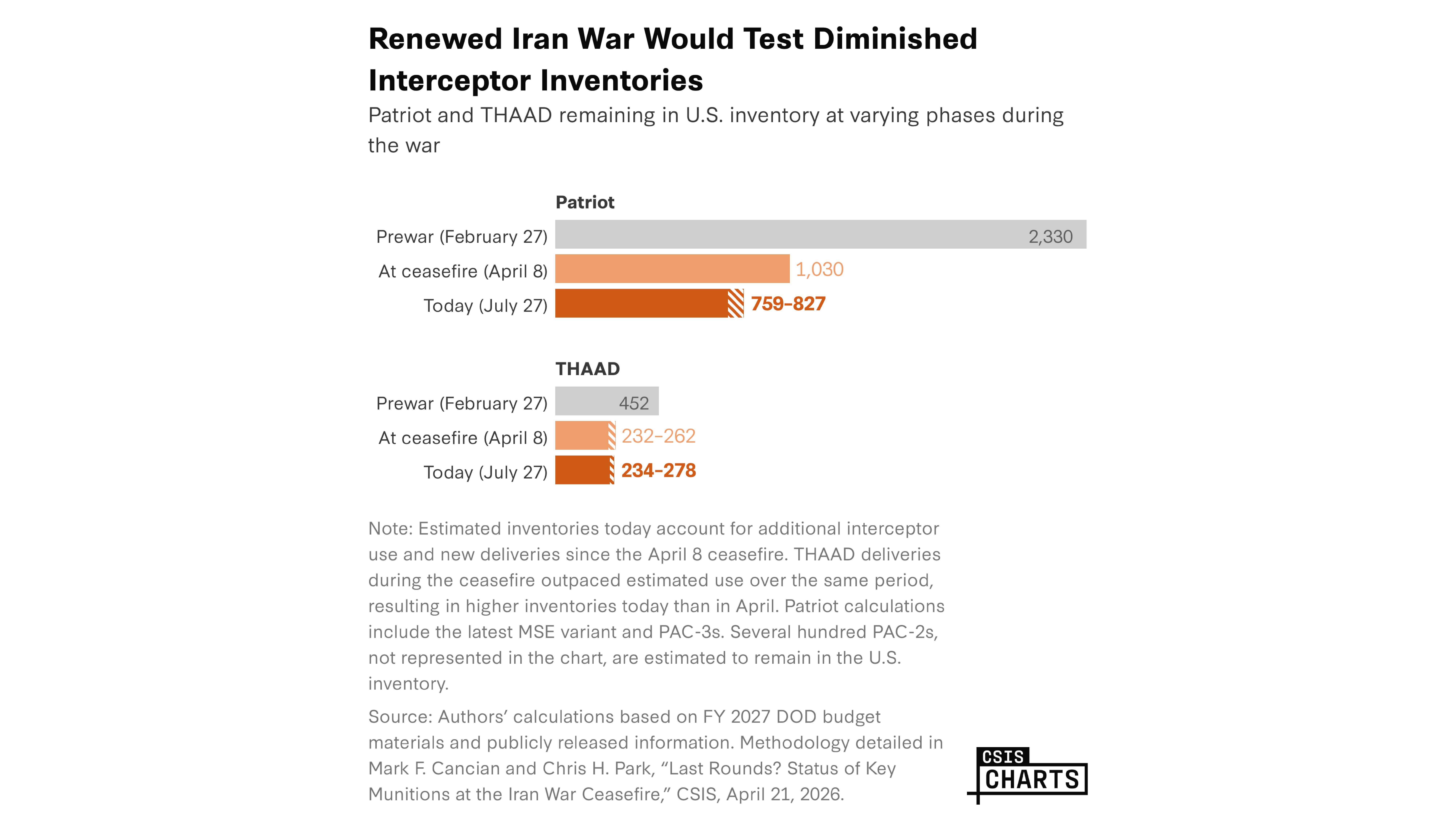
U.S. forces fired many air defense munitions during the first phase of Operation Epic Fury. Resumption of combat operations has reduced inventories further, though Iranian launches have so far been at a lower rate than before the ceasefire.
The air defense campaign has been largely successful with high—though not perfect—interception rates. While some Iranian attacks got past defenses, causing causalities and extensive base damage , these attacks have been unable to diminish U.S. and coalition operations. This has required extensive use of interceptors, with Patriot inventories now under 1,000 and THAAD inventories at 250.
Diminished stockpiles may force the United States and its coalition partners to take more risks with interceptions. There are no good alternatives to Patriot and THAAD for ballistic missile defense. Navy ships, with Standard Missiles that can intercept such threats, generally are too far away.
Expended munitions create a near- to medium-term risk for U.S. readiness to fight a war against China in the western Pacific. The Trump administration’s munitions request of $95 billion in the FY 2027 defense budget and $21 billion in the war supplemental reflects this urgency.
CSIS Charts is produced by the Center for Strategic and International Studies (CSIS), a private, tax-exempt institution focusing on international public policy issues. Its research is nonpartisan and nonproprietary. CSIS does not take specific policy positions. Accordingly, all views, positions, and conclusions expressed in this publication should be understood to be solely those of the author(s).
The full story
This article is one source in a clustered incident — the cluster page carries the summary, timeline and every other outlet covering it.