 Back En.Vijesti.Me
RFE/RL: Moscow entrusts Serbian minister with fight against "foreign interference"
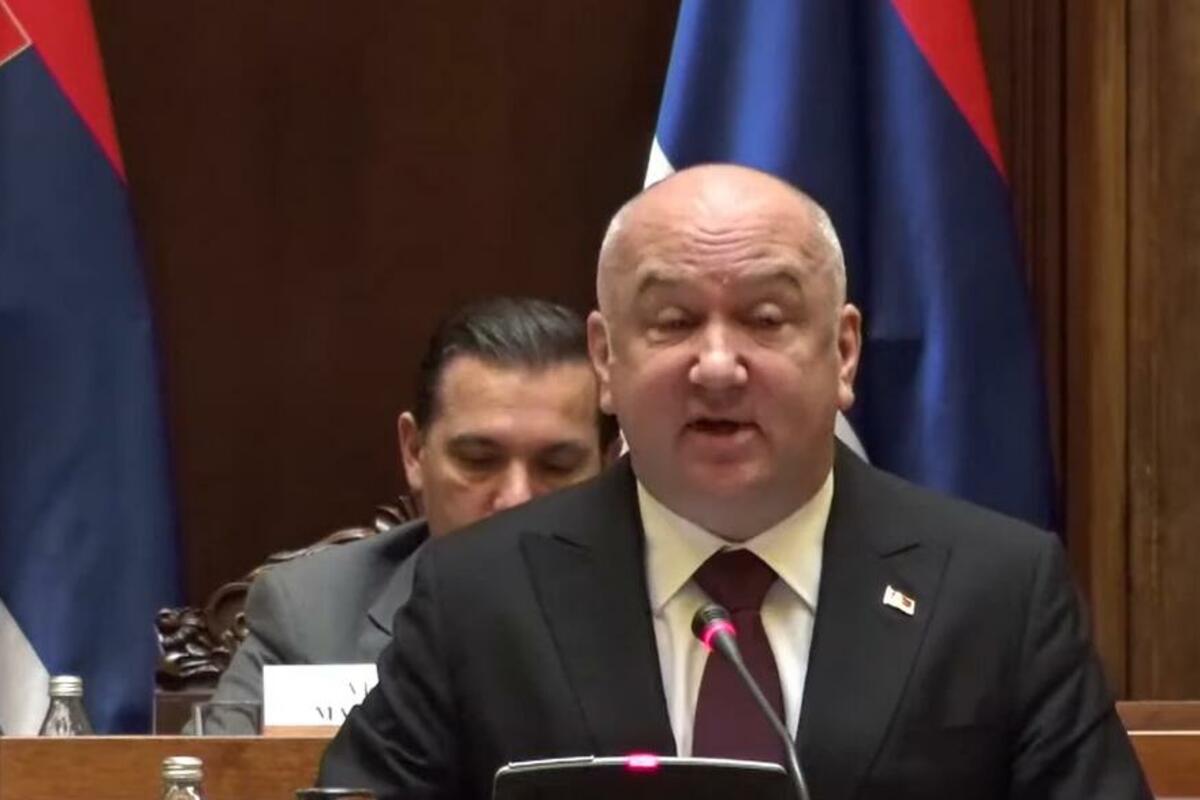
Nenad Popović, a minister without portfolio in Serbia's caretaker government and a politician under US sanctions for ties to Russia, has been appointed coordinator of the fight against "foreign interference in elections" in an international movement founded by the ruling United Russia party.
United Russia President Dmitry Medvedev assigned Popović to the position at a session of the "For Freedom of Nations!" Movement on November 16, stating that "many Western countries are blatantly interfering in electoral processes."
"The experience of our colleagues who have also faced such phenomena will be useful here," Medvedev said, according to the United Russia website.
Medvedev explicitly said in October that the West was trying "to interfere in the electoral processes in Serbia within the framework of the early parliamentary elections and destabilize the situation," Russia's Interfax reported.
This thesis the interference of foreign intelligence services was also advocated by the former government of Aleksandar Vučić, of which Nenad Popović is also a part.
Popović is the pro-Russian minister in charge of international economic cooperation and the social position of the church, and has been under US sanctions since 2023 due to political and business ties to Moscow.
Vuk Vuksanović, a lecturer in foreign policy and grand strategy at the Department of War Studies at King's College London, told Radio Free Europe (RFE) that Popović's new position in the Movement is not a strategic move by Russia, but rather an initiative by Popović himself.
"This is most likely an attempt primarily by Popović himself, as a representative of the old clique that suffered defeat, to use his old connections with Russia and thereby try to fire a few propaganda arrows at the new government by continuing the narrative of foreign interference," Vuksanović believes.
RFE/RL did not receive a response by the time this article was written from Nenad Popović, nor from representatives of the "For the Freedom of Nations!" Movement, regarding what steps they will take in the "fight against foreign interference in elections."
The opposition Student List won the snap parliamentary elections in Serbia on October 25. The Kremlin then announced that it wanted to continue cooperation with Serbia even though their ally Vučić's party lost the elections.
Theses on 'electoral neocolonialism'
The topic of Western interference in elections has been a recurring theme since the founding of the "For Freedom of Nations!" Movement in Russia.
The ruling United Russia party founded the movement in February 2024, with the support of Russian President Vladimir Putin. Its full name is "Forum of Supporters of the Fight Against Modern Practices of Neocolonialism – For the Freedom of Nations!".
The movement, as stated on the United Russia website, aims to bring together countries of the "global majority to build a just and equal multipolar world order."
50 political movements participated in the founding meeting: six European, seven Latin American, 14 African and 23 Asian.
The movement also has other bodies, such as the Standing Committee, whose members are representatives of political parties from several countries, and the representative from Serbia is Nenad Popović on behalf of the Serbian People's Party.
In July 2025, at a meeting of the Movement's Standing Committee, Medvedev proposed to members to conclude agreements "to protect electoral processes."
"It is necessary to provide partners with methodological assistance in countering external influence on our internal, electoral processes," he said at the time, according to Dmitry Medvedev's official website.
Medvedev also said at the time that electoral processes are "a favorite target for interference by the US and its NATO allies."
Medvedev added that an example is Venezuela, which, as he says, was exposed to "unprecedented pressure" from the West during the preparation and holding of presidential and parliamentary elections.
Venezuela's National Electoral Council has declared Nicolas Maduro the winner of the 2024 presidential election without providing details the vote, claiming it was the victim of a computer hack that many experts consider unreliable.
The opposition then declared victory and accused the government of fraud.
Washington has also challenged Maduro's legitimacy as president since he succeeded Hugo Chavez in 2013. US authorities arrested Maduro in early January 2026 on charges of narco-terrorism.
At the Movement's meeting in November 2025, Medvedev called "Western interference" in the electoral process "electoral neo-colonialism."
He then specified that countries should reach agreements on providing assistance in the field of election observation "so that later there would be no attempts to delegitimize them by referring to the violation of some standards that Western countries themselves invented."
The European Union has also rejected the 2026 elections in Russia as "sham elections."
In the parliamentary elections in September, United Russia won almost 58 percent of the vote, and the only party that opposed the war in Ukraine, Yabloko, was excluded from the electoral process.
Vuk Vuksanović from King's College London tells RFE/RL that Russia, along with China, which also participates in this Movement, is trying to impose itself as a power that insists on the "principle of sovereignty."
"Russia is always afraid of any suggestion that NATO might support any forces within Russia, whether liberal or illiberal, with the aim of overthrowing the regime," he says.
Serbia and the 'Colored Revolution'
The issue of "electoral neocolonialism" was raised in the Movement by Nenad Popović himself at a meeting of the Standing Committee in June.
He said then that in the two years, elections would be held in Serbia, Russia and other member states of the Standing Committee and proposed "intensifying joint work in that direction."
The former Serbian government insisted that the student protests that led to its fall in the October 25 elections were a "color revolution," implying that foreign intelligence services were involved in the protests. Russian officials supported that narrative.
These messages were also coming in the run-up to the elections. Ambassador to Belgrade Aleksandar Bocan Kharchenko said in mid-August that Serbia's leadership could not eliminate the risk that after the vote, regardless of the results, "the well-known scenario of a 'colored revolution' could be launched."
Resistance to the alleged "color revolutions" of Serbia and Russia has been announced since December 2021, when the then Serbian Minister of Police Aleksandar Vulin and the Secretary of the Security Council of the Russian Federation Nikolai Patrushev met in Moscow.
They then assessed that "colored revolutions" had become a traditional instrument of policy for certain centers of power.
Cooperation with the new government in Serbia
However, after the victory of the "Student List" in the Serbian elections, the Kremlin announced that they wanted to continue developing relations with Serbia despite Vučić's defeat, with the hope that the new leaders would understand that "cooperation with Russia is in the interests of their country."
Ahead of the elections, one of the representatives of the "Student List", Radomir Saičić, told Radio Television of Serbia that "productive relations with Russia" would be fostered.
Ilija Srdanović, the first on the list that won the snap parliamentary elections, told RFE/RL after the elections that citizens will decide on relations with Russia.
Vuk Vuksanović believes that the Russian authorities will pragmatically cooperate with the new authorities in Belgrade, despite sporadic claims of Western interference.
The Russian Foreign Intelligence Service announced in November that Brussels and leading European capitals were "determined to bring the leaders of the Student List to justice" and were ready to "use the entire arsenal of intelligence and diplomatic instruments of influence."
According to Vuksanović, the issue of Kosovo and the price of gas will be relevant issues for cooperation between Serbia and Russia in the future.
Russia has so far supported Serbia in negotiations over Kosovo, its former southern province whose independence it does not recognize.
Also, Serbia is energy dependent on Russian gas, with over 80 percent of that energy coming from Russia.
The authorities in Serbia have not yet imposed sanctions on Russia for its invasion of Ukraine.
