 Back Ynetnews
Russia faces largest Ukrainian drone attack of war as 1,336 drones are intercepted
Russia faces largest Ukrainian drone attack of war as 1,336 drones are intercepted
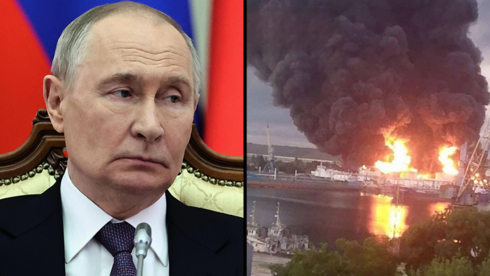
Russia says it intercepted 1,336 Ukrainian drones in the largest attack of the war; Zelenskyy claims Ukraine has disabled 55% of Russia's oil refining capacity as both sides intensify strikes amid renewed US-mediated peace talks
Russian authorities reported Monday that Ukraine had launched its largest
since the war began nearly five years ago. According to Russia's Defense Ministry, its forces intercepted 1,336 drones overnight across 16 regions. The ministry did not say how many drones were launched in total, but the reported number of interceptions alone surpassed the record set October 29, when Moscow claimed to have intercepted 1,254 Ukrainian drones.
The number of drones Ukraine has launched deep into Russian territory has increased in recent weeks, with Moscow reporting several attacks involving more than 1,000 drones. The strikes are part of what Kyiv calls its "
campaign to bring the war to ordinary Russians
." Ukraine's aim is to make Russian civilians experience at least some of the
, thereby increasing pressure on President Vladimir Putin to end the war and pursue a peace agreement that includes significant Russian concessions.
As part of that campaign, Ukraine has successfully struck numerous oil facilities. On Sunday evening, President Volodymyr Zelensky claimed his country had already disabled 55% of Russia's oil refining capacity.
"This is our justified response to Russia’s refusal to de-escalate and its strikes on our energy infrastructure," Zelensky said in his daily address to the nation. He also claimed that 50,000 Russian soldiers had been killed or wounded in frontline fighting last month.
His claims have not been independently verified. However, Russia, a major oil exporter, did report severe fuel shortages over the summer. Long lines formed outside gas stations across the country, and Moscow was forced to temporarily restrict diesel exports to international markets. The ban contributed to a surge in diesel prices, prompting U.S. President Donald Trump to intensify his verbal attacks on Zelensky and lift U.S. sanctions on Russian diesel exports.
The massive Ukrainian attack overnight also targeted energy facilities. According to the Ukrainian military, its forces struck an oil depot in the city of Azov in the Rostov region, which borders Ukraine. Local authorities reported three people wounded in the attack.
Six people were also reported wounded in the Krasnodar region of southern Russia, in a town that is to the Ilsky oil refinery, a facility that has been targeted several times before.
Moscow Mayor Sergei Sobyanin reported that a total of 600 drones had been launched toward the Russian capital. He claimed that most were shot down far from the city, although 191 were intercepted only as they approached Moscow.
Authorities in Crimea, which Russia seized and annexed in 2014, reported that Kyiv had struck the strategic Kerch Bridge, which connects the occupied peninsula to Russia's Krasnodar region. The Kremlin, however, described the damage as "minor." According to Russia's Transportation Ministry, the strike temporarily disrupted vehicle traffic on the bridge but did not affect rail service.
Meanwhile, Russian attacks on Ukrainian cities have continued. Kyiv accuses Moscow of deliberately targeting energy and electricity infrastructure to leave civilians freezing during the winter in an attempt to break their morale.
Ukrainian Prime Minister Serhii Koretskyi said Russian attacks Monday damaged high-voltage power lines and substations in the Zaporizhzhia region in southern Ukraine and the Dnipropetrovsk region in central Ukraine, leaving hundreds of thousands of people without electricity. One person was killed and three others were wounded in an attack on the city of Dnipro.
In his address Sunday evening, Zelensky accused Russia of pursuing a strategy of bombarding specific areas for days until their energy infrastructure is destroyed.
He said the Dnipropetrovsk region alone had been hit by 131 attacks since the beginning of September, while the Kyiv region, which surrounds the capital, had experienced 125 attacks.
According to Zelensky, Russia launched more than 2,300 drones, 1,590 glide bombs and 15 missiles of various types at Ukraine over the past week alone.
"Brutal strikes that are difficult to counter.," he said.
Ukrainian officials have also warned that restrictions on their military use of Starlink, the satellite communications and internet network operated by Elon Musk's SpaceX, are undermining their ability to intercept Russian drones.
The restrictions, which lasted a week in October and were reportedly reinstated last week, cause the small interceptor drones used by Ukraine's air defense forces to lose connectivity when they reach speeds exceeding 160 kilometers per hour (100 mph).
The exchange of attacks comes amid continued efforts by the Trump administration to broker an agreement ending the war.
Last week, representatives of Kyiv and Moscow held direct talks in Abu Dhabi under U.S. mediation, marking the first round of negotiations between the sides in nine months.
Apart from an agreement in principle on a major prisoner exchange, the talks produced no breakthrough. Immediately afterward, on Thursday, Trump's envoys Steve Witkoff and Jared Kushner met with Putin at the Kremlin before flying directly to Ireland, where they met Zelensky in Dublin as he attended a gathering of European leaders.
The current American initiative differs from efforts in that it seeks to advance not only a direct settlement between Kyiv and Moscow but also a broader agreement addressing Europe's overall security architecture, including the deployment of NATO forces across the continent.
Moscow has long claimed that one of the "root causes" behind its invasion of Ukraine in February 2022 was NATO's eastward expansion, which the Kremlin describes as an existential threat to Russia.
European leaders view Washington's willingness to such issues with Moscow as a significant concession to Putin without any meaningful concessions in return. However, fearing that agreements could be reached without their involvement, they are now demanding a seat at the negotiating table.
Following their meeting with Putin, Trump's envoys claimed that Russia had agreed to allow European representatives to participate in the round of talks with Kyiv.
Nevertheless, the prospects for any agreement remain unclear. Putin continues to demand that Kyiv surrender large areas of territory in eastern and southern Ukraine and firmly rejects a temporary ceasefire during negotiations.
At the same time, he is demanding that NATO withdraw its forces from eastern and even central Europe, a condition European leaders consider unacceptable.
Over the weekend, Zelensky expressed serious doubts the Trump administration's new approach, particularly its willingness to NATO and European security issues with Russia.
"We cannot turn everything upside down and start by talking changing the security framework in the world or across the continent overall, and only then talk ending this war. This war must be ended first," he said.
At the same time, Zelensky revealed a surprising proposal that he said the American envoys had presented to him: Kyiv would withdraw from areas of the Donbas region in eastern Ukraine that Russia has failed to capture, in exchange for Ukraine's admission to NATO.
Moscow has repeatedly declared that Ukrainian membership in the alliance would cross a red line.
Kyiv has demanded NATO membership as part of an agreement to end the war, viewing admission to the alliance as the strongest possible guarantee against another Russian attack.
But since Trump returned to the White House, he and his aides have repeatedly stated that Ukrainian membership is out of the question.
According to Zelensky, this is the first time American officials have linked Ukraine's admission to the North Atlantic alliance to territorial concessions by Kyiv.
Zelensky reiterated his position that Ukraine is not prepared to surrender territory, but he did not reject the idea outright.
He said that if Ukraine received a comprehensive settlement package that included security guarantees, the right to maintain a strong and adequately resourced military and funding for the country's reconstruction, he would put the proposal to a referendum.
It remains unclear whether the American proposal was coordinated with Moscow.
Kremlin spokesman Dmitry Peskov avoided answering questions the proposal during a press briefing Monday.
"Our position remains as it was before: It is not appropriate to disclose details of the discussions taking place between us and the Americans, in the interest of the peace process," Peskov said when asked Moscow's position on the proposal.
The full story
This article is one source in a clustered incident — the cluster page carries the summary, timeline and every other outlet covering it.
