 Back Rodtrent.Substack
Security Check-in Quick Hits: Air Force Cloud One Breach, UK DWP Services Offline, Drupal ...
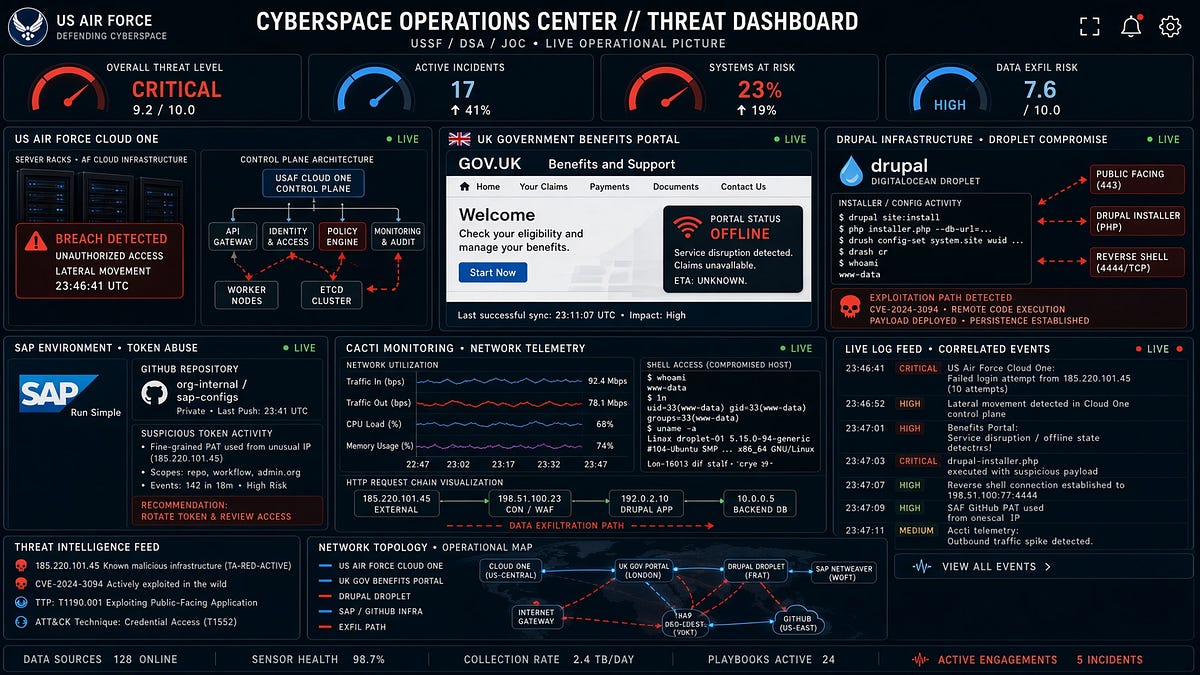
Reuters reported exclusively on November 27 that hackers breached Cloud One, the US Air Force’s flagship multi-cloud computing platform (drawing on resources from Microsoft, Amazon, Oracle, and Alphabet). The intrusion was discovered within the past month during a system upgrade. One source said the attackers exploited a software vulnerability to reach the control plane—the management layer that oversees the platform, likened by a source to a “universal remote.”
The discovery disrupted operations: migrations of back-office applications to Cloud One were paused, and updates to existing applications were blocked. US Cyber Command was brought in to assess the damage. Cloud One supports applications handling personnel data, logistics, maintenance, and other operational systems. Reuters could not confirm the attackers’ identity, the full scope of access, or whether data was stolen. The Air Force stated it does not on the security posture or operational status of specific systems.
This incident underscores the risks to large-scale military cloud environments, especially when control-plane access is obtained. Even without confirmed data exfiltration, the operational disruptions and potential visibility into tactical, personnel, or logistics information make it a high-priority concern. Organizations operating similar multi-cloud setups should review control-plane exposure, vulnerability management during upgrades, and incident response readiness involving national cyber forces.
UK Department for Work and Pensions Takes Services Offline After Cyber Incident
The UK’s Department for Work and Pensions (DWP) took multiple online services offline on November 27 as a precaution after identifying a cyber incident. Affected systems included those for state pensions, Universal Credit, Personal Independence Payment (PIP) applications, and the “Tell Us Once” service used to notify government of a death. Regular benefit and pension payments continued unaffected.
The DWP is working with the National Cyber Security Centre and the Government Cyber Coordination Centre to investigate and restore services. Officials detected suspicious activity and acted to limit potential further impact; the precise nature of the incident (and whether personal data was accessed) has not been confirmed. Public messaging emphasized that the department will never request bank details or ask users to click links.
This precautionary outage highlights the tension between availability and security for critical public services that millions rely on daily. Rapid isolation can contain incidents, but it also creates immediate operational and public communication challenges. Similar government digital services should ensure robust detection, clear contingency plans for payment continuity, and transparent user guidance during disruptions.
Drupal Warns of Second Exploited Installer Flaw Enabling Site Takeover
Drupal disclosed CVE-2026-136716 (SA-CORE-2026-019), a highly critical access-bypass vulnerability (rated 21/25) that allows site takeover on certain installations. It is a follow-up to the earlier Fail2Install issue (CVE-2026-132165), which was patched on November 18 and quickly exploited. The new flaw affects sites left in unusual or incomplete install states—including some production sites—where the vulnerable condition is not visible in the admin interface. Attackers are already exploiting it in the wild.
Sites that previously secured the installer ( install.php ) are not affected. Fixed versions are Drupal 11.4.14, 11.3.23, and 10.6.23; an update hook must be run after upgrading. End-of-life branches receive no fixes. Admins should also verify the site-owner (user 1) email, review logs for unexpected account changes, and consider blocking installer access via web-server configuration if immediate patching is not possible.
The rapid sequence of related installer flaws and active exploitation illustrates how residual attack surface can persist after an initial patch. Drupal operators should treat installer exposure as a permanent hardening priority and monitor for signs of prior compromise even after updating.
SAP Confirms Security Incident Involving Suspicious GitHub Activity
SAP confirmed a security incident after detecting suspicious activity in its IT environment, specifically involving GitHub. According to reporting based on an internal memo (tracked internally as “Project Granite”), attackers may have used stolen employee authentication tokens to copy and modify source code. Der Spiegel and other outlets noted possible involvement of AI tools. SAP stated it took urgent protective measures and that its investigation has so far found no evidence of unauthorized access to customer business data.
The company declined to provide further details on affected environments or recommended actions for customers pulling code or updates from its repositories. The incident coincides with broader warnings from German and other European agencies agentic AI tools accelerating cyberattacks.
Supply-chain and developer-platform incidents like this reinforce the need for strong token hygiene, least-privilege access on code repositories, monitoring of automated workflows, and rapid key rotation. Even when customer data is not confirmed compromised, source-code exposure can create long-term risk for downstream users.
Unpatched Cacti Zero-Day Enables Unauthenticated RCE in Four HTTP Requests
A newly disclosed zero-day in the open-source network monitoring tool Cacti (tracked as 4HTTP2SHELL / 4HTTP2ROOT) allows unauthenticated remote code execution when guest access is enabled. Researcher ek0ms savi0r published a proof-of-concept showing that four HTTP requests against Cacti Core 1.2.31 can achieve command execution: a guest session writes an unsanitized value into a setting, which is later used in a SQL LIMIT clause (second-order SQL injection), and the realtime poller is then triggered to execute a modified command via popen() .
No CVE has been assigned yet and no official patch is available. The attack requires only the default guest surface and works against the latest release under the right configuration. Commands run with the privileges of the Cacti process; root was demonstrated in lab conditions where the process already ran as root. Exposure is limited to instances with guest access enabled and reachable web interfaces. Administrators should disable guest access, restrict network exposure, and monitor poller entries for unexpected commands while awaiting a fix.
This is a classic example of chained application logic flaws in widely deployed monitoring software creating an unauthenticated path to code execution. Network monitoring systems often hold credentials for managed devices, so a compromise can serve as a pivot point.
These stories collectively highlight active exploitation of known and zero-day flaws, high-profile organizational incidents (military, government, enterprise software, and international bodies), and the accelerating role of AI in both offense and discovery. Prioritize patching exposed systems, reviewing control-plane and installer access, and validating incident-response playbooks.
