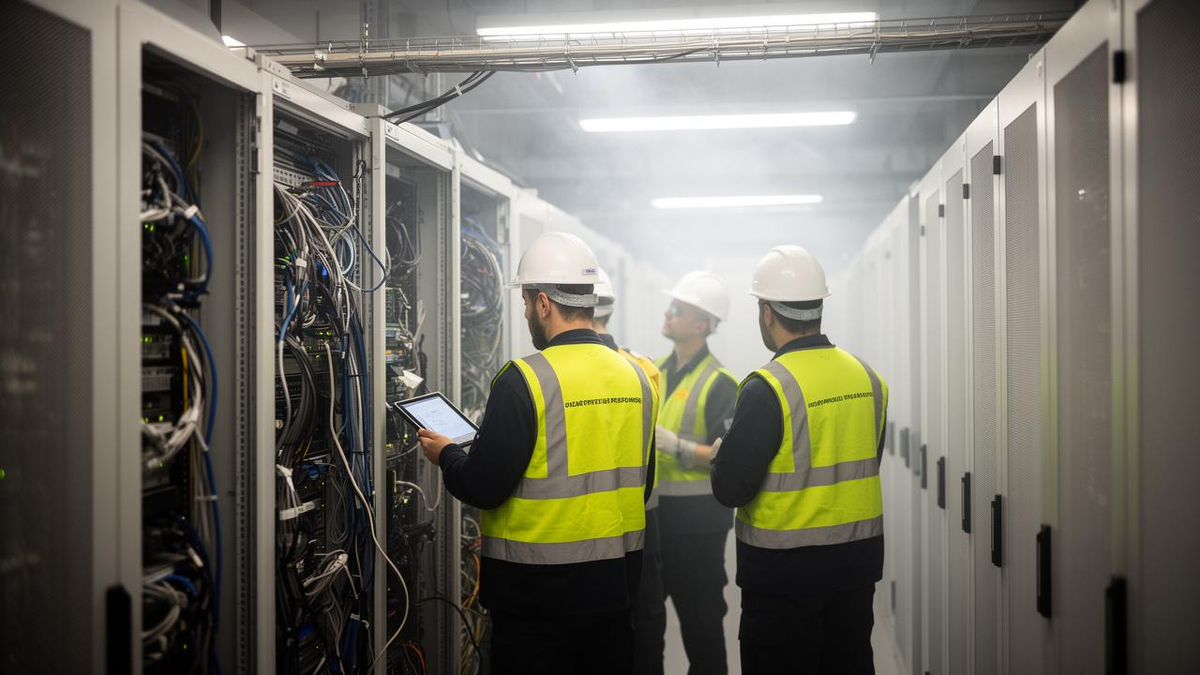
South Korea's Financial Services Commission (FSC) has conducted a joint response drill simulating a complex disaster in which a large sinkhole and a distributed denial-of-service (DDoS) attack combine to paralyze the securities market's data infrastructure. With the spread of artificial intelligence (AI) raising the financial sector's dependence on computer systems, the South Korean authorities put the "zero outage" goal of preventing a full service shutdown front and center.
The FSC said on Oct. 29 that it held the "2026 Safe Korea Exercise for the Financial Sector" at the Korea Exchange's Seoul headquarters in Yeouido and reviewed its response system together with financial-related institutions. FSC Chairman Lee Eok-won said at the event that "with the financial sector's digital transformation and the rapid spread of AI, the safety and service continuity of financial data infrastructure have become more important than ever."
Eleven institutions took part, including the FSC as organizer, the Korea Exchange, the Financial Supervisory Service, the Financial Security Institute, the Korea Development Bank, the Industrial Bank of Korea, the Korea Securities Depository, the Korea Financial Telecommunications & Clearings Institute, Koscom, the Yeongdeungpo Fire Station and the Yeongdeungpo Police Station.
The scenario was built around overlapping disasters rather than a single incident. A large sinkhole near Yeouido damages power and telecommunications facilities, a fire in outdoor air-conditioning units degrades the data center's cooling capacity, and a DDoS attack hits at the same time, causing some systems at the exchange's data center to go down.
The FSC and the exchange, together with the fire station and other agencies, practiced on-site response including disaster detection and notification, evacuation and rescue, and suppression of the outdoor-unit fire. They then ran a discussion-based exercise assuming that a DDoS attack overlaps with the partial loss of data-center functions as the sinkhole expands.
The FSC chairman personally chaired a meeting of the central accident response headquarters and reviewed the procedure for switching to an alternative site when data-center functions are damaged. He comprehensively checked whether service continuity is actually secured through the sequence of failing over to the Busan disaster recovery center, restoring normal securities-market operations and recovering the Seoul data center.
He noted that an accident at a data center — the heart of financial infrastructure — can paralyze people's daily lives and trigger turmoil in financial markets, imposing large social costs if not thoroughly prevented and responded to. "Finance operates on public trust," he said, stressing that "even a single outage damages trust, and trust once lost is not easy to restore." He added that "we must thoroughly inspect and prevent all possible risks in advance and respond swiftly when a crisis occurs, so as to achieve 'zero outage,' in which financial services never stop under any circumstances."
Korea Exchange Chairman Jeong Eun-bo said the drill was "an important occasion to check whether our response system actually works in a complex-disaster situation in the financial market," and pledged efforts to ensure the stable operation of the securities and derivatives markets.
Note: The drill results will be reflected in the "National Critical Infrastructure Paralysis Disaster Crisis Management Manual."
The FSC plans to incorporate the drill's results into the national critical infrastructure paralysis disaster crisis management manual and strengthen its capacity to assess risks at major financial systems and facilities. Because revising the manual means setting out in writing each institution's division of roles and recovery priorities when an accident occurs, the effectiveness of the follow-up measures is expected to be the yardstick for judging the drill's success.
Behind the attention on the drill is the financial sector's rapidly rising dependence on computer systems. In a structure where trade execution, settlement, custody and fund transfers all run through networks, the failure of just one of power, telecommunications or cooling can halt the entire market. On top of that, the spread of AI-based services is increasing the data and traffic that must be processed, enlarging the potential damage when external attacks and physical disasters coincide.
For market participants, the key issue is recovery time. If the exchange's data center goes down, trade execution stops and settlement schedules and derivatives expiry management are disrupted. Analysts say the crux is whether failover to the Busan disaster recovery center can actually be completed within hours and whether trading-data integrity is maintained during the switch. Since the authorities have said they will reflect the drill results in the manual, recovery target times by institution and mock-drill schedules are likely to be fleshed out going forward.
The full story
This article is one source in a clustered incident — the cluster page carries the summary, timeline and every other outlet covering it.
