 Back Debuglies
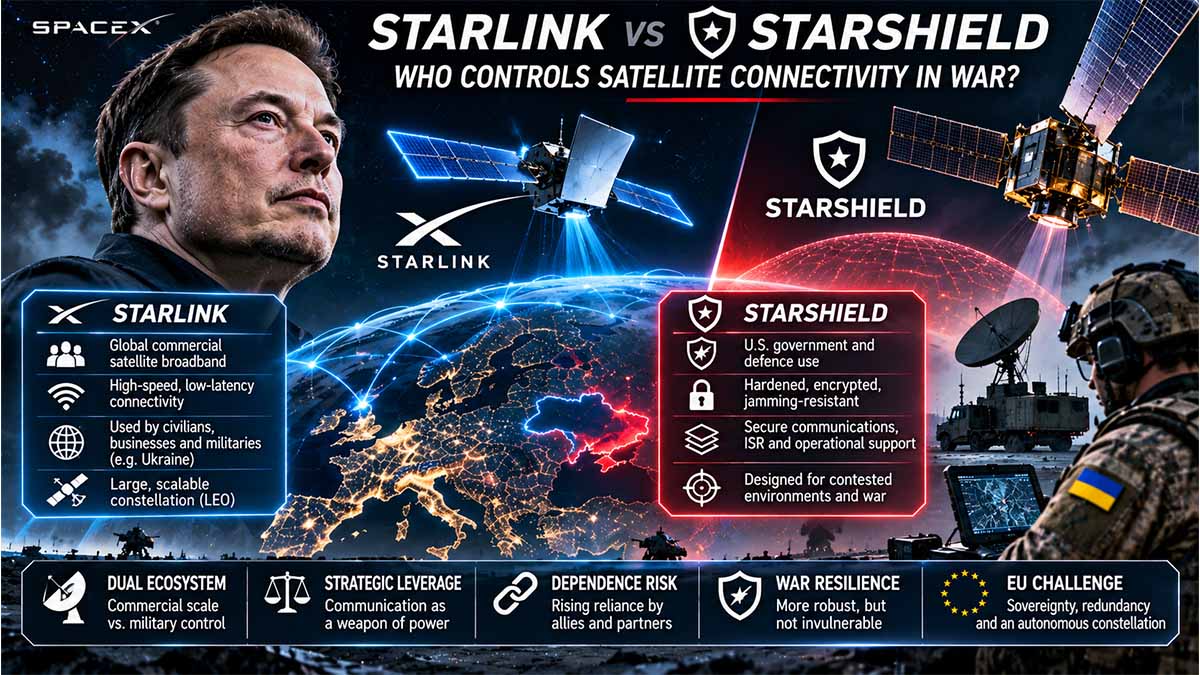
Starlink vs Starshield: Who Controls Satellite Connectivity in War? - https://debuglies.com
Strategic control, military command authority, commercial sovereignty and the emerging power to authorize or deny satellite connectivity in contested environments
Geographic scope: Ukraine, United States, Russia and relevant allied theatres, with separate European security implications. Period examined: February 2022–7 November 2026. Assessment horizon: 2027–2031.
Executive Summary — Bottom Line Up Front
The decisive distinction between Starlink and Starshield is not simply commercial versus military technology. It is the allocation of authority over network access, operational restrictions and continuity of service.
The verified record establishes that SpaceX retains substantial technical capability to implement network restrictions, while governments can exercise authorization and mission authority through regulatory processes, contracts and operational agreements. Neither ordinary terminal ownership nor military command of a connected unit automatically establishes control of the underlying satellite network.
Ukraine provides the most consequential documented example. On 4 February 2026, Starlink implemented restrictions requiring Ukrainian government approval for terminals operating within Ukraine. By 5 February, Ukrainian authorities reported that unauthorized Russian terminals had been blocked while approved terminals remained operational. In October 2026, Ukrainian authorities separately documented speed-related restrictions affecting Starlink/Starshield and their subsequent removal.
These incidents demonstrate two complementary realities: commercial infrastructure can enforce exclusion decisions with military consequences, and governments can exercise substantial influence over such decisions without owning the constellation.
The principal risk for national security authorities is therefore dependency without assured control: a military organization may possess communications terminals, purchase subscriptions and direct missions while relying on another actor to maintain operational connectivity.
Overall assessment: High confidence in the existence of distributed governmental and provider control; moderate confidence concerning the precise allocation of operational authority under non-public Starshield arrangements.
The decisive question in modern warfare is no longer simply who owns the satellites, but who has the authority to keep military communications operating when governments and technology providers disagree. Ukraine’s February 2026 restrictions on Starlink terminals exposed a structural contradiction at the centre of Western defence policy: armed forces can command their operations, purchase communications equipment and finance connectivity without independently controlling access to the network. SpaceX’s Starlink and government-oriented Starshield services occupy different contractual positions, but neither product designation alone establishes sovereign control. The consequences extend beyond the Ukrainian battlefield to American defence procurement, European industrial autonomy and NATO interoperability. For governments investing billions in satellite infrastructure, the critical distinction is between buying connectivity and securing legally enforceable, technically executable rights to maintain it during conflict.
1. Ukraine demonstrated that access can be denied without destroying a satellite
On 4 February 2026 , Starlink confirmed that terminals operating in Ukraine required authorization through a Ukrainian government whitelist. The measure followed a decision announced by Ukraine’s Ministry of Defence on 2 February to counter unauthorized Russian employment of Starlink equipment, including terminals reportedly installed on unmanned aerial systems. By 5 February, Ukrainian authorities reported that Russian terminals had been blocked while approved Ukrainian equipment remained operational.
The institutional significance exceeded the immediate military objective. Ukraine determined which terminals were authorized, while SpaceX implemented the restriction through its network. The government exercised authority over eligibility without acquiring ownership of the constellation or independent control of its technical administration. SpaceX retained responsibility for enforcing the decision without thereby acquiring authority over Ukrainian military operations.
The mechanism also exposed a vulnerability for legitimate users. Ukrainian authorities initially operated daily whitelist updates and warned that registration could take up to 48 hours to become effective. Personally owned military terminals could remain outside government property inventories while still requiring official authorization. Physical possession, subscription payment and permission to receive service had become separate conditions.
The system demonstrated selective exclusion, but the public record does not establish the total number of Russian terminals disconnected or the aggregate battlefield effect. The distinction matters: an officially reported successful restriction is not equivalent to an independently measured collapse in adversary communications.
A second episode reinforced the operational significance of provider-administered settings. On 24 October 2026 , Ukraine’s Ministry of Defence reported restored Starlink and Starshield connectivity at movement speeds exceeding 400 kilometres per hour , following earlier restrictions. The figure described terminal movement, not data-transfer capacity. The ministry did not publicly identify who had originally ordered the restrictions.
Together, the two developments established a consequential reality: satellite networks can remain physically intact while administrative authorization and operating parameters determine whether particular military applications remain usable.
2. The $13 billion procurement ceiling is not $13 billion of sovereign capability
SpaceX’s distinction between Starlink and Starshield is substantive. Commercial Starlink services operate under published acceptable-use restrictions, including limitations affecting military activities and remotely operated unmanned vehicles unless specifically authorized. Starshield targets government national security requirements across communications, Earth observation and hosted payloads , with additional security capabilities advertised by the company.
Yet the description of a service as government-focused does not establish that the purchasing government controls spacecraft operations, terminal admission, geographic restrictions or emergency restoration. Those rights depend on the particular agreement.
The financial architecture of American procurement demonstrates the scale of the policy shift and the limits of interpreting headline figures. In July 2023 , Space Systems Command awarded proliferated low-Earth-orbit service framework contracts to 16 companies , initially establishing an aggregate ceiling of $900 million . By 2025, the framework had expanded to 20 vendors and an aggregate ceiling of $13 billion .
That amount represents potential purchasing authority across multiple suppliers, not expenditure already incurred, money transferred to SpaceX or operational Starshield capacity delivered to the armed forces.
The distinction is equally important in Ukraine. On 29 August 2025 , the United States Defense Security Cooperation Agency announced approval of a possible $150 million Foreign Military Sale covering satellite communications services and associated support, with Starlink Services identified as the principal contractor. The notification did not establish that the entire amount had been spent or that the proposed services had been fully delivered.
Poland provided another financing channel. In January 2025, its Ministry of Digital Affairs announced 5,000 additional Starlink terminals , with the first 2,600 expected toward the end of that month, alongside a prospective agreement of approximately PLN 113 million for continued subscription support through September 2025.
These figures describe different financial instruments: American multivendor procurement authority, a proposed defence sale and Polish equipment and subscription financing. They cannot be aggregated as a single spending program. More importantly, none independently establishes who can authorize a terminal, reverse a restriction or compel restoration during combat.
The economic question is therefore not merely the price of satellite connectivity. It is the cost of obtaining continuity rights, technical integration and alternative services capable of sustaining military operations when one network becomes unavailable.
3. Military command and network control operate under different authorities
The central institutional contradiction is that a military commander can possess lawful authority over a mission without controlling the infrastructure carrying its communications. A commercial network operator can administer access, implement technical restrictions and maintain the system while remaining outside the military chain of command.
The United States Government Accountability Office’s March 2025 satellite communications assessment described the Department of Defense’s transition toward an integrated architecture combining military-owned and commercial capabilities. Its findings identified interoperability, acquisition oversight and organizational coordination as continuing challenges.
The Department’s procurement structure already separates important functions. The Commercial Satellite Communications Office purchases commercial services, military organizations establish operational requirements and manage relevant equipment, while other defence institutions perform acquisition, integration and space-operation responsibilities. The existence of these institutions does not automatically produce one authority capable of resolving every urgent network decision.
Commercial dependence consequently has several dimensions. A government may hold a valid contract but depend on a provider to execute an emergency change. It may own terminals but require separate geographic authorization. It may protect its information through government-controlled encryption while relying on external infrastructure for transmission. It may have legal remedies for service interruption that arrive after the relevant military operation has ended.
The American response reflects this problem. The United States Space Force Commercial Space Strategy of April 2024 established balance, interoperability, resilience and responsible conduct as organizing principles. Its objective was not the unconditional replacement of military networks with commercial systems, but the integration of different capabilities without creating excessive dependence on one solution.
The Commercial Augmentation Space Reserve was intended to prepare additional commercial capacity for emergencies. However, the GAO reported in March 2025 that the relevant office had not yet concluded commercial satellite communications contracts under that initiative at the time of its audit.
The distinction between a reserve framework and usable reserve capacity is decisive. Contracting authority does not automatically generate terminals, compatible security systems, available bandwidth or trained operators.
4. Europe is acquiring legal sovereignty faster than operational independence
The European response differs because it increasingly seeks to establish governmental rights through legislation, ownership and dedicated infrastructure.
Regulation (EU) 2023/588 established the Union Secure Connectivity Programme, distinguishing governmental infrastructure from commercial infrastructure. Its provisions assign the European Union ownership of defined governmental assets, establish relevant service-priority rights and require participating authorities to manage governmental user authorization.
This is a stronger legal foundation for public control than an ordinary commercial satellite subscription. It is not, however, proof that the corresponding infrastructure is already available to military users.
The European Commission reported that initial GOVSATCOM services became operational in January 2026 , pooling governmental satellite capacity through an institutional framework involving the Commission and the European Union Agency for the Space Programme.
The larger IRIS² program remains a different proposition. Following an implementation agreement announced on 7 August 2026 , its planned principal constellation increased to 348 satellites: 330 in low Earth orbit and 18 in medium Earth orbit . Initial launches were targeted for 2029 , while projected secure governmental capacity increased by 60% within the European Union and 54% worldwide relative to the earlier design.
Those percentages are projected improvements, not measured capacity delivered to European armed forces in 2026. A legal entitlement to a future communications service cannot replace an existing military link until the required infrastructure, terminals, security systems and operating procedures are deployed and tested.
The industrial implications differ across Europe. Italy’s participation through companies including Telespazio creates opportunities in the secure-connectivity supply chain, but industrial participation does not itself confer independent national control over European orbital infrastructure. France benefits from Eutelsat’s role in the SpaceRISE consortium, while Germany participates through industrial and telecommunications companies including OHB and Deutsche Telekom. In each case, manufacturing or service integration must be distinguished from sovereign authorization and operational command.
The United Kingdom follows a more diversified model. Its SKYNET 6 military satellite communications program involves more than £5 billion over ten years , combining dedicated military capabilities with contracted services. The existing SKYNET 5 architecture includes four satellites , while SKYNET 6A was scheduled, under the August 2025 program baseline, for launch in 2027 .
London also holds a 10.89% stake in Eutelsat , confirmed in January 2026, alongside special national security-related rights associated with OneWeb. Eutelsat completed a €1.5 billion capital increase in December 2025 .
These arrangements create several instruments of governmental influence: dedicated infrastructure, procurement rights, corporate participation and reserved security powers. They do not establish that Britain independently operates every component of the associated commercial networks.
For European governments, the strategic problem is therefore temporal as well as industrial. They must secure reliable connectivity through available commercial and allied infrastructure while financing systems intended to reduce future dependence.
5. The ability to restrict intelligence data is becoming another form of state power
The sovereignty question extends beyond broadband communications.
In its August 2026 report , the United States GAO documented an unidentified commercial Earth-observation company that restricted customer orders for imagery of the Middle East in February 2026 , citing protection of American military interests. In March, the company worked with the National Reconnaissance Office’s Commercial Systems Program Office to modify restrictions affecting access and publication.
The company was not identified as SpaceX. The case nevertheless demonstrates that commercial space capabilities can be constrained through information-access decisions even when satellites remain operational.
The same GAO report identified uncertainty over licensing, redistribution and long-term access to commercial space data. Between 27 January 2023 and 30 September 2025 , the Space Force purchased $123.9 million in services through the Global Data Marketplace. Of that amount, $76.8 million , approximately 62% , was attributable to the Joint Commercial Operations Cell. By July 2026, the marketplace contained 319 participating vendors .
These figures concern commercial space data and services, not Starshield communications spending. Their importance lies in the institutional dependence they reveal. A government may purchase intelligence data without automatically acquiring unrestricted rights to retain it, redistribute it among allies or use it indefinitely in artificial intelligence applications.
The implications for Starshield’s Earth-observation and hosted-payload offerings are substantial, although the public record does not establish the terms of individual contracts. The ability to collect, transport, process and disseminate information can be divided among different organizations. A government may control the mission while lacking unrestricted rights over every supporting data product or processing service.
Consequently, communications sovereignty and intelligence sovereignty must be assessed together. Securing the transmission channel does not resolve the legal or operational restrictions governing the information carried through it.
6. Over the 24 months, dependency will become a procurement liability
Between November 2026 and November 2028 , the immediate burden will fall on defence ministries, contracting authorities and military communications commands that must guarantee operational continuity before new sovereign infrastructure becomes available.
The alternatives are not equivalent. Governments can renegotiate service terms, establish emergency authorization procedures and conduct interoperability exercises without constructing new constellations. Deploying independent space infrastructure requires substantially greater capital commitments and longer implementation schedules. The European timetable for IRIS², with first launches targeted for 2029, makes that distinction unavoidable.
Three risks will shape the procurement cycle: selective denial of otherwise functioning terminals, changes in operating conditions affecting military applications, and the failure of nominally available backup networks to support actual missions. Cybersecurity adds another dependency, as recognized in the March 2022 CISA–FBI satellite communications advisory and subsequent American oversight findings.
The relevant standard is whether a government can identify the authority responsible for a restriction, enforce its contractual rights, obtain timely restoration and transfer essential traffic to an independent alternative. Purchasing additional terminals from the same provider may expand capacity without resolving any of those questions.
The fiscal cost of inaction will fall on governments forced into emergency procurement, duplicated integration work and unplanned continuity expenditure. The industrial cost will fall on defence manufacturers and telecommunications suppliers required to adapt equipment to competing architectures without predictable procurement requirements. The operational cost will fall on armed forces whose communications remain dependent on access decisions they cannot independently execute.
The strategic distinction between Starlink and Starshield is ultimately a distinction between the service a state purchases and the authority it actually secures. The 24 months will determine whether Western defence procurement converts commercial connectivity into enforceable military capability or continues financing networks whose availability is not fully aligned with sovereign command.
Pillar I — Architecture, Contracts and Operational Evidence
Chapter 1. Key Judgments Chapter 2. Technical and Contractual Overview Chapter 3. Case Study: Ukraine, 2022–2026
Pillar II — Sovereignty, Decision Rights and Strategic Competition
Chapter 4. Authority and Control Analysis Chapter 5. Strategic Implications Chapter 6. Analysis of Competing Hypotheses
Pillar III — Resilience, Escalation and Intelligence Priorities
Chapter 7. Resilience Requirements Chapter 8. Future Risks, Indicators and Warnings Chapter 9. Gaps and Collection Recommendations Chapter 10. Source Evaluation Appendix
The incorporation of commercially developed low-Earth-orbit satellite networks into military operations has created an authority structure that conventional military communications doctrine does not fully describe. A state may direct combat operations, authorize terminal deployment, purchase communications services and own its equipment without necessarily holding unilateral authority over satellite admission, traffic policies, software changes, geographic restrictions or service restoration. The reverse distinction is equally important: a company may operate the technical infrastructure without possessing legitimate authority to determine the objectives of a government’s military operations. In practice, control is distributed across the state conducting the mission, the telecommunications provider, the contracting authority, the licensing jurisdiction and, in some circumstances, allied governments that finance or sponsor connectivity.
Starlink and Starshield represent different contractual and security arrangements built on related SpaceX technologies. Starlink is primarily a commercial connectivity product, including government civil-service offerings, while Starshield is designed for national security requirements involving communications, Earth observation and hosted payloads. Public documentation does not establish that all Starshield services use entirely separate orbital infrastructure, that every government customer enjoys identical control rights, or that a military contract transfers full technical administration to the purchasing state. The evidence instead supports a variable-control model in which contractual mission authority and technical network operations must be evaluated separately.
The February 2026 Ukrainian terminal authorization system is particularly revealing because the government defined the authorization policy and SpaceX implemented service eligibility. The subsequent October 2026 restoration of speed-sensitive connectivity illustrates the consequences of operational restrictions and the importance of governmental negotiation. Taken together, these events establish that connectivity is not merely a delivered military capability: control of access is itself an instrument of strategic power. The central requirement for governments is consequently to transform provider dependence into enforceable, testable and operationally survivable arrangements rather than assume that service procurement confers sovereign control.
– KJ-1 — High confidence: Starlink and Starshield have different intended markets, security capabilities and contractual frameworks, but their technical relationship does not establish identical government control rights across all deployments.
– KJ-2 — High confidence: On commercial Starlink services, SpaceX retains consequential network-operating authority, including the technical ability to enforce access restrictions, geographic eligibility and service suspension under applicable agreements.
– KJ-3 — High confidence: The February 2026 Ukrainian verification system demonstrates an implemented form of dual control: Ukraine determined government authorization, while Starlink enforced terminal eligibility across its network.
– KJ-4 — Moderate confidence: Starshield arrangements can provide governments with substantially greater mission-specific contractual authority, although publicly available documents do not establish that every Starshield customer possesses unilateral network-operating authority.
– KJ-5 — High confidence: Military ownership or possession of a terminal, responsibility for its subscription and operational command of the connected military unit are insufficient, independently, to guarantee continued access to satellite services.
– KJ-6 — High confidence: The October 2026 Ukraine restrictions and restoration demonstrate that mobility-dependent satellite connectivity is sensitive to network policies and that governmental engagement can materially influence operational outcomes.
– KJ-7 — Moderate confidence: In a future regional conflict, selective denial, authorization disputes or changes in service parameters could disrupt military command-and-control functions before any physical satellite losses occur.
– KJ-8 — High confidence: Contractually defined decision rights, independently tested fallback communications and diversified network access are essential safeguards against concentration of operational dependency.
2. Technical and Contractual Overview
Starlink: commercial connectivity under provider-administered rules
Established fact. Starlink is SpaceX’s satellite broadband service, supplying communications through a network of satellites, user equipment and associated ground and network-management infrastructure. Although government organizations can purchase commercial Starlink services, SpaceX explicitly distinguishes civil-government uses from military applications and identifies Starshield as its product for United States national defence requirements.
Starlink’s government procurement guidance states that commercial priority services may be suitable for civil agencies but that ordinary Starlink offerings are not intended for military end-users or military end-uses. Its acceptable-use policy restricts military activity and the remote operation of aerial drones unless specifically permitted through an appropriate contractual arrangement. Its published service terms also provide for suspension or termination under specified circumstances, including legal requests, security problems, prohibited use and regulatory requirements.
The significance of these restrictions is not that every military use of Starlink is prohibited. The published language leaves room for separately authorized arrangements. The decisive issue is that ordinary commercial procurement does not, by itself, establish permission for unrestricted military operations.
Assessment — High confidence. Commercial Starlink customers generally obtain defined communications services rather than independent authority over network admission, geographic policies or provider infrastructure. Government customers must therefore distinguish equipment ownership from the rights actually granted under their agreements.
Starshield: a national security architecture with different mission requirements
SpaceX describes Starshield as a secured satellite network designed for government entities, drawing on Starlink’s technology and the company’s launch capabilities. Its announced scope comprises three mission categories.
Source: SpaceX — Starshield, Supporting National Security .
The company also advertises additional high-assurance cryptographic capabilities, modular satellite architecture and interoperability with laser-linked space networks. These are provider-declared capabilities and design features; the public material is insufficient to establish the exact classification accreditation, cryptographic architecture or configuration of each deployed government system.
A further distinction is important. Starshield should not automatically be understood as one physically isolated satellite constellation through which all military traffic is carried. The program describes multiple offerings, including communications services and spacecraft or payload capabilities. Different government contracts may purchase different elements, with differing network-operating and mission-control arrangements.
Assessment — Moderate confidence. Starshield’s government-oriented design permits more extensive national security integration than commercial Starlink, but the degree of sovereign control depends on the particular service, equipment, contract and operational command arrangements.
Procurement does not equal operational sovereignty
The distinction is reflected in the broader American acquisition model. The United States Government Accountability Office (GAO) reported in March 2025 that the Department of Defense uses both military-owned satellite communications systems and commercially procured services. The report describes a continuing effort to integrate these capabilities into hybrid architectures, while highlighting difficulties associated with interoperability, terminals, management systems and implementation progress.
A particularly significant distinction in the GAO analysis is that purchasing commercially developed satellites for government ownership can offer different rights from leasing satellite communications as a service. Government ownership may eliminate some usage restrictions associated with commercial capacity, although ownership alone does not resolve all operational dependencies. – GAO — DOD Satellite Communications: Reporting on Progress Needed to Provide Insight on New Approach — March 2025 . Gao Files
The United States Space Force’s Commercial Satellite Communications Office procurement mechanisms likewise provide a means of purchasing commercial and government-tailored connectivity. SpaceX identifies the Proliferated Low-Earth-Orbit contracting framework as a principal procurement route for Starshield communications services.
Assessment — High confidence. National security communications procurement must be evaluated against the rights conveyed by a specific contract, not the provider’s description of the product as commercial, military, secure or assured.
Operational control points
The following table separates authority that can be attributed from the published record from authority whose exact allocation depends on a non-public arrangement.
This distinction leads to a general finding: government mission authority can coexist with contractor-operated network infrastructure. Government users may possess the authority to decide what information must be transmitted, or which operation should be supported, without themselves administering the physical network through which the information travels.
Key official evidence
3. Case Study: Ukraine
2022–2025: the formation of strategic dependency
Ukraine’s experience began as an emergency communications problem and evolved into a question of state authority over essential wartime infrastructure.
Following Russia’s February 2022 full-scale invasion, Starlink provided an important means of maintaining connectivity when terrestrial infrastructure was damaged, disrupted or threatened. Ukrainian authorities subsequently integrated satellite services into civilian communications, governmental continuity and military operations.
The Ukrainian government’s February 2026 retrospective explicitly credited SpaceX’s early activation and delivery of terminals with supporting civilian communications, military coordination and emergency services. This is an official Ukrainian assessment of Starlink’s contribution, not a quantified measure of its of military traffic.
Digital State Ukraine — Ukraine Is Securing Starlink Access: Unauthorised Russian Terminals Are Being Cut Off — February 2026 .
The financing structure demonstrates how many actors can become involved in maintaining access to one provider’s network.
In January 2025, Poland’s Ministry of Digital Affairs discussed support for an additional 5,000 Starlink terminals and a proposed agreement valued at almost PLN 113 million to continue subscription financing through 30 September 2025. A subsequent Polish ministry statement confirmed Poland’s undertaking to cover subscriptions for terminals loaned to Ukraine during 2022–2024 and finance the additional 5,000 terminals then being delivered.
These figures concern identified Polish support commitments and do not represent the total cost of Ukrainian Starlink operations or the total value of all international satellite communications assistance. – Sources: Polish Ministry of Digital Affairs — Polish-Ukrainian Cooperation on Satellite Communications — January 2025 and Polish Ministry of Digital Affairs — Strengthening Digital Cooperation — 2025 .
The strategic implication is that paying for terminals, funding subscriptions, owning terminal hardware and controlling the network are four different functions.
Assessment — High confidence. The Ukrainian model developed into a multilateral dependency involving Ukraine as operational user, allied governments as equipment or subscription sponsors, and SpaceX as the essential provider of network connectivity.
February 2026: a change in the access-control regime
The most decisive documented event occurred between 1 and 5 February 2026.
On 1 February, the Ukrainian Ministry of Defence announced work with Starlink to establish a system allowing only authorized terminals to operate within Ukraine.
On 2 February, the ministry reported that the Cabinet of Ministers had adopted the relevant resolution establishing a whitelist. According to the ministry, the immediate security problem was the use of Starlink terminals by Russian forces, including terminals mounted on drones.
On 4 February, Starlink’s own published service notice made Ukrainian government whitelist approval a condition of operating a terminal within Ukraine.
The sequence is supported by both the Ukrainian government’s implementation notices and SpaceX’s directly published restriction notice. – Ukrainian Ministry of Defence — Ukraine and Starlink to Roll Out Terminal Authorization System — 1 February 2026 . – Ukrainian Ministry of Defence — Ukraine Rolls Out Starlink Terminal Verification — 2 February 2026 . – Starlink — Update on Starlink Service in Ukraine — 4 February 2026 . – Ukrainian Ministry of Defence — Starlink Terminals on the Whitelist Remain Operational — 5 February 2026 .
How the verification system worked
The Ukrainian procedure introduced a distinction between governmental authorization and technical enforcement.
Military users were instructed to submit terminal information through the DELTA system or other designated military channels. Civilian users were directed toward Administrative Service Centers, while businesses were assigned an online verification route through Diia.
The registration process relied on terminal-identifying information, including equipment or user terminal identifiers. Importantly, Ukrainian military personnel were told that personally owned terminals did not need to be transferred onto military unit balance sheets and that account credentials did not have to be supplied merely to complete military whitelist registration.
The procedure also introduced an important operational limitation: the whitelist initially operated through batch updates, with the ministry communicating a processing period of up to 48 hours for certain registrations. The ministry acknowledged that a terminal could remain blocked after its information had been submitted, pending processing. – Ukrainian Ministry of Defence — Countering Russian Drones: How to Complete Starlink Verification — 2 February 2026 . – Ukrainian Ministry of Defence — Commanders Urged to Verify Starlink Terminals — 4 February 2026 . – Ukrainian Ministry of Defence — Frequently Asked Questions on Starlink Verification — 5 February 2026 .
This is a consequential distinction. The government could decide whether a terminal was eligible without necessarily owning the equipment, knowing its account credentials or directly operating the satellite network. Conversely, a physically functional terminal could lose connectivity because it lacked the required authorization.
Starlink’s published support guidance explicitly attributes authorization decisions in Ukraine to the Ukrainian government and describes Starlink as the actor implementing them. – Starlink — Why Has My Starlink Service Been Restricted or Disabled in Ukraine? .
Assessment — High confidence. The February system demonstrates practical separation between an authorization authority and a network enforcement authority, with neither function independently sufficient to explain continued access.
What the blocking of Russian terminals establishes
The Ukrainian government reported that unauthorized terminals, including those used by Russian forces in occupied territory, were disconnected. The provider’s own policy confirms that terminals without government authorization cannot receive service in Ukraine.
The results support three findings.
First, terminals can be subject to a network-enforced eligibility regime that is distinguishable from their physical possession.
Second, a government and provider can coordinate selective access policies across a contested territory, even when unauthorized users have obtained the underlying equipment.
Third, the same mechanism that excludes an adversary creates a dependency for friendly users: an approved terminal must remain correctly registered and subject to effective enforcement to receive service.
However, the publicly accessible official evidence does not establish the exact number of Russian-operated terminals disabled, the completeness of the blocking measure, the internal SpaceX commands used, or the proportion of Russian battlefield communications affected.
The Ukrainian government’s operational claims establish its reported outcome. They do not independently prove a comprehensive denial of all Russian satellite connectivity.
Assessment — High confidence that the authorization regime blocked at least a reported class of unauthorized Russian users; moderate confidence regarding the scale and enduring operational effects.
October 2026: mobility restrictions and subsequent restoration
A second, distinct development occurred in October 2026.
On 24 October, the Ukrainian Ministry of Defence announced that its monitoring systems were recording restored Starlink/Starshield connectivity at movement speeds exceeding 400 kilometres per hour, following earlier operational restrictions. It attributed the result to high-level engagement and emphasized the importance of satellite communications for drones, logistics and battlefield communications. Ukrainian Ministry of Defence — Starlink and Starshield Speed Restored in Ukraine — 24 October 2026 . MoD News
This reported figure is a terminal movement speed, not a broadband transmission rate. It must not be interpreted as 400 Mbps of network capacity.
The announcement is significant because it identifies a service parameter affecting moving platforms rather than merely ordinary fixed-terminal subscription eligibility. In mobility-dependent military systems, restrictions tied to movement can have operational consequences even if some stationary or slower-moving links remain available.
The announcement does not publicly establish who initially ordered the restriction, whether it arose from a unilateral provider decision, a government instruction, a contractual interpretation or a security safeguard. Nor does it establish that the same mechanism affected every Starlink and Starshield configuration.
Assessment — High confidence that restrictions and restoration occurred as officially reported; low confidence in any attribution of the initial decision to a particular actor without additional documentary evidence.
The October episode strengthens the overall conclusion: in contested environments, the capacity to adjust network operating conditions can be militarily consequential without any satellite being physically destroyed.
4. Authority and Control Analysis
Military mission authority
Military mission authority concerns the lawful power to define operational objectives, deploy forces, authorize activities, allocate military resources and determine how communications support a mission.
A military commander may legitimately direct the movement of a drone, the transmission of intelligence, the establishment of a command post or the exchange of operational information. Such authority arises from military command arrangements and applicable national and international law.
It does not automatically include the right to compel an external commercial company to maintain a particular telecommunications service under all circumstances.
The distinction is especially important when a military organization purchases commercial communications capacity. It may command every connected soldier and own every deployed terminal without exercising technical administration over satellite admission or the commercial network’s operating policies.
Assessment — High confidence. Military mission authority and satellite network-operating authority are legally and functionally distinct, even when the communications service is indispensable to the operation.
Network operating authority
Network operating authority concerns the practical ability to administer the communications system itself. Relevant control functions include authorization and deauthorization of terminals, enforcement of geographic restrictions, management of network service parameters, maintenance of network infrastructure, security updates and restoration of disrupted access.
The precise division of these functions is architecture-specific. A government-operated satellite system may allocate them to military personnel, while a service purchased from a commercial constellation may leave substantial technical functions with the provider.
The GAO’s March 2025 examination of American satellite communications identifies the continuing importance of integrating commercial and military systems, including the management architecture needed to connect multiple services. – GAO — DOD Satellite Communications — March 2025 .
Assessment — High confidence. The actor capable of implementing or reversing a service restriction possesses a form of operational leverage that cannot be inferred solely from equipment ownership, network encryption or mission command.
The role of the provider
The provider occupies a dual position. It is a commercial contracting party, but it is also the technical organization responsible for delivering services through infrastructure that may have become essential to military operations.
Three categories of provider control must be distinguished.
Contractual control arises from service conditions and contractual provisions governing acceptable use, permitted customers, suspension, performance and termination.
Technical control arises from administering the infrastructure and software through which access is delivered or restricted.
Institutional influence arises from the practical difficulty of replacing the service, the provider’s knowledge of its network and the contracting government’s dependence on the provider’s implementation capabilities.
These categories do not necessarily give the provider a legitimate right to select military objectives. Nor do they establish that a provider can disregard binding government contracts or applicable law. They identify different sources of influence over whether the military can receive the communications service it needs.
The role of host governments and contracting governments
The February Ukrainian system shows that the territorial government can become a significant actor in determining which users receive service. Ukraine established an authorization framework, and SpaceX enforced its consequences through network access controls.
A separate question concerns the government that contracts for, funds or legally regulates a service. In this case, the provider is a United States company subject to relevant American law, while Ukraine is the state conducting the military operations and foreign partners may finance some equipment or subscriptions.
These roles are not interchangeable. Territorial authorization, export-control jurisdiction, procurement authority and military mission command can reside in different institutions.
The resulting control arrangement depends on whether these authorities are compatible and whether there are effective procedures for resolving disagreement.
Analytical conclusion — High confidence. Connectivity control is best understood as a collection of separately allocable decision rights, not a single property attached to the terminal, constellation or contracting government.
5. Strategic Implications
Connectivity as a military capability versus access as strategic power
A telecommunications network is conventionally evaluated according to coverage, capacity, latency, availability, security and resilience. In contested military environments, an additional measure is necessary: the degree to which the operating state can guarantee continued lawful access when its mission requirements become politically or commercially sensitive.
This introduces an important distinction between connectivity as capability and control of connectivity as strategic power.
Connectivity as capability allows military forces to exchange information, maintain distributed command and exploit remote sensors or connected platforms. Control of connectivity determines which actors may access that capability, under what conditions and for how long.
The February Ukrainian experience demonstrates the distinction directly. The physical satellite equipment did not need to be destroyed for unauthorized users to lose service. Access authorization was sufficient to determine whether particular terminals could continue operating.
The October episode demonstrates a related but different mechanism: operating parameters governing mobile connectivity can matter to military systems even when the underlying satellite network remains functional.
Assessment — High confidence. Access policies and network operating parameters constitute militarily relevant control points alongside physical satellites, terminals and terrestrial ground infrastructure.
From single-provider reliance to strategic vulnerability
Reliance on one commercial network can generate operational advantages, particularly when it supplies rapidly deployable connectivity across a broad area. However, the same concentration creates correlated exposure.
A service interruption can affect multiple military functions if those functions depend on the same provider, contractual authority or authorization database. A state may have redundant terminals but still lack meaningful network redundancy.
This risk is amplified when communications are used across both civilian and military infrastructure. Emergency services, civil administration, critical infrastructure operators and military units may compete for support or face overlapping consequences from network restrictions.
The appropriate measure of resilience is therefore not simply the number of terminals held by a government. It is the ability to continue the required mission when a network becomes unavailable, when government authorization systems fail, when service parameters change or when the provider cannot implement an urgent request.
The distinction between Starlink and Starshield as a security issue
A government-oriented network can reduce some risks associated with ordinary commercial terms by establishing mission-specific requirements, enhanced security mechanisms and contractual obligations.
However, additional security and contractual assurances should not be confused with an automatic transfer of technical control. A service may be encrypted to a government-approved standard while its physical transport and service-administration functions remain contractor-operated.
Likewise, government payload ownership does not automatically mean the government independently operates the communications links or spacecraft supporting that payload.
This distinction is particularly important for Starshield Earth-observation and hosted-payload missions, where collection authority, spacecraft operation, data handling and dissemination may be separately allocated.
Assessment — Moderate confidence. Government-tailored procurement can materially reduce uncertainty over mission permissions and priorities, but residual reliance on contractors and shared technological infrastructure will remain consequential unless expressly addressed in the operating architecture.
National and alliance implications
United States. The United States has the most direct institutional tools to shape relationships with an American provider, including procurement, national security contracting, industrial policy and applicable regulation. Nevertheless, access to these mechanisms does not prove government ownership or direct operation of every Starshield asset. The GAO has explicitly identified integration and governance challenges as the military expands its use of commercial satellite capabilities.
In August 2026, the GAO again emphasized the importance of contracts ensuring access to commercial space services during conflict and the integration of these capabilities into military exercises before emergencies occur. – GAO — National Security Space: DOD Has Opportunities to Improve Its Use of Commercial Data and Related Services — August 2026 . Gao Files
Ukraine. Ukraine demonstrates the effectiveness of government-provider cooperation but also the limits of external network dependence. The state secured a consequential role in authorizing terminals without acquiring the constellation. Its experience shows that such cooperation can be operationally valuable, while its October 2026 announcement establishes the importance of continuing high-level engagement over service restrictions.
Russia. The February 2026 case establishes that Russian forces had reportedly obtained and used Starlink terminals despite not being legitimate beneficiaries of the Ukrainian authorization regime. It also demonstrates that the subsequent restrictions were intended to deprive these forces of that access. The official public record does not establish the completeness of Russian alternatives or their performance following the restrictions.
Italy. The principal implication is the need to assess military and civil-prote...
The full story
This article is one source in a clustered incident — the cluster page carries the summary, timeline and every other outlet covering it.
