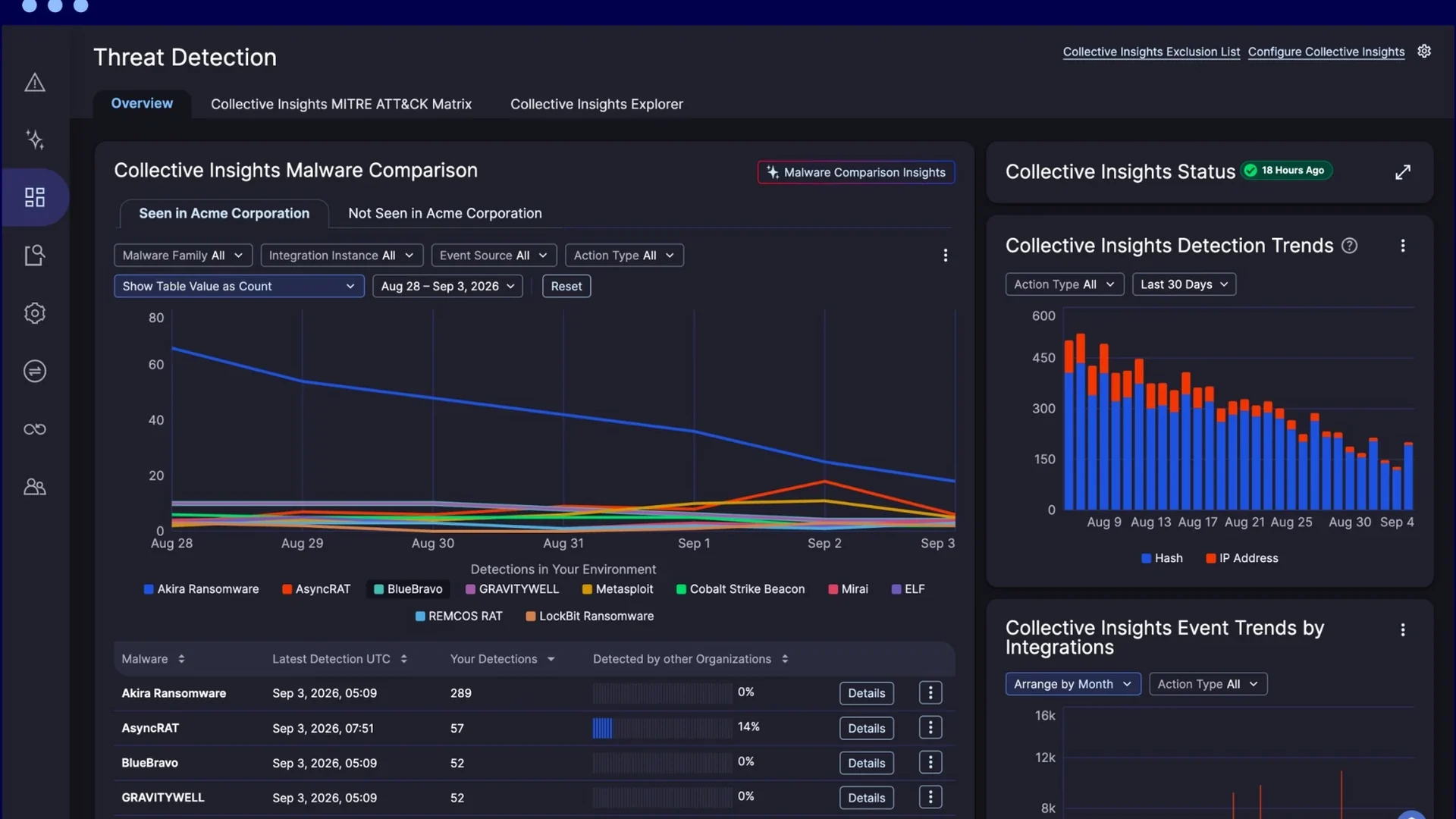
Threat intelligence platforms now sit in two price worlds. Four are commercial products sold by contract or bundle, and two are open-source projects you can install for nothing. Recorded Future’s AWS Marketplace listing describes four domains (Cyber Operations, Digital Risk Protection, Third-Party Risk and Payment Fraud) and says its price depends on contract duration and terms, which is the pattern across the paid side of this market.
The other three paid options fold intelligence into something bigger. Google sells Google Threat Intelligence, built on Mandiant, VirusTotal and Google’s own visibility. CrowdStrike lists threat intelligence and hunting inside its Falcon bundles. Microsoft has been merging Defender Threat Intelligence into Defender XDR and Sentinel. On the free side, MISP offers a 2.5.47 stable release plus a MISP 3.0 early-access build, while OpenCTI ships under Filigran with a Community Edition at no cost.
Picking among them has less to do with feed quality than with where your analysts already work. A team that lives in an endpoint protection platform console will weigh CrowdStrike or Microsoft differently from a four-person intelligence shop that needs one place to correlate indicators from sharing communities, vendor reports and its own incident data.
No independent lab scores these six head to head the way labs score endpoint products. Buyers lean on analyst reports, vendor-reported numbers and trials. The evidence you can collect from public pages stops at analyst placements, vendor claims and release notes, and that limit shapes everything below.
Don't miss new tech stories on Google
Add Shattered once in the Google app and our stories show up in your news suggestions.
What a Threat Intelligence Platform Does, and What It Does Not
A threat intelligence platform ingests indicators and reports from many sources, normalizes them into one data model, enriches them with context, scores them, and pushes the useful ones to the tools that block or alert. The word platform matters. A feed hands you a list of bad IP addresses. A platform lets an analyst ask which actor used that address, which campaigns it belongs to, whether it still matters, and which of your assets it touched.
Three product shapes hide under the same label. The first is the data service, where a vendor’s research team and collection network supply the intelligence and you consume it through a portal or API. Recorded Future and Google Threat Intelligence lean this way. The second is the capability inside a security suite, where intelligence enriches detections and investigations. CrowdStrike and Microsoft sell it like this. The third is the sharing and knowledge-management platform, where you bring the data and the software organizes it. MISP and OpenCTI belong here.
Those shapes answer different questions. A data service answers what is happening out there. A suite capability answers whether this alert connects to something known. A sharing platform answers what you and your partners know, and who needs to see it. Many mature teams run one of each, which is why the choice is rarely either-or.
A platform does not replace detection. The EDR and XDR products that watch endpoints and identities generate the alerts, and a platform makes those alerts easier to judge. Nor does it replace log analytics. If you still need a place to store and telemetry, the SIEM tools question stays open no matter which intelligence product you pick. Intelligence is context. It never contains an intrusion on its own.
Two open standards sit underneath nearly every serious platform. STIX describes threat objects such as indicators, actors, malware and campaigns. TAXII moves collections of those objects between servers. Support for both decides how easily you can swap a vendor later, feed a partner community, or pull data into a SIEM. The MISP project maintains a dedicated MISP-STIX library, and its November 2026 release aligned STIX 2.1 export with the standard’s deprecations.
Finally, a warning quality. More indicators do not mean better defense. Stale indicators create false positives, and false positives teach analysts to ignore the queue. The best platform is the one that expires, scores and contextualizes data so that your team trusts what survives. Every product below claims to do that. Only a trial in your own environment can show whether it does.
The Six Platforms Side by Side
The table uses only details confirmed on vendor or project pages fetched in the past days. Where a cell says not confirmed, the public sources we could reach did not settle the question, and you should ask the vendor.
Two patterns jump out. First, the standalone intelligence product is shrinking on the paid side. CrowdStrike and Microsoft no longer present intelligence as a clearly separate line item, while Recorded Future and Google keep it as the main event. Second, the two free projects ship often, though speed is not the same as polish.
The STIX row looks thin on purpose. Commercial vendors tend to document export formats in customer portals, and the public pages we reached did not state versions. That gap belongs on every proof-of-concept checklist.
Recorded Future: Packages, Integrations and a Mastercard Parent
Recorded Future is the pure-play name in this group, and its 2026 story is packaging. The company’s press material still describes it as Mastercard-owned. Its current pitch is organized around four solution areas: Cyber Operations, Digital Risk Protection, Third-Party Risk and Payment Fraud. Reporting from its own site and marketplace listings points to three platform packages named Core, Professional and Elite, and each one includes access to the Intelligence Graph, Recorded Future AI, compatible integrations, APIs and Collective Insights.
That is a change from the older module-by-module buying pattern. According to the company’s own description, the shift to solution and platform packages came in April 2026, and integrations are now described as included without separate integration fees. Treat both points as vendor statements to confirm in a quote. One extra cost is spelled out plainly: Customer Credential Monitoring is a paid add-on across all tiers.
The newest product news is practical rather than flashy. On Nov. 18, Recorded Future announced the Tech Stack Watch List Connector, which synchronizes a customer’s watch list of technologies with existing security tools. The announcement names Tenable Vulnerability Management and Recorded Future Attack Surface Intelligence as integrations, with Microsoft Defender XDR listed as coming soon. The connector costs nothing extra for customers holding the Vulnerability Intelligence Module, the Threat Intelligence Module or the Cyber Operations solution. For a vulnerability team, that is the useful kind of feature, because it turns a list of the products you run into a filtered view of the flaws attackers are exploiting.
Digital Risk Protection deserves a note of its own. The company says it launched in September as a unified offering for malicious-site, impersonation, code-repository, dark-web brand and identity-exposure monitoring, available standalone and inside the three packages. If your brand gets cloned in phishing kits, that scope overlaps with what email security vendors sell, so compare it against tools like those in our email security rankings before you pay twice for the same takedown workflow.
On the research side, Recorded Future’s own pages advertise several headline numbers. They include an average 468% ROI, access to 1.5 million new malware samples collected every day, and up to 95% less time spent creating detection signatures. These are marketing figures from the vendor, not audited results, and the ROI claim in particular depends on assumptions you cannot see. The company also reported findings from its 2027 State of Threat Intelligence survey, which covered 768 cybersecurity professionals at enterprises with at least 1,000 employees. Regional summaries followed on Nov. 19.
Where does it fit? Recorded Future suits organizations that want an external intelligence service with analyst-grade depth across vulnerabilities, brand abuse, third-party exposure and fraud, and that have a budget to match. It does not suit a team looking for a cheap indicator database. Reported list prices for its platform packages run well into six figures, a point the pricing section covers in detail.
Google Threat Intelligence: Mandiant, VirusTotal and Gemini Agents
Google Threat Intelligence combines three assets that were once separate: Mandiant’s incident-response research, VirusTotal’s file and URL corpus, and the visibility Google gets from running infrastructure at internet scale. Google’s own description frames the product as internet-scale visibility, frontline expertise and AI applied to external threat intelligence. The Google Threat Intelligence Group, usually shortened to GTIG, publishes the research that feeds it.
The recent direction is agentic. On Sept. 17, Google described specialized threat-intelligence agents that run multi-step investigations and malware analysis, backed by Mandiant, VirusTotal, Google-scale visibility and deep and dark-web monitoring. Earlier, in March 2026, it announced a dark web intelligence capability inside the product. On Nov. 4, Google said it was releasing updates aimed at helping organizations build and defend at machine speed in the agentic-AI era.
The strongest 2026 signal is analyst recognition. On Nov. 20, Google announced that Gartner named it a Leader in the 2026 Magic Quadrant for Cyberthreat Intelligence Technologies, citing the integration of Mandiant, VirusTotal, Google infrastructure visibility and Gemini. A Leader placement says the vendor scored well on Gartner’s vision and execution criteria. It does not say the product will fit your team’s workflow.
GTIG research also lands in the news cycle regularly, which matters if you value an intelligence provider for what its analysts publish. On Oct. 30, the group published research on ARTEX and other agentic offensive frameworks. On Nov. 16, GTIG and Mandiant reported that adversaries were operationalizing generative AI across cybercrime, espionage and information operations, compressing attack timelines and enabling multi-stage intrusions at machine speed. That tracks with what many incident-response teams report from the field.
Pricing is the opaque part. Google’s public pricing table reportedly names four subscription tiers (Standard, Enterprise, Enterprise Plus and OEM) without showing monetary prices, and describes a flat annual rate with a set number of API calls plus optional extra call packs. A third-party comparison dated Nov. 21 labels the Enterprise tiers as unconfirmed, so ask Google’s sales team for current plan names in writing. API-call limits deserve scrutiny because automated enrichment from a SIEM or SOAR playbook can burn through a quota faster than analysts expect.
Best fit: teams already running Google Security Operations or heavy on Google Cloud, plus incident-response-driven organizations that value Mandiant’s frontline view. If your estate leans on Google Cloud, the same buyers often compare it with the posture tools in our cloud security platform comparison. The trade-off is pricing opacity and a quota model that rewards planning.
CrowdStrike Falcon Intelligence: Intelligence Inside the Bundle
CrowdStrike takes the opposite packaging approach. Its public offer page lists three Falcon bundles (Go at $59.99, Pro at $99.99 and Enterprise at $184.99, each per device per year, billed annually), and each includes threat intelligence and hunting among its capabilities. The page does not list a separate Falcon Intelligence SKU or price, and our sources could not tell us which bundle unlocks which depth of intelligence. A November 2026 industry comparison describes the more advanced intelligence offerings as Adversary Intelligence, Adversary Intelligence Premium, Counter Adversary Elite and Adversary OverWatch, though that naming comes from a single secondary source.
CrowdStrike’s Elite Adversary Intelligence page is the closest thing to an official product description, and the company’s site also states that it was named a Leader in the 2026 Gartner Magic Quadrant for Cyberthreat Intelligence Technologies. It further lists recognition as a MITRE ATT&CK evaluation leader and a SOC 2 Type II certified platform with 99.99% guaranteed uptime. Those are the vendor’s claims, so ask for the underlying reports.
The Falcon roadmap in November leans toward AI security. On Nov. 3 and 4, CrowdStrike announced Falcon Guardian’s AI Kill Switch and a formal agreement to acquire Dreadnode, a company that automates AI-security testing. On Nov. 4 it unveiled Agentic Adversary Emulation, powered by its SafeMind family of purpose-built security models, in early access for select customers through Project QuiltWorks partners. Coordinated multi-agent investigations became generally available the same day. None of that is a new Falcon Intelligence release. It shows where engineering attention sits.
The practical value of CrowdStrike’s intelligence is its attachment to endpoint telemetry. When the sensor sees a process, the platform can tie it to a tracked adversary and its tradecraft without an analyst copying an indicator into a second console. CrowdStrike’s Counter Adversary Operations team also works on public cases. In late September it worked with the FBI to disrupt the North Korea-linked FAMOUS CHOLLIMA operation, which involved fraudulent employment schemes. A report it issued on Nov. 19 documented agentic AI campaigns in which attackers used AI agents to make decisions and run commands, based on incidents observed between May and August 2026.
The limits are equally clear. Falcon pricing is per device, so intelligence cost scales with your endpoint count rather than your analyst count. A 250-device estate on Falcon Enterprise comes to $46,247.50 a year at list price, and that figure buys the whole platform, not only the intelligence. For organizations without Falcon, that makes CrowdStrike a platform decision first and an intelligence decision second. Teams that outsource monitoring should also read our managed detection and response comparison , since several providers bundle intelligence with the service.
