 Back Independent
Ukraine war latest: Kyiv rejects Russia's claim of full control of Luhansk region
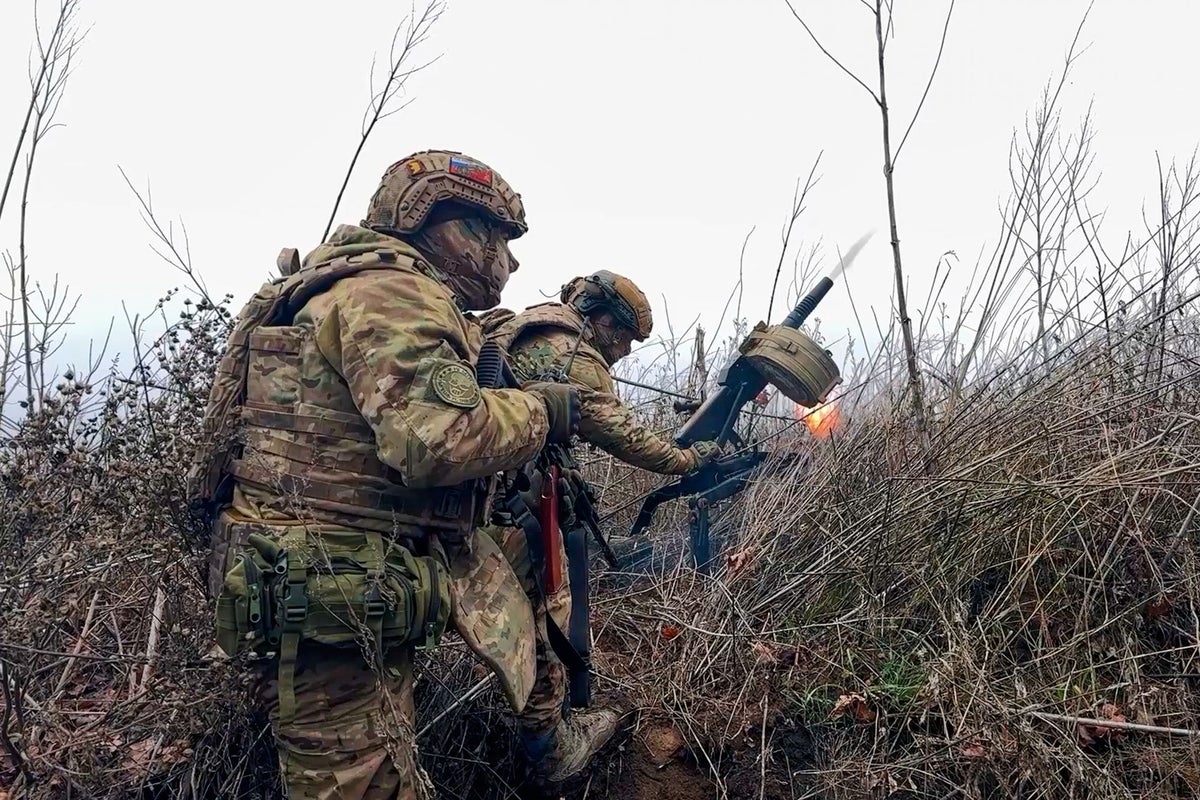
Ukraine 's military has rejected Russia 's claim to have taken full control of the eastern Luhansk region, saying there have been no significant battlefield changes in the area.
Luhansk is one of two industrialised regions that make up the Donbas . It has been almost entirely occupied by Russia since the start of the war, while Ukraine still holds a relatively large stretch of neighbouring Donetsk.
The Russian defence ministry claimed on Wednesday that its forces had finally wrested control of the small sliver of land that had remained beyond their reach since 2022.
The Kremlin demanded Ukrainian forces withdraw from the Donbas as a whole in order to end the “hot phase” of the war. Kyiv has dismissed the idea of ceding so much territory as absurd.
Meanwhile, Donald Trump has threatened to stop supplying weapons for Ukraine if his European allies do not join a new “coalition of the willing” to reopen the Strait of Hormuz, people aware of the discussions told the Financial Times.
European nations have repeatedly resisted Trump’s demands for support in the Middle East beyond defensive missions, and said the Iran conflict was “not our war”.
Volodymyr Zelensky has said Russia responded to his offer for a temporary ceasefire over Easter with airstrikes and drone attacks.
“Russia is responding [to the Easter ceasefire offer] with Shahed drones and continues its terrorist operations against our energy sector, against our infrastructure,” he said, adding that he had discussed ways of advancing diplomacy with US negotiators.
“A silence over Easter could be exactly the signal that tells everyone that diplomacy can be successful,” he said.
Moscow said that it was looking for peace and not just a brief ceasefire. Russia’s foreign ministry also rejected Zelensky’s Easter truce proposal as a PR stunt.
Russia attacked facilities of Ukraine's state oil and gas company Naftogaz in the north-eastern Sumy region of Ukraine yesterday, causing fires, Naftogaz CEO Serhiy Koretskyi said.
In a statement this morning, Koretskyi said the attack caused significant damage, but gave no more details.
Hungary's centre-right Tisza party widened its lead over prime minister Viktor Orban's ruling Fidesz ahead of the parliamentary election on 12 April, two opinion polls showed yesterday, although a large of voters remained undecided.
Veteran nationalist Orban faces the biggest challenge to his rule in 16 years, although the outcome of the election remains uncertain due to the many undecided voters.
His opponent, Peter Magyar, has said his party would curb corruption, unlock billions of euros in frozen European Union funds to boost the economy, and firmly anchor Hungary in the EU and Nato.
While most polls have shown a Tisza lead, Fidesz points to other surveys that still show it on course to victory, though its opponents say these have mainly been conducted by institutes with financial or personal ties to the ruling party.
But even if Magyar wins the elections, he is unlikely to represent the pro-Ukrainian alternative Brussels is hoping for.
Magyar often sounds strikingly similar to Orban when it comes to Ukraine. He has opposed fast-tracking Ukraine’s EU membership, said he would deny military help to Kyiv, and signalled he would put Ukraine's EU accession to a referendum – which could derail the process entirely.
Donald Trump has threatened to stop supplying weapons for Ukraine if his European allies do not join his “coalition of the willing” to reopen the Strait of Hormuz, people aware of the discussions said.
Trump has demanded that Nato countries deploy their navies to help him reopen the Strait, through which a fifth of the world’s oil passes and where traffic is now halted by Iran, reported the Financial Times.
At least three officials aware of the discussions said that Trump dangled the threat of ending the weapons supply for Ukraine under PURL, a Nato-led weapons procurement initiative for Ukraine.
European nations have resisted Trump’s push and said the Iran conflict was “not our war”.
The Nato secretary general, Mark Rutte, urged a group of key European nations who are Ukrainian allies – France, Germany and the UK – to release a statement that they are ready for any appropriate measures.
“We express our readiness to contribute to appropriate efforts to ensure safe passage through the Strait [of Hormuz],” the statement read.
Ukraine’s Odesa port has come under attack from Russian forces, officials said this morning, confirming damage to residential buildings and port infrastructure.
“Residential buildings and the port area have been hit. Containers and four cars caught fire in the port zone. Two warehouses have been damaged,” Oleh Kiper, head of Odesa military administration said on his Telegram channel.
No casualties have been reported and the fire has been extinguished, the regional official said.
Russia has attacked Ukraine with more than 170 drones since last evening and overnight, Ukraine’s air force said this morning, adding that the airstrikes are still underway.
The Ukraine Air Force said Russian forces fired 172 drones from 6pm Wednesday evening on several Ukrainian cities and hits have been recorded at at least 12 locations.
These include Shahed, Gerbera, Italmas and other types of drones fired from the Russian cities of Bryansk, Kursk, Oryol, Millerovo and Primorsko-Akhtarsk and Ukraine’s occupied territories of Donetsk and Crimea.
Of these, at least 120 were recorded to be Iran’s Shahed loitering drones.
As of 8am local time, Ukrainian air defence forces said they have destroyed or jammed 147 Russian drones in the country's north, south and east.
Sports authorities in Ukraine asked the International Olympic Committee to examine the "neutral" status of Russian athletes they accused of having links to the military or competing in events that violated Olympic sanctions.
The IOC allowed a limited number of athletes from Russia and Belarus to compete at the 2024 Paris Olympics and the 2026 Milan Winter Games with no flags or anthems, subject to vetting.
This included stipulations that athletes not be linked to the military or have supported Moscow's 2022 invasion of Ukraine.
An appeal signed by Ukrainian sports minister Matvii Bidny and National Olympic Committee head Vadym Guttsait said they had compiled evidence that some athletes had flouted recommendations established by the IOC in 2023 – more than a year after Russia's full-scale invasion.
The appeal cited in particular "systematic violations" in sports climbing and its governing federation, the IFSC.
"The Ukrainian side has provided evidence of direct links between a number of athletes and the military structures of the aggressor state," the statement said.
It cited several athletes the officials alleged had links with the military, supported the invasion or had trained in Crimea, seized and annexed by Russia from Ukraine in 2014.
It also said an international competition was held in Moscow last November under the auspices of the CISM (International Military Sports Council) in violation of IOC rules.
"This confirms the involvement of Russian military structures in the international sports movement with the aim of legitimising Russia's aggressive policy," the appeal said.
"The Ukrainian side calls on the leadership of the IOC and the IFSC to conduct a comprehensive review of these facts and to suspend the individuals in question from international competitions.”
Several Ukrainian drones were shot down close to oil refineries in the Russian city of Ufa, the largest in Bashkortostan, while debris of one of them fell in an industrial area, the local governor said this morning.
Another drone struck a residential building but no one was injured, Bashkortostan's leader, Radiy Khabirov wrote on his Telegram channel.
Tensions between the US and Nato allies flared up as president Donald Trump said he was considering pulling the US out of the Western military alliance due to its European members' refusing to send ships to unblock the Strait of Hormuz.
Nato, which includes European countries, the United States and Canada, was formed in 1949 with the aim of countering the risk of Soviet attack and has been the cornerstone of the West's security ever since.
Trump told Reuters on Wednesday that he would state in an address to the nation later in the day that he was "absolutely" considering withdrawing the US from the Nato alliance.
“I'll be discussing my disgust with Nato," he said of the speech. Asked if he was thinking pulling out of Nato, he said: "Oh, absolutely without question. Wouldn't you do that if you were me?"
In the event, Trump didn't directly talk Nato during his primetime address.
Trump's earlier remarks reflect his ongoing frustration with Nato and came just hours after his defence secretary Pete Hegseth declined to reaffirm the US commitment to Nato's collective defence, a concept that lies at the heart of the alliance.
The full story
This article is one source in a clustered incident — the cluster page carries the summary, timeline and every other outlet covering it.