 Back Debuglies
Undersea Drone Fleets: China and the Global Race for Maritime Persistence - https://debuglies.com
This assessment examines China’s emerging underwater-drone support architecture alongside developments in the United States, Australia, Europe, Israel, Japan and South Korea, distinguishing documented capabilities from announced ambitions and assessing their strategic implications through 2031.
The strategic significance of underwater drones increasingly depends on the infrastructure that deploys, recovers, maintains and commands them. China’s apparent development of additional dedicated support vessels therefore deserves attention, but the accessible official record does not establish the mission, embarked capacity, operational status or fleet assignment of the newly discussed hulls. International developments nevertheless demonstrate that the wider technological transition is substantive: Australia disclosed additional undersea payload integration on 19 October 2026 ; the United Kingdom reported a heavyweight-torpedo launch from an experimental uncrewed submarine in September; and industry documented delivery of BlueWhale to Germany in February. These represent different stages of development, rather than interchangeable evidence of operational maturity. The decisive question is which countries can sustain useful underwater missions repeatedly, at acceptable cost and with reliable command arrangements.
China’s apparent investment in underwater-drone support ships confronts Western governments with a procurement choice: buy more autonomous vehicles, or build the operating infrastructure that makes those vehicles useful. The distinction now carries fiscal and industrial consequences. On 19 October 2026, Australia disclosed further payload integration across its unmanned maritime programmes, while European governments were pursuing different combinations of experimental submarines, imported systems and infrastructure services. Yet the public record remains far stronger on contracts and demonstrations than on sustained operational performance. The governing question is therefore whether governments will finance complete mission capabilities or accumulate equipment whose maintenance, integration and decision structures remain unfinished. Through 2031, the advantage will accrue to countries that turn autonomous hardware into repeatable military output and shorter infrastructure disruptions.
The spending figures buy different things
Australia’s A$1.7 billion Ghost Shark contract, announced on 10 September 2025, covers delivery, maintenance and continued development over five years. Fincantieri’s July 2026 announcement envisaged approximately €600 million in initial expenditure on an underwater-sector acquisition programme. Britain’s December 2022 Cetus contract committed £15.4 million to an experimental vehicle, while its December 2025 Atlantic Bastion announcement identified £14 million in combined government and industry seed funding. These figures cannot sustain a league table of national ambition: Australia is purchasing an evolving capability and its support; Fincantieri is acquiring industrial holdings; Britain is financing a test platform and early development.
The same accounting discipline applies to European infrastructure funding. The Commission’s February 2026 allocation of €347 million for strategic submarine-cable projects included a €20 million repair-module call. A second €40 million repair-capacity call followed in June, alongside €5.8 million announced for the first two Regional Cable Hubs in the Baltic and Mediterranean. Adding every announcement together would risk counting related programme envelopes twice. More consequentially, treating those allocations as delivered protection would confuse budget authority with operational capacity.
Japan’s FY2026 documentation exposes another common distortion. Approximately ¥100.1 billion supports initiatives intended to establish SHIELD in FY2027, within a broader unmanned-defence allocation of approximately ¥277 billion on a contract basis. Neither amount is a dedicated underwater-drone budget. The fiscal question is not which government has announced the largest number, but which expenditure resolves the constraint preventing an accepted mission from being performed.
Payload cooperation matters more than a common submarine
Australia’s 19 October 2026 press conference clarified the current AUKUS industrial proposition. Defence Industry Minister Pat Conroy identified common payloads and sensors as the focus of undersea cooperation, while the partners retain their own platforms. Ghost Shark exports were discussed separately. That distinction allows governments to preserve national designs and industrial participation while seeking economies in mission equipment; it does not establish an allied decision to purchase the same vehicle.
The American portfolio illustrates why that separation matters. The US Pacific Fleet Submarine Force reported an Orca transit exceeding 1,000 nautical miles in July 2026, but also documented three Yellow Moray tactical sorties near Norway in 2025, launched and recovered through USS Delaware’s standard torpedo tubes without divers. These are different operating models. Their value lies in the missions they can support, not in whether one platform can claim to supersede the other.
AUKUS cooperation will produce savings only where shared payloads avoid repeated engineering. Power requirements, software interfaces, safety evidence and customer acceptance can turn one nominally common system into several national integration projects. Australia’s latest disclosure establishes a direction; contracts and accepted configurations must establish whether that direction reduces duplication or merely gives it a common programme name.
Europe is choosing where to own the value chain
Fincantieri’s proposed integration of Geosolutions, WSense, Graal Tech and Defcomm seeks to connect survey services, underwater communications, robotic vehicles and surface systems. The industrial mechanism is clear: a supplier of platforms and equipment can move toward recurring service revenue by assuming responsibility for a larger part of the customer’s task. Italy’s potential gain is therefore broader than ownership of a particular drone. Its exposure is that corporate integration may advance faster than the public customer’s ability to specify, accept and govern the resulting service.
France has separated its requirements more explicitly. Naval Group’s UCUV framework concerns a combat demonstrator; the Thales–Exail SLAMF arrangement covers eight mine-detection AUVs, with eight more optional; Exail’s deep-seabed development targets reconnaissance and surveillance to 6,000 metres. Maintaining distinct programmes avoids forcing one vehicle to satisfy incompatible tasks. It also requires the customer to coordinate support, information and procurement decisions across them.
Germany chose accelerated introduction through BlueWhale, following Baltic testing in November 2024 and a first handover in February 2026. Britain has used Excalibur to investigate military applications while placing autonomous systems within Atlantic Bastion’s wider sensing concept. The European division is consequently not between countries embracing or resisting autonomy. It concerns where governments retain design responsibility, where they buy available technology and whether successful experiments receive funded routes into routine service.
Repair capacity puts a measurable limit on protection
The International Cable Protection Committee reports approximately 150–200 submarine telecommunications cable faults annually, with 70–80% attributed to accidental human activities, principally fishing and anchors. Those figures do not resolve the cause of any individual incident, and they do not describe submarine power cables. They do establish that a protection policy organised exclusively around hostile underwater vehicles would neglect the largest documented recurring source of damage.
The June 2026 European repair call translates resilience into a concrete requirement: applicants should identify at least three compatible vessels, and equipment should be installable within a maximum of three days after a vessel reaches the designated port or yard. That is not a three-day cable-repair promise. It leaves transit, fault assessment, access, weather and the repair itself outside the installation clock. The distinction reveals where security expenditure can fail: equipment may exist while the organisation required to mobilise it remains incomplete.
The Porto Declaration of 3 February 2026 accordingly recommends predictable permitting, fewer administrative barriers and a single government point. Its recommendations are non-binding, and a point does not inherit every statutory power. Governments must still connect operators, ports, customs, emergency bodies and competent authorities. An underwater sensor that detects damage sooner cannot compensate for a repair vessel waiting on an unresolved authorisation.
Fast acquisition cannot waive technical maturity
The US Government Accountability Office’s July 2026 assessment found that eighteen of forty programmes entering the Middle Tier of Acquisition pathway between 2018 and 2025 began with immature technologies. That is not an underwater-drone failure rate. It is evidence against the assumption that selecting an accelerated procurement route removes development risk. Speed becomes credible when a bounded capability can be accepted, while immature elements are developed against separate decisions.
The French SLAMF order demonstrates why scope matters: eight firm vehicles and eight options are different commitments. Australia’s Ghost Shark contract similarly combines production with continuing development, making configuration control central to what the customer is buying. A payload demonstrated on one vehicle cannot silently become a capability attributed to every delivered platform. Expansion should follow evidence that the accepted combination can be supported, rather than the publicity surrounding an individual trial.
Britain’s JSP 936 framework addresses governance and assurance throughout the defence-AI lifecycle. Its procurement implication is practical: software changes require identifiable responsibility, records and proportionate retesting. A modular vehicle remains a supplier dependency if the customer lacks the rights, documentation or access needed to maintain it or integrate alternatives. Sovereignty resides partly in those contractual provisions, not solely in the location of the assembly line.
The two years will charge the cost of unfinished decisions
Over the 12–24 months, the relevant tests will be whether SHIELD’s FY2027 objective produces accepted functions, whether European cable-repair funding produces mobilisable equipment and whether AUKUS payload cooperation produces usable cross-platform arrangements. China’s apparent support-ship expansion should be assessed through the same discipline: identifiable operators, recurring integrated deployments and servicing evidence would change the judgment more than another unusual hull.
The costs of inaction will fall on different balance sheets. Defence ministries will carry vehicles that cannot generate the expected output; infrastructure operators will retain restoration delays that additional monitoring does not remove; industrial suppliers will face uncertain follow-on demand after successful demonstrations. Fincantieri’s service ambition, Germany’s accelerated acquisition and Britain’s experimental programme will each be tested by the customer’s decision. Buying hardware is a commitment. Funding the personnel, interfaces, permissions and support that make it useful is the choice that determines whether that commitment earns its cost.
Pillar I — China’s Maritime Support Architecture and the Changing Undersea Battlespace
Chapter 1 — From Individual Vehicles to Sustained Underwater Operations Support vessels, launch and recovery, maintenance, autonomy and the distinction between experimental activity and deployable force structure.
Chapter 2 — China’s Emerging Architecture: Industrial Capacity, Mission Ambiguity and Operational Reach
The Chinese support-ship question, established scientific infrastructure, alternative employment pathways and evidence required to assess military integration.
Chapter 3 — Persistence, Detection and Escalation Beneath the Surface
Surveillance, mine warfare, infrastructure operations, payload employment and the constraints on sustained contested operations.
Pillar II — Competing International Solutions and Industrial Models
Chapter 4 — The United States and Australia: Long-Endurance Vehicles, Modular Payloads and AUKUS Integration Orca, Ghost Shark and the relationship between autonomous endurance, shore support and expeditionary sustainment.
Chapter 5 — Europe’s Divergent Approaches: Italy, France, Germany and the United Kingdom
National capabilities, industrial structures, experimentation, procurement and critical-infrastructure requirements.
Chapter 6 — Wider International Competition: Israel, Japan, South Korea and Strategic Outliers
Sensor platforms, coastal defence, fleet integration and the limits of comparison between reusable drones and specialised strategic weapons.
Pillar III — Strategic Exposure, Governance and Decisions to 2031
Chapter 7 — Infrastructure Security, Industrial Dependencies and Alliance Coordination Submarine cables, offshore assets, repair capacity, shared interfaces and information governance.
Chapter 8 — Development Pathways and Observable Indicators
Alternative trajectories, evidence thresholds and the transition from demonstrations to sustained fleet employment.
Chapter 9 — Policy Options and Final Net Assessment
Procurement priorities, experimentation standards, support infrastructure and measures of operational value.
The support system determines the strategic value of the vehicle
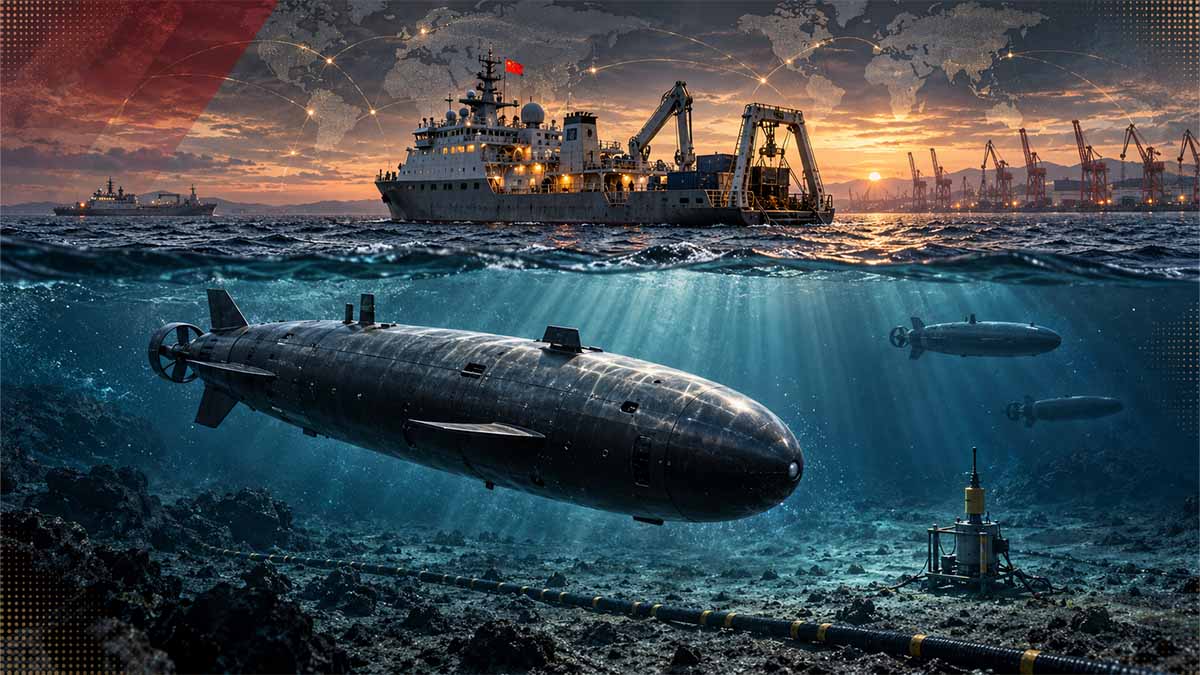
The central development in autonomous undersea warfare is the gradual assembly of complete operating systems around individual vehicles. A large underwater drone acquires greater military value when a navy can transport it to the relevant theatre, prepare its payload, release it safely, retrieve its information, recover the vehicle and return it to service. A dedicated support ship could bring these functions closer to an operating area and reduce dependence on distant ports. It could also concentrate expensive equipment and specialist personnel aboard a conspicuous surface platform. The resulting balance depends on geography, protection requirements and the frequency with which vehicles need physical servicing. Consequently, the emergence of an apparent carrier or tender should prompt an assessment of the whole operating cycle; its appearance alone cannot establish patrol persistence, combat readiness or the number of missions that an embarked fleet can sustain.
The United States illustrates an alternative architectural choice. Boeing describes Orca as designed for pier-side launch and recovery without a dedicated support vessel, with a declared range of up to 6,500 nautical miles and a removable modular payload section. These are manufacturer specifications, rather than evidence that every configuration has demonstrated the advertised performance. Nevertheless, the design clarifies an essential distinction: a navy can seek reach through the endurance of individual vehicles, through forward support ships, or through a combination of both. A visible difference in support fleets therefore cannot, by itself, establish which country possesses the stronger autonomous undersea capability. boeing.com
China’s industrial foundation is established; the new military architecture remains unresolved
China already possesses documented experience with an unmanned-systems mothership in the scientific sector. The Second Institute of Oceanography, under the Ministry of Natural Resources, recorded the delivery of Zhu Hai Yun on 12 January 2023 , following trials that included autonomous and unmanned surface-vehicle launch and recovery. The institute reported twelve continuous hours of autonomous during those trials. This establishes relevant experience in integrating a host ship, robotic systems, operators and operating procedures. It does not establish that a scientific vessel and a prospective naval UUV tender the same mission architecture, equipment or readiness standards. 自然资源部第二海洋研究所
For the newly discussed Chinese hulls, the decisive official records remain unavailable in the material successfully verified for this assessment. Their operators, assigned missions, handling limits, embarked vehicles and acceptance status cannot responsibly be presented as settled facts. The distinction matters because a broadly similar configuration could support several overlapping functions: development trials, training, oceanographic work, maintenance support or eventual operational deployment. Even confirmation that two ships exist would not independently establish a serial procurement programme or an expeditionary combat capability. The strongest defensible judgment is conditional: if China demonstrates repeated deployment and recovery of large UUVs, supported by embarked maintenance and sustained deployments, the ships would represent a consequential extension of its underwater operating infrastructure. Evidence of that operating cycle would carry greater analytical weight than additional photographs of completed hulls.
Australia’s latest disclosure shifts attention toward payloads
On 19 October 2026 , Australia’s defence ministers announced development and integration of payloads across Ghost Shark, Speartooth and BlueBottle, identifying examples that include supply caches, sea mines and uncrewed aerial vehicles. Some payloads were scheduled to participate in the AUKUS Maritime Big Play Pacific exercise in San Diego during the following week. The release also identified investment of up to A$5.8 billion over the decade in autonomous and uncrewed undersea warfare capabilities, including A$1.7 billion for the Ghost Shark fleet. These are Australian-dollar programme commitments, not expenditure on dedicated motherships. The announcement does not establish that every listed payload is integrated on every named platform. Defence Ministers
The strategic implication is that platform development and mission development are becoming increasingly interdependent. Endurance without a useful payload provides limited military effect; a sophisticated payload without dependable , servicing and command arrangements creates a different limitation. Shared experimentation can expose these dependencies, although an exercise announcement remains distinct from a completed demonstration or an operational deployment. Australia’s disclosure consequently strengthens the case for assessing undersea autonomy as an integrated capability while preserving the distinction between announced integration work and demonstrated fleet performance.
Britain and Germany demonstrate different routes toward military utility
The Royal Navy’s 30 September 2026 announcement documented a trial in which XV Excalibur fired and controlled a US Navy Mk48 Mod 4 heavyweight torpedo. The experiment used an inert, recoverable torpedo , and the navy described it as the beginning of a series intended to increase in scope and complexity. Excalibur remains an experimental platform. The event demonstrates a specific integration achievement; it does not establish an operational squadron, autonomous target selection or unrestricted authority to release weapons. royalnavy.mod.uk
Germany’s BlueWhale represents a different emphasis. IAI and TKMS announced delivery to the German Navy at Eckernförde on 25 February 2026 , following Baltic testing. Their statement describes reconnaissance, acoustic collection, above- and below-water target detection and seabed mine-location functions. Delivery is a concrete milestone, while the manufacturers’ descriptions of mission performance retain their status as first-party claims. Together, the British and German cases show why a single international ranking would be misleading: a weapons-integration experiment and delivery of an autonomous sensor platform answer different operational questions. IAI
Europe already has relevant mothership experience
The Belgian-Dutch mine-countermeasures programme offers an important comparison because it explicitly combines a host ship with surface, underwater and aerial robotic systems. Naval Group’s November 2025 documentation describes a twelve-vessel programme , with a published configuration including two Inspector 125 surface drones, three A-18 autonomous underwater vehicles and associated mine-identification and neutralisation equipment. This is a documented support-ship architecture for a defined mission. It should not be treated as equivalent to a tender for very large, long-endurance underwater vehicles. naval-group.com
France’s industrial contribution is particularly relevant through Naval Group and Exail’s respective roles in the programme. Its wider strategic significance lies in system integration: host-ship design, handling machinery, mission software, unmanned vehicles and maintenance arrangements must function together. The appropriate European comparison with China therefore extends beyond hull size to the reliability and completeness of the operating system. Published equipment lists are useful evidence of design scope; they remain insufficient to establish mission availability across different sea conditions or sustained wartime performance.
Italy’s opportunity lies in connecting maritime robotics with infrastructure services
Italy’s industrial direction increasingly links underwater vehicles with sensors, communications, handling equipment and offshore services. On 17 June 2026 , Eni and Fincantieri announced an agreement granting IDS an exclusive licence for worldwide commercialisation and industrial development of Clean Sea, Eni’s robotic technology for monitoring marine ecosystems and subsea infrastructure. In July, Fincantieri announced agreements concerning Geosolutions, WSense, Graal Tech and Defcomm, spanning survey services, underwater communications, autonomous underwater vehicles and autonomous surface vehicles. The announcement distinguished acquisition agreements from completion conditions; it should not be read as proof that all transactions and integration activities had already concluded. fincantieri.com
These developments support an industrial option for Italy: integrating inspection, environmental knowledge, communications and intervention support into persistent infrastructure services. Their military value would depend on subsequent requirements, procurement and operational validation. Civil inspection competence cannot automatically be translated into survivability or effectiveness under hostile conditions. Equally, concentrating exclusively on combat payloads would overlook the importance of detecting anomalies, establishing what happened and supporting restoration.
Asian programmes broaden the competition beyond large vehicles
Japan’s 2026 defence white paper places UUV acquisition within SHIELD , a planned layered coastal-defence architecture combining aerial, surface and underwater unmanned systems with crewed forces. Its stated objective is establishment during fiscal year 2027; that date is a programme target, not evidence of completed deployment. South Korea’s Hanwha describes development of unmanned surface and underwater systems intended to operate within existing naval command structures, an industrial statement of direction rather than a verified fleet inventory. mod.go.jp
These approaches reinforce the distinction between vehicle size and operational purpose. Large vehicles may support endurance and payload capacity, while smaller systems can serve distributed surveillance or specialised coastal missions. Israel’s participation through BlueWhale further demonstrates that the competitive landscape includes partnerships between vehicle developers, sensor specialists and naval integrators. International comparison must therefore preserve differences in mission, development stage and support requirements rather than grouping all underwater drones into a single category.
Three pathways merit continued examination, although the available evidence does not support numerical probabilities or a firm ranking for the newly discussed Chinese ships.
These pathways can overlap during programme maturation. Additional hulls would strengthen the evidence of investment, but only operating patterns would establish how that investment translates into military reach.
Principal Gaps and Watch Indicators
The most consequential Chinese evidence would be an attributable programme designation, identification of the operating organisation and documented launch-and-recovery activity involving identifiable vehicles. Acceptance records, sustained deployments and visible maintenance arrangements would help distinguish development infrastructure from an operational support fleet. A claimed ability to threaten distant bases or continental coastlines requires separate evidence concerning vehicle endurance, , payloads and command arrangements.
For international comparison, the principal missing measures are repeated mission completion, recovery reliability, maintenance burden and availability over time. Those measures would allow governments to assess sustained output rather than nominal inventories or isolated demonstrations.
For Europe, infrastructure protection also requires a response after detection. The Commission’s February 2026 package explicitly included support for adaptable cable-repair modules, illustrating the connection between monitoring and restoration capacity. The practical decision is how to connect naval awareness, commercial inspection, incident assessment and repair without assuming that purchasing additional drones resolves the entire problem. Shaping Europe’s digital future
Three routes to underwater persistence
Conceptual comparison. Card height, depth and position encode no numerical score or ranking.
Forward support at sea
A surface host can bring handling equipment, technicians and servicing closer to the operating area.
China: scientific mothership experience is documented. The roles and acceptance status of the newly discussed naval hulls remain unresolved.
Trade-off: support proximity versus exposure and concentration of assets. Source 1
Shore launch and autonomy
A vehicle uses its own range and endurance to reduce dependence on a dedicated host ship.
United States: Boeing describes Orca as designed for pier-side launch and recovery, with up to 6,500 nautical miles of range.
Manufacturer-declared design, not a readiness measurement. Source 2
Host, drones and control
Specialised host ships combine robotic vehicles, handling systems and mission management for a defined task.
Belgium / Netherlands: the rMCM programme integrates surface, underwater and aerial systems for mine countermeasures.
Different mission and vehicle scale from a large-UUV tender. Source 6
The mission cycle that turns hardware into capability
Each stage depends on the stage; recovery feeds maintenance and preparation for another sortie. The sequence describes an analytical operating model, not verified performance of a particular fleet.
Prepare Mission definition, payload integration and vehicle checks.
Deploy Shore or host-ship launch; transit to the operating area.
Execute , sensing or authorised payload employment.
Recover Vehicle retrieval and transfer of collected information.
Service Inspection, energy replenishment and repairs.
Regenerate Validate availability and prepare the mission.
Different milestones, different meanings
Equal-size 3D-style event blocks; dates are labels, not a proportional time axis. These events are not a maturity ladder.
Naval Group publishes host-ship and robotic-system configuration.
IAI and TKMS announce delivery to the German Navy.
Royal Navy reports firing and controlling an inert heavyweight torpedo.
Government discloses integration work across multiple unmanned platforms.
The global capability landscape
Compare operating concepts and documentary status. Categories describe evidence types; they do not assign countries a common readiness level.
10 entries · Full comparison
What would change the assessment?
Confirm the operating role
Named operator, programme designation, identifiable embarked vehicles and repeated launch-and-recovery activity.
Measure repeatability
Mission completion, recovery reliability, servicing burden and sustained availability over time.
Connect detection to repair
Link monitoring, incident assessment and restoration capacity. Additional drones alone do not complete the response system.
Sources and interpretation
Sources retained from the accompanying assessment. Official announcements establish what the issuer reported; manufacturer specifications remain attributed claims. Unknown quantities are not represented as zero. No invented scores, probabilities or cross-programme budget comparisons are used.
China: Zhu Hai Yun delivery Second Institute of Oceanography · 12 Jan 2023
Orca XLUUV specifications Boeing · undated; accessed 19 Oct 2026
Australia: undersea payload integration Australian defence ministers · 19 Oct 2026
Excalibur torpedo trial Royal Navy · 30 Sep 2026
BlueWhale delivery IAI / TKMS · 25 Feb 2026
Belgian-Dutch rMCM programme Naval Group / Exail · 4 Nov 2025
Clean Sea technology agreement Eni / Fincantieri · 17 Jun 2026
SHIELD coastal defence plans Japan Ministry of Defense · 2026 white paper
Integrated maritime systems Hanwha · 24 Feb 2026
Cable-security investment European Commission · 5 Feb 2026
Operational availability is the decisive measure of an underwater fleet
The transition from an experimental underwater vehicle to a deployable military capability occurs when an operating organisation can repeatedly deliver a defined mission under representative conditions, recover the system where recovery is intended, restore its configuration and prepare it for subsequent employment. This is a more demanding threshold than completing a long transit, demonstrating an autonomous manoeuvre or launching a payload. Each achievement can establish an important technical proposition, but none independently establishes that the vehicle, its support infrastructure and its command organisation can maintain useful output over an extended deployment. For governments evaluating autonomous underwater systems, the relevant unit of analysis is therefore the mission-capable operating system: vehicles, handling equipment, energy provision, maintenance personnel, software, communications, mission planning and the procedures governing their interaction.
This distinction has direct acquisition consequences. The US Government Accountability Office’s September 2022 examination of the Extra Large Unmanned Undersea Vehicle programme found that the effort was at least US$242 million, or 64%, above its original estimate , and at least three years late at that historical assessment point. GAO attributed important difficulties to starting fabrication without adequately demonstrating production readiness and to redesign requirements affecting critical components. These figures describe the programme’s position in 2022; they are not presented as its October 2026 cost or schedule. Their continuing relevance is the acquisition mechanism they expose: a predecessor demonstrator does not remove the integration risks associated with a substantially different military configuration. Extra Large Unmanned Undersea Vehicle: Navy Needs to Employ Better Management Practices to Ensure Swift Delivery to the Fleet — US Government Accountability Office — September 2022, with subsequent recommendation updates . U.S. GAO
A fleet assessment should consequently distinguish physical ownership from practical availability. A vehicle awaiting software clearance, replacement seals, battery inspection or a compatible recovery system remains part of the inventory, but it cannot necessarily contribute to the assigned operation. Equally, a functioning vehicle may be available for seabed survey while remaining unsuitable for a different payload or environmental condition. Readiness is mission-specific, and aggregation across configurations can conceal rather than clarify operational strength.
Table 1.1 — Evidence required to establish an operational underwater capability
Analytical assessment framework; the table assigns no readiness rating to an individual programme.
Launch and recovery determine the usable operating window
The launch-and-recovery problem is especially important because underwater endurance and surface handling operate under different constraints. A vehicle may remain capable of submerged operation while the host ship cannot safely recover it. Conversely, a support ship may remain seaworthy while its handling arrangements have reached an operational limit. The practical deployment window is bounded by the most restrictive element of the combined system, including the vehicle’s configuration, the handling equipment, the ship’s motion and the procedures available to the crew.
A crane’s nominal lifting capacity does not resolve this problem. Safe handling also depends on dynamic loads, attachment arrangements, capture geometry, vehicle buoyancy and the interaction between ship and vehicle during the transition through the water surface. A photographed lifting tower may indicate substantial handling infrastructure, but it cannot reveal the certified operating envelope or demonstrate autonomous recovery. Counting visible towers therefore provides a weak basis for estimating simultaneous UUV operations, sortie generation or embarked capacity.
A current commercial development illustrates where engineering effort is being directed. On 30 September 2026 , Kongsberg Maritime announced a contract for an integrated AUV hangar and subsea docking system for a research vessel being built by VARD for Inkfish. The proposed installation combines below-surface launch, recovery and docking with internal handling arrangements, including a skidding system and overhead crane. The company states that moving docking below the surface reduces wave effects and expands the operating window. Delivery is planned for the end of 2027 : this is evidence of a contracted engineering approach, not an already delivered capability aboard that vessel. Kongsberg Maritime to deliver AUV hangar and subsea docking system for new research vessel — Kongsberg Maritime — September 2026 .
The significance extends beyond the commercial application. Purpose-built underwater-drone support vessels should be assessed as handling and servicing installations whose naval utility depends on their performance at the interfaces between ship, vehicle and water. Hull dimensions matter, but the operational advantage may reside in less visible features: protected preparation spaces, integrated diagnostics, the ability to move vehicles internally and recovery equipment that reduces dependence on favourable surface conditions.
Table 1.2 — Support architectures and their principal constraints
These architectures can coexist within the same force. The table compares dependencies rather than ranking effectiveness.
Maintenance moves the human workload rather than eliminating it
An uncrewed vehicle removes personnel from the vehicle itself, but it does not remove the requirement for engineering expertise, mission preparation, inspection, fault diagnosis and configuration control. The workforce changes location and composition. A support organisation may require fewer personnel exposed aboard a submerged platform while demanding more specialist effort in battery management, software assurance, acoustic systems and data exploitation.
The maintenance problem also changes with mission duration. Components exposed to seawater and repeated pressure cycles must retain their integrity; sensors must remain sufficiently clean and calibrated; propulsion and buoyancy systems must continue operating within acceptable limits. DARPA’s Manta Ray programme explicitly identifies corrosion, biofouling, material degradation, energy management and mission management as problems that must be addressed to enable long-duration operation without human-present support. These are programme objectives, not evidence that all such problems have been solved. Manta Ray — Defense Advanced Research Projects Agency — programme description, accessed October 2026 .
The strategic consequence is that increasing vehicle endurance does not automatically reduce the support burden in proportion. Longer missions may reduce the frequency of recovery, but they also increase the importance of reliability, fault tolerance and confidence in the vehicle’s condition before departure. A maintenance regime that works for short, closely supervised sorties may be inadequate for a prolonged deployment in which physical intervention is unavailable.
A useful performance measure is mission-capable hours delivered per unit of total support effort , assessed for a defined mission and environment. This would capture the personnel, facilities and servicing time required to generate useful output. It would also discourage procurement comparisons that treat the absence of an onboard crew as a complete measure of reduced operating cost.
Table 1.3 — Measures that reveal whether a fleet can sustain operations
Proposed reporting measures; no undisclosed programme values are inferred.
Autonomy must be assessed by function and operating conditions
The term “autonomous” can conceal major differences between , obstacle avoidance, mission adaptation, target recognition and weapon employment. A vehicle may navigate independently along a planned route while requiring human review of collected data. Another may identify candidate objects onboard but lack authority to alter the mission beyond predetermined limits. The policy and engineering implications depend on which functions are automated, the circumstances in which they operate and the consequences of failure.
Commercial documentation already reflects this functional distinction. Kongsberg describes HUGIN configurations capable of operator-supervised, semi-autonomous or autonomous operation, with deployment from dedicated vessels, suitable alternative vessels or shore. Its published system description also identifies containerised operator consoles, launch-and-recovery equipment and vehicle transport arrangements. These are manufacturer descriptions of available configurations, rather than evidence that any vessel can immediately operate any HUGIN system. HUGIN Autonomous Underwater Vehicle — Kongsberg Discovery — product documentation, accessed October 2026 .
For naval assessment, autonomy should be treated as a distribution of responsibilities between software, operators and commanders. The operational question is whether the allocation remains effective when environmental conditions change, communications are interrupted or the mission cannot continue as planned. A system that behaves predictably within a narrow authorised task can be more useful than a nominally more autonomous system whose behaviour is difficult to validate.
Integration is becoming a distinct capability in its own right
The support architecture need not take the form of a newly built dedicated mothership. HII’s 2026 account of its integration work describes several routes: torpedo-tube launch and recovery, automated surface-ship handling and a capture arrangement intended for amphibious ships with well decks. The company also reported an April 2026 Defense Innovation Unit contract for submarine launch-and-recovery development. These statements show that existing naval platforms are being considered as hosts through different interfaces; they do not establish that every described system has entered operational service. HII Leading in Technologies to Integrate Unmanned Systems with Naval Platforms — HII — 2026 .
The implication is that comparisons based solely on dedicated support-ship inventories will systematically miss part of the competitive landscape. A country may pursue specialised tenders, adapt existing platforms, emphasise shore-launched endurance or combine these approaches. The relevant comparison is the support network’s ability to generate the required mission at the required place and time, including the burden imposed on its host platforms.
Organisational readiness is equally consequential. GAO’s 15 June 2026 assessment of US naval robotic and autonomous systems identified leadership and organisational challenges affecting progress. Its findings reinforce the distinction between possessing technology and establishing the authority, priorities and institutional arrangements needed to use it consistently. Robotic Autonomous Systems: Navy Needs to Address Leadership and Organizational Challenges to Meet Urgent Needs — US Government Accountability Office — June 2026 .
The most informative evidence of an operational underwater fleet is repeated mission delivery supported by documented recovery, servicing and command arrangements. Endurance, payload capacity and hull counts remain relevant inputs, but none substitutes for availability.
Support-ship design should be assessed through its handling envelope and maintenance throughput. Visible infrastructure establishes the presence of equipment; it does not establish certified performance or sustainable sortie generation.
Autonomy is operationally meaningful only when its functions, limitations and human responsibilities are defined. Procurement should evaluate the complete mission configuration rather than a general claim of autonomous operation.
What would change the assessment
Confidence would increase with representative operating records showing repeated missions, recovery outcomes, servicing requirements and availability across different conditions. Evidence of a low-maintenance operating cycle would strengthen the case for expanding vehicle numbers; evidence that host equipment or specialist labour constrains output would instead strengthen the case for investment in support capacity.
The principal unresolved comparison concerns sustained output. Public announcements frequently identify vehicles, contracts and demonstrations, while disclosing much less turnaround, maintenance effort and mission-capable availability. Without those measures, international readiness rankings would imply precision that the available evidence cannot sustain.
China’s strongest documented advantage is the breadth of its supporting ecosystem
China’s emerging underwater architecture should be assessed through the relationship between shipbuilding, research institutions, specialist equipment, operating personnel and access to the sea. The newly discussed support hulls are potentially important, but the broader industrial foundation is more firmly documented than their specific military role. Official Chinese institutional records identify established support ships with substantial endurance, laboratories, positioning equipment and deep-submergence handling systems. These records demonstrate an ability to construct and operate complex offshore support platforms. They do not establish that scientific fleets form part of a naval UUV command structure.
This distinction permits a more precise judgment than either dismissing scientific capability as strategically irrelevant or treating it as proof of military intent. Scientific operations can develop expertise in underwater , acoustic positioning, vehicle handling and engineering support. Whether that expertise transfers into a particular naval programme depends on institutional links, equipment compatibility, procurement decisions and operational requirements that must be established separately.
The available official record therefore supports an assessment of industrial and operational potential , while leaving the assignment and readiness of the newly discussed naval support ships unresolved.
Existing support ships provide measurable evidence of engineering capacity
The Institute of Deep-sea Science and Engineering’s published specifications describe materially different support platforms. Tansuo Yi Hao is listed as a 94.45-metre , 6,250-tonne full-load displacement vessel with range exceeding 10,000 nautical miles , endurance exceeding 60 days , DP-2 dynamic positioning and eleven laboratories. These specifications describe the host ship, not the independent endurance or military reach of an embarked underwater vehicle. R/V Tan Suo Yi Hao — Chinese Academy of Sciences Large Research Infrastructures User Service Platform — April 2025 .
Tansuo Er Hao’s institutional record identifies a 100-tonne stern A-frame , with a separately specified 50-tonne guide mechanism , alongside a ten-tonne telescopic crane, acoustic communication and underwater positioning equipment. These figures must retain their equipment-specific definitions: they are not interchangeable lifting ratings and cannot be used to infer the dimensions or mass of an undisclosed naval UUV. R/V Tan Suo Er Hao — Institute of Deep-sea Science and Engineering, Chinese Academy of Sciences — December 2024 .
Table 2.1 — Published specifications of established Chinese deep-sea support ships
Sources: Tansuo Yi Hao — CAS — April 2025 ; Tansuo Er Hao — IDSSE-CAS — December 2024 ; Tansuo San Hao — IDSSE-CAS — December 2024 .
Operator-published specifications, not independently measured performance. Endurance and range are separate characteristics and should not be assumed to apply simultaneously at maximum speed or under every operating condition.
These ships illustrate why the support ecosystem matters. Laboratories, workshops, positioning systems and operating spaces permit much more than transport. They support equipment preparation, data processing, fault diagnosis and the development of procedures. Their strategic relevance lies partly in the accumulated ability to conduct complex operations repeatedly, although transferring that competence into contested military employment would introduce requirements that scientific service does not itself validate.
Guangzhou’s special-purpose shipbuilding competence is directly documented
The industrial significance of Guangzhou Shipyard International can be established without assuming the identity of the newly discussed UUV-support vessel. A Chinese Academy of Sciences account records that GSI built Tansuo San Hao , with construction beginning in June 2023 and completed over an approximately eighteen-month period. The vessel departed the yard on 26 December 2024 and arrived at Sanya on 29 December. This documents delivery of a complex research platform by the same industrial organisation attracting attention in the support-ship discussion; it does not establish that the vessels a design lineage or military programme. Tansuo San Hao enters service at Sanya — Chinese Academy of Sciences Guangzhou Branch — December 2024 .
A separate 2 September 2026 China Classification Society announcement identifies GSI as builder of a deep-diving work support ship for the Ministry of Transport’s Shanghai Salvage Bureau, with the Shanghai Ship Research and Design Institute responsible for design. The published description includes electric azimuthing propulsion and tasks such as deepwater lifting, flexible-pipe installation, diving support and emergency evacuation. This is a civil support project whose construction had commenced; it should not be conflated with the newly discussed naval hull. Construction begins on a CCS-surveyed deep-diving work support ship — China Classification Society — September 2026 .
The analytical consequence is twofold. First, there is a documented industrial basis for producing ships with demanding handling and support functions. Second, the same breadth of special-purpose construction makes visual identification more difficult. Substantial cranes, work decks, positioning equipment and accommodation can support several civil or military missions. Yard location and unusual appearance narrow the possibilities, but do not establish the customer or operational purpose.
Table 2.2 — What the industrial record establishes
Sources: CAS Guangzhou Branch — December 2024 ; China Classification Society — September 2026 ; IDSSE-CAS support-ship specifications .
Expeditionary scientific activity demonstrates experience under demanding conditions
Published specifications establish intended capability; completed expeditions provide a different form of evidence. The Chinese Academy of Sciences reported that a 98-day Arctic voyage , returning on 27 October 2025 , included 43 Fendouzhe dives and coordinated underwater operations involving Jiaolong. The account describes operations supported by Tansuo San Hao and claims development of a coordinated ship-submersible operating mode in heavy ice. These are first-party institutional reports of scientific operations, and their broader claims of precedence should remain attributed rather than adopted as independently established international comparisons. Chinese Scientists Pioneer “Ship-Submersible Coordination” Operations in the Arctic — Chinese Academy of Sciences — October 2025 . english.cas.cn
The military relevance is indirect but substantive. Such expeditions expose crews and engineers to prolonged support requirements, variable environmental conditions and coordination between ships and submerged systems. They can generate practical experience that is difficult to acquire through isolated harbour trials. Nevertheless, manned scientific diving, autonomous underwater patr...
The full story
This article is one source in a clustered incident — the cluster page carries the summary, timeline and every other outlet covering it.
