 Back Huntress
What Business Email Compromise (BEC) Looks Like & How to Catch It
If you're looking for a history lesson on your company's finances, start in your inbox, where you might find invoices and vendor details, along with the renewal haggling that shows exactly what you pay and to whom.
Cybercriminals can be history buffs too. Digging through old email threads shows them exactly who to impersonate and how money actually moves. In 2025 alone, the FBI logged more than $20.8 billion in cybercrime losses, with roughly $3 billion tied to business email compromise (BEC) , second only to investment fraud.
Business email compromise (BEC) pays because it hides in the long-running vendor and billing conversations you already trust.
"I'd notice if someone was in my inbox"
You might assume you know the signs of an intruder lurking in your mailbox. We've all been trained to recognize the obvious, sloppy signs of phishing.
BEC is stealthier. Often with the help of AI, attackers aim at specific targets by crafting legit-looking phishing and social engineering scams to steal credentials or session tokens for access and persistence. They set up inbox rules that quietly move messages into folders nobody checks, hiding their dirty work in plain sight. This gives them time to figure out how to route money to their own accounts straight from your mailbox.
Here's how that attack chain plays out in a real Microsoft tenant. Huntress CEO Kyle Hanslovan breaks down how attackers sneak into Microsoft 365 mailboxes with low-fi resources to stage attacks like BEC.
According to the FBI, reported BEC losses have climbed more than tenfold since 2015.
Figure 1: Reported BEC losses by year. Source: FBI IC3 annual reports, 2015 to 2024 .
The Huntress 2026 Cyber Threat Report puts numbers behind the identity tradecraft that fuels BEC:
Logins with a shady footprint made up 37% of the identity threats we tracked, often as the first step toward email compromise and wire fraud.
Logins with a shady footprint made up 37% of the identity threats we tracked, often as the first step toward email compromise and wire fraud.
Adversary-in-the-middle (AiTM) attacks, which steal a session token and let the attacker skip the password and the MFA prompt, accounted for 18.9% of identity-based threats in 2025.
Adversary-in-the-middle (AiTM) attacks, which steal a session token and let the attacker skip the password and the MFA prompt, accounted for 18.9% of identity-based threats in 2025.
Mailbox manipulation and persistence, a key BEC technique, accounts for 24.6% of Identity Threat Detection and Response (ITDR) signals so far in 2026, according to the Huntress Tragic Quadrant , our ranking of the top attacker techniques by impact.
How one gut check stopped a BEC attempt
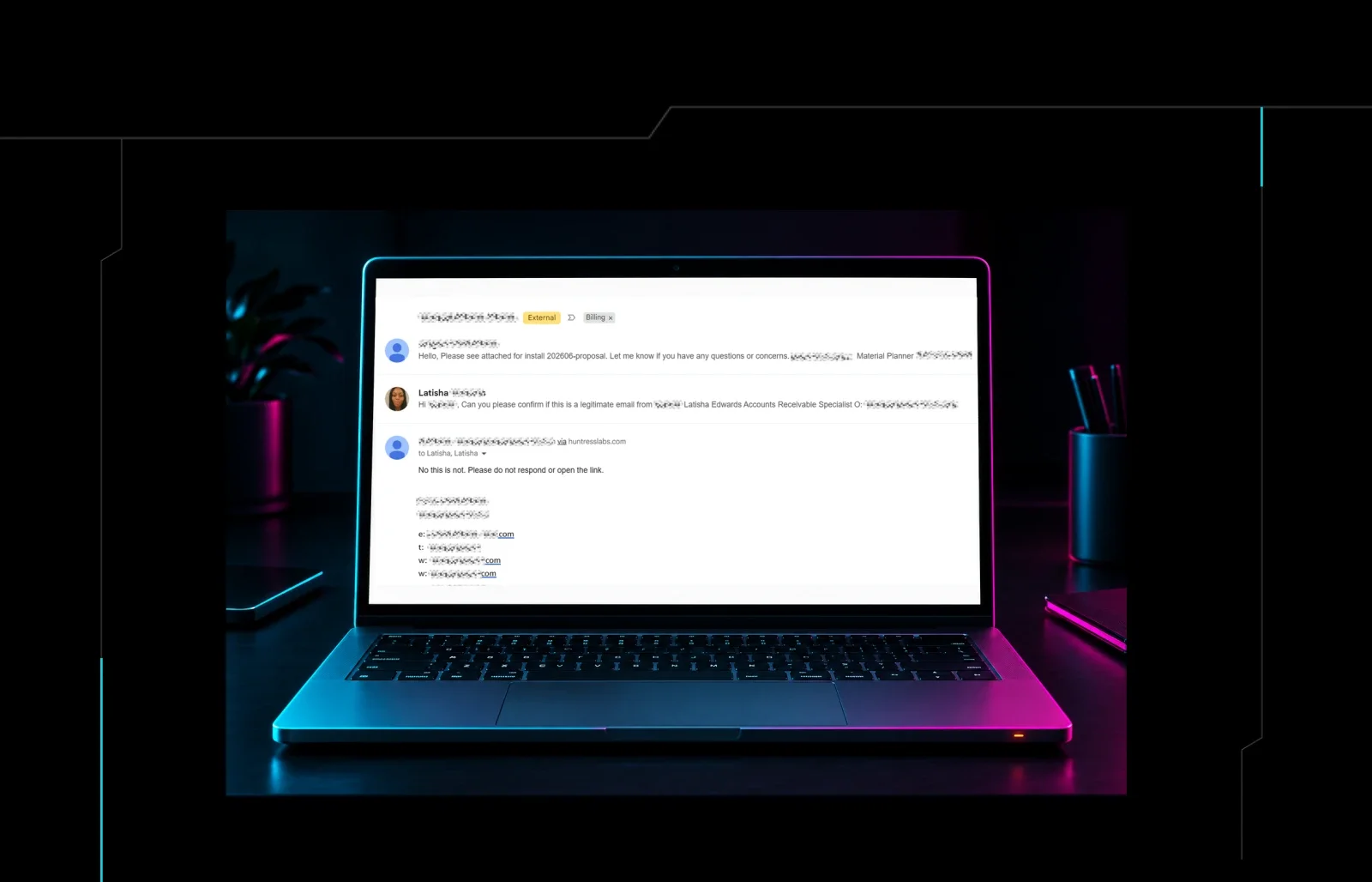
Latisha Edwards, Accounts Receivable Specialist on the Huntress billing team, received an email that looked like just every other order or renewal message in the queue. It referenced a real partner account with an order form that looked like the right step.
But something felt off. The order form had a "log in" link embedded in it, which didn't match how this partner usually handled business. Instead of clicking, Latisha emailed her at the partner to follow up. That follow-up confirmed the email was a BEC attempt, sent by someone impersonating the partner. Stopping this attack came down to one person slowing down long enough to ask a question. The email looked right because it sat inside a conversation the team already trusted.
Figure 2: A real-world BEC email attempt caught by the Huntress billing team
What you can do to slow down BEC
Now that you've seen what BEC looks like in the wild, let's dig into what you can do it.
Encouraging your teammates to ask questions is the first step in a good defense against BEC. The Huntress billing team caught this one because Latisha felt safe asking it.
From there, build good mailbox hygiene habits. The attack can start in your mailbox or arrive as an email from someone posing as a partner, and each one calls for a different kind of check.
For your own mailboxes, watch for inbox rules that don't seem to make sense. Set up alerts for any new forwarding rule, especially one that sends mail to an external domain.
Figure 3: Hidden inbox rules in a 2026 token replay campaign .
For emails that appear to come from partners, flag any request to change account numbers or payment instructions, or any unexpected link that asks you to log in, as high risk, and check the sender's actual address. Verify it directly with your usual through a channel you already trust, like a known phone number or portal.
What technology can do to shut down BEC
BEC scams are built to slip right past you. Here's where Huntress fills the gaps.
Managed Identity Threat Detection and Response (ITDR) watches for identity-driven threat behavior across Microsoft 365 and Google Workspace, including session hijacking, suspicious logins, and malicious inbox and forwarding rules, backed by our 24/7 human-led, AI-centric Security Operations Center (SOC).
Managed Identity Threat Detection and Response (ITDR) watches for identity-driven threat behavior across Microsoft 365 and Google Workspace, including session hijacking, suspicious logins, and malicious inbox and forwarding rules, backed by our 24/7 human-led, AI-centric Security Operations Center (SOC).
Managed Identity Security Posture Management (ISPM) works earlier in the attack chain, closing the misconfigurations and policy drift that let attackers into mailboxes and helping enforce conditional access policies.
Managed Identity Security Posture Management (ISPM) works earlier in the attack chain, closing the misconfigurations and policy drift that let attackers into mailboxes and helping enforce conditional access policies.
Managed Security Awareness Training (SAT) helps your people recognize when to pause and verify a change to a payment.
Managed Security Awareness Training (SAT) helps your people recognize when to pause and verify a change to a payment.
Figure 3: Example of BEC activity flagged by ITDR
The most dangerous BEC email looks exactly like the one you were expecting. Start defending your identities against BEC today with a free trial of Huntress Managed ITDR.
The full story
This article is one source in a clustered incident — the cluster page carries the summary, timeline and every other outlet covering it.
