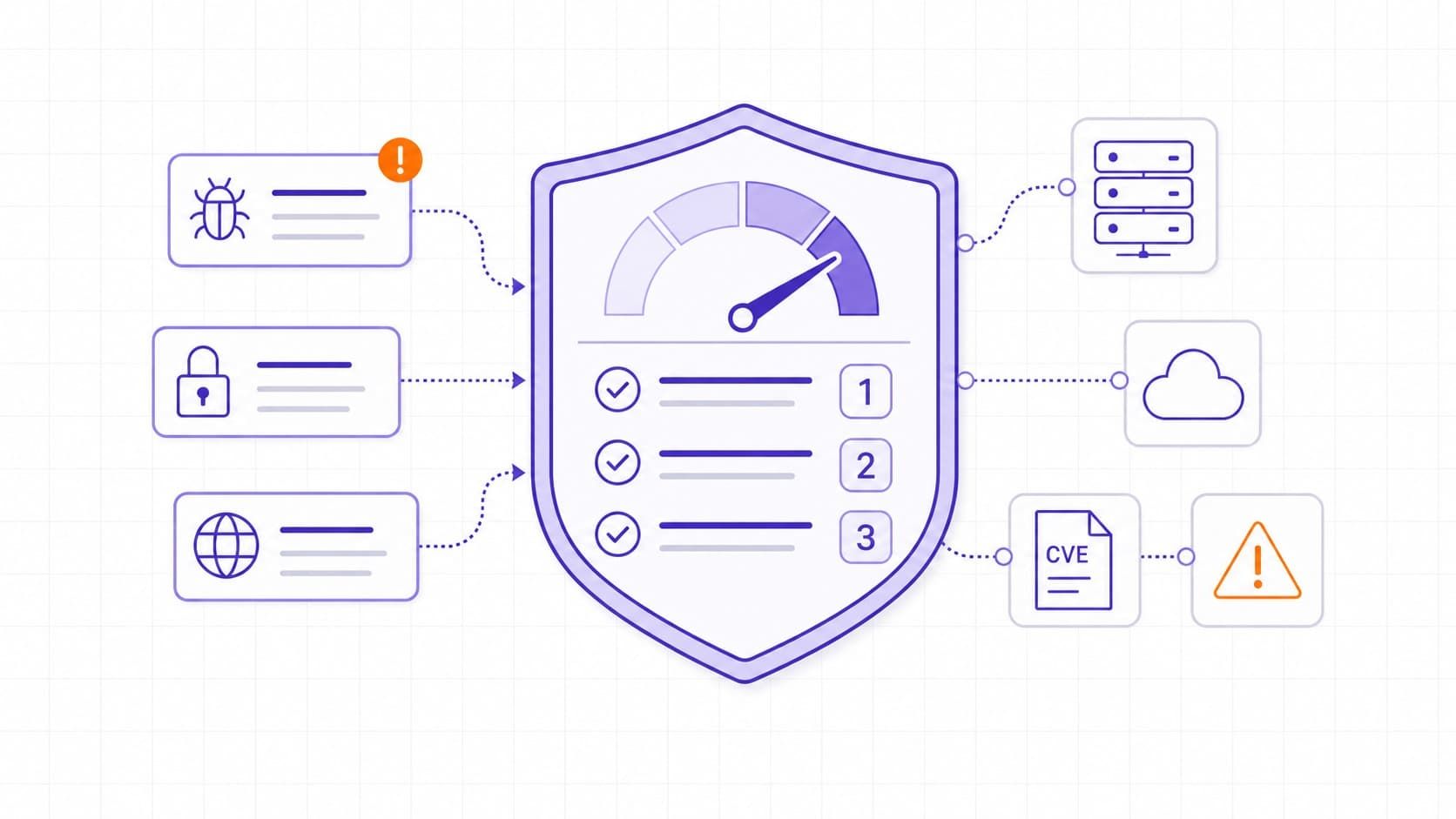
Vulnerability prioritization is the process of deciding which confirmed security findings need action first. It combines technical severity with the exposure and business importance of the affected asset, plus evidence that attackers may exploit the issue.
Vulnerability prioritization is the process of ranking confirmed vulnerabilities so the team can address the riskiest work first. It is a decision process, not simply a sort by CVSS score.
A scanner may return hundreds of findings. A critical CVSS score on a retired internal test host and a medium-severity issue on an internet-facing customer portal should not automatically receive the same treatment. Priority changes with asset value, exposure, compensating controls, exploit evidence, and the time needed to reduce risk.
Prioritization sits between discovery and remediation in a vulnerability management workflow . It gives owners a defensible order for patching, configuration changes, temporary mitigations, or accepted risk.
CVSS is a common way to describe the technical characteristics and severity of a vulnerability. The standard assigns a score from 0.0 to 10.0, but it does not calculate the business impact of a finding in a particular environment.
The CVSS guide explains this distinction in more detail.
Treat CVSS as the opening signal. Then add the context that a generic score cannot know:
For background on CVE identifiers and what they do not tell you, see What Are CVEs?
A CVE identifies a publicly known vulnerability; it does not prove that a specific asset is exploitable.
The best workflow uses a small, repeatable set of inputs. Teams do not need a complex proprietary formula to start. They do need evidence that is recorded consistently.
What do the CVSS vector and vendor advisory say impact and attack conditions?
Sets an initial triage level, but never the final priority alone.
Is the asset production, business-critical, regulated, or a shared control point?
Raises priority when disruption or data exposure would materially affect the organization.
Is the affected service internet-facing, reachable by untrusted users, or broadly accessible internally?
Raises urgency when the attack path is short and realistic.
Exploitation evidence
Is the CVE in CISA KEV, linked to active exploitation reporting, or assigned a high EPSS probability?
Moves validated findings toward immediate review and remediation.
Remediation feasibility
Is a tested patch available, or is a temporary mitigation required?
Shapes the action plan and the due date, not the underlying risk.
Do not hide uncertainty inside a score. If the scanner cannot confirm the installed version or the vulnerable code path, label the finding for validation. This avoids spending an emergency change window on a false positive while keeping a potentially exposed asset visible.
Confirm that the affected software, version, and asset are in scope. Link the finding to a technical owner who can confirm whether the component is present and exposed. Validation does not mean waiting for perfect proof before acting: a public, critical asset with a credible active-exploitation signal can receive immediate containment while the team verifies details.
Attach the asset's owner, environment, criticality, internet exposure, data sensitivity, and dependency role. Add vendor advisories, CISA KEV status, and EPSS where the finding has a CVE. FIRST describes EPSS as a model estimating the probability that a published CVE will be exploited in the wild within the 30 days. Use it as one signal, alongside local context.
Create a clear decision: patch, change configuration, isolate or disable the service, apply a compensating control, accept the risk for a defined period, or investigate further. The owner and due date should be visible. Contractual or regulatory requirements may set remediation deadlines, but their exact rules differ by program and environment. Check the applicable contract, framework, and version instead of applying one universal timeline.
After remediation, rescan or otherwise verify the fix. Record evidence, the remediation date, and any remaining limitation. A finding can return after a rollback, a new deployment, or rediscovery of an unmanaged asset. Closing the ticket without verification produces a clean dashboard, not necessarily a safer system.
Risk-based prioritization asks how much harm a successful exploitation could cause in your environment . It therefore emphasizes asset criticality, business process impact, data sensitivity, and exposure.
Threat-informed prioritization asks whether attackers are likely to use the weakness now . It uses evidence such as CISA KEV, vendor alerts, threat reporting, exploit availability, and EPSS. This method is especially valuable when the queue contains many technically severe CVEs.
Use both. A high-severity finding on a public production service with a KEV entry is normally an immediate decision. A medium-severity finding may also move to the top if it enables access to an identity system or a sensitive API. Conversely, a high CVSS score on an isolated, decommissioning asset can be scheduled after the team confirms the isolation and retirement date.
A useful operational distinction is that KEV and EPSS answer different questions. KEV is evidence of known exploitation, while EPSS is a forward-looking probability estimate. A CVE can have a high EPSS score without appearing in KEV, so it merits close review rather than an automatic emergency change. A KEV entry affecting an exposed critical asset is a stronger reason to move directly to containment and remediation.
Patching is the preferred remediation when the vendor provides a tested fix and the change can be applied safely. Test the update where possible, define rollback conditions, and verify the installed version after deployment.
When a patch cannot be applied immediately, reduce the attack path. For example, restrict network access to a management interface, disable an unnecessary service, rotate exposed credentials, or isolate the affected workload. These are temporary controls that require a follow-up date and an owner. They do not make the underlying vulnerability disappear.
Teams also need visibility into assets that were not deliberately added to a scan list. Asset discovery and perimeter monitoring can support the inventory and exposure checks that give prioritization its context.
For the discovery stage itself, vulnerability scanning explains what scanners can identify and where manual validation remains necessary.
Measure the workflow by risk reduction, not only ticket volume. A decreasing count of open findings can be misleading if the remaining items are concentrated on critical, exposed assets.
An effective vulnerability queue gives each item a reason for its placement: confirmed severity, asset context, exposure, exploitation evidence, owner, action, and due date. That lets a small security or DevOps team explain why one finding is addressed today while another is safely scheduled later.
Start with the assets that matter most, validate scanner output, and make urgent decisions based on evidence rather than a score alone. Review the queue whenever a new advisory, exposed asset, or operational change alters the risk.
Vulnerability management is the broader cycle of discovering, assessing, prioritizing, remediating, verifying, and reporting security findings. Vulnerability prioritization is the decision stage within that cycle. It answers which validated issue should receive attention first and why. A team can run scans without a mature prioritization process, but the result is often an unstructured backlog. Prioritization turns the findings into owned, time-bound work.
No. A critical CVSS score deserves prompt review, but it is a technical severity measure rather than a complete business-risk calculation. Check the asset's role, exposure, reachability, exploitation evidence, and existing controls before setting the final due date. A medium-severity issue on a public production identity service may be more urgent than a critical issue on an isolated system scheduled for retirement. Document the reasoning for every exception.
Use CISA KEV as evidence that a vulnerability has been exploited in the wild and treat a relevant entry as a strong escalation signal. Use EPSS to estimate the probability of exploitation for published CVEs over the 30 days. Neither source replaces asset context. A practical workflow checks KEV first, then EPSS, exposure, and asset criticality before assigning an owner and remediation date.
First confirm whether the vulnerable feature or version is present and reachable. If the risk is material, use temporary measures that reduce exposure, such as restricting network access, disabling an affected feature, isolating the workload, or applying a vendor-recommended workaround. Give the mitigation an owner and expiration date. Monitor vendor advisories, plan the permanent fix, and verify that the temporary control remains active until remediation is complete.
Review priorities when new scan results arrive, a high-impact advisory is published, an asset becomes internet-facing, or a business change affects criticality. High-priority queues often need daily attention, while a broader backlog can be reviewed weekly or on the cadence that fits the environment. The essential rule is event-driven review: a priority set before a new exploit report or deployment may no longer reflect current risk.
Vulnerability management automation turns recurring discovery, triage, and follow-up work into a reliable workflow. It should give engineers better context and faster handoffs, not patch production systems blindly.
Vulnerability management is the ongoing process of finding, prioritizing, fixing, and verifying security weaknesses across an organization's assets. It turns scanner output into owned remediation work instead of a growing list of alerts.
The full story
This article is one source in a clustered incident — the cluster page carries the summary, timeline and every other outlet covering it.
