 Back Cybersecurity-Insiders
Widespread Use of AI Agents Is Opening Up Enterprises to a Whole New World of Risk
Cybersecurity has always been a game of cat and mouse. Threat actors develop a strategy to exploit victims, security teams develop a way to defend against it, so the threat actors pivot to a new strategy. While the emergence of advanced AI has changed virtually everything cybersecurity, it hasn’t managed to alter this dynamic. The only difference now is that the game is moving at a much faster pace.
In their third annual Cybersecurity Threat Report, From Deepfakes to Double Agents: The New Face of AI-Driven Cyber Risk , the analysts at IRONSCALES paint a vivid picture of this reality in action, in which we see organizations gaining ground against the rise of deepfakes, only to be opened up to a whole new realm of risk by the emergence of agentic AI.
Moving forward, how enterprises choose to vet, operate, and secure their use of AI agents will play a critical role in whether they can successfully navigate this latest evolution of the game.
AI Agents Are Being Widely Embraced in the Workplace
Despite being a relatively new technology, AI agents are already seeing rapid, widespread adoption in the modern enterprise. In the aforementioned survey report, 96% of respondents said their organizations are already using AI agents that can act on employees’ behalf, with more than half (52%) saying they are using them widely. Even more importantly, only 19% say they limit agents to the public web, meaning roughly 4 in 5 organizations give AI agents access to internal systems.
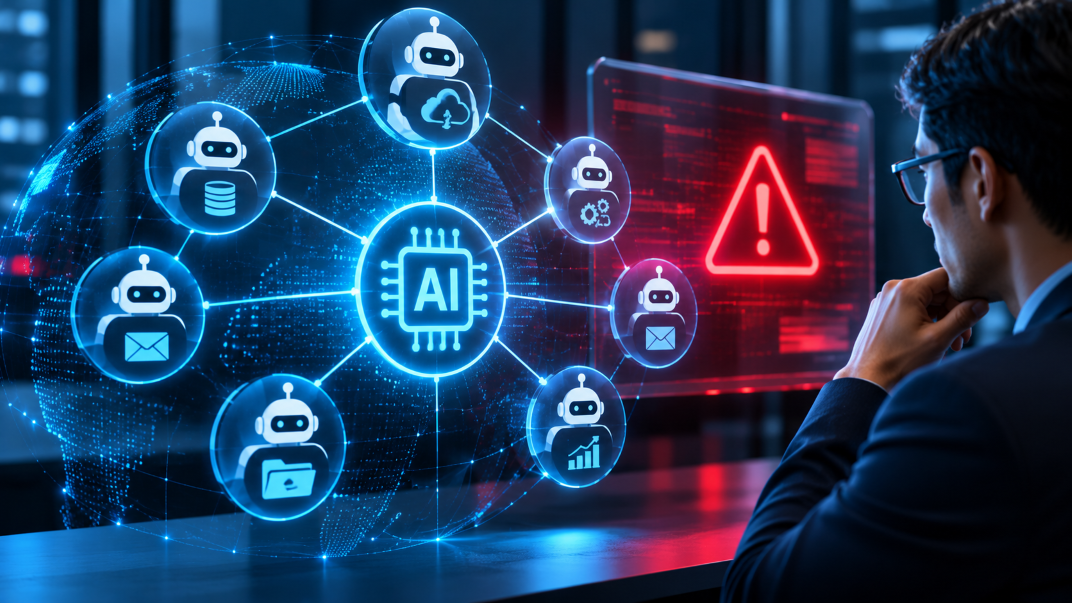
And those systems are both wide-ranging and rife with risk. The top four most common systems AI agents are being used in are ticketing and helpdesk systems (67%), cloud storage (49%), email and messaging platforms (49%), and internal file repositories (49%). Even finance, billing, and payment systems are within reach of these tools at 30% of organizations.
With sweeping access and rapidly-growing autonomy, these AI agents are transforming day-to-day operations at companies across industries. However, this transformation hasn’t gone unnoticed by bad actors. For them, the rise of agentic AI represents a whole new world of possibilities for exploitation and attacks. And they’re already hard at work.
Agentic Risk Realized: Nearly Three in Four Organizations Have Already Been Hit
It would be one thing to simply highlight the risks the widespread use of AI agents poses. It’s another thing entirely to know that those risks are already becoming realities for the overwhelming majority of organizations today. In this year’s report, a staggering 77% of respondents say an AI agent or tool acted on instructions or content that turned out to be malicious, misleading, or unauthorized in the past 12 months.
The data is clear: threat actors are actively exploiting the proliferation of agentic AI. And the inbox appears to be their preferred entry-point. Among organizations that experienced incidents, the two most common types were an AI tool summarizing or acting on a malicious email or message (42%) and an attacker using an AI tool in a phishing or social engineering attempt (41%). Moreover, professionals are acutely aware of this reality, saying acting on a malicious email, prompt, file, or link is the #1 way an AI agent could cause a security incident.
In the past, there was just one target for these attacks: the person reading the email. As a result, we’ve spent the past several decades developing security systems that seek to protect humans from malicious emails and phishing. Now, there is an entirely different target to be exploited, and organizations seem to be woefully unprepared for this new reality.
The Security Oversight Gap
So as more AI agents gain access to more systems and open the door to even greater cyber risk, one can’t help but ask, who’s overseeing this transformation? Oddly enough, of those organizations using AI agents, only 6% say their security team is the primary approver of AI agents, plugins, and connectors. Instead, IT teams are being given that responsibility, with 78% of organizations saying they were responsible for agentic adoption.
While IT being a central player in agentic adoption isn’t inherently problematic, the lack of input and oversight by security teams certainly is. Any and every new tool entering an enterprise stack should be vetted by its security team. And this is especially true of agentic AI, whose ability to act autonomously inherently poses significantly greater risks than traditional technologies.
It goes without saying that this gap needs closing. And while it puts another layer of approvals in front of adoption, the organizations that close that gap will be better off than those that race past security assessments.
A Lesson Learned From Improved Deepfake Defenses
As the third annual cybersecurity threat report from IRONSCALES, this year’s edition included benchmark questions that provided insights into certain year-over-year trends. The focus of last year’s report was deepfakes — how many organizations are being exposed to attacks driven by them, what the average costs are, and what teams are doing it.
Last year, most of the IT and cybersecurity professionals surveyed said their organizations had yet to invest in deepfake defense, but planned to do so soon. Based on this year’s findings, they did just that. And it is paying off. The of organizations already actively investing in deepfake defense rose from 37% to 48% year-over-year and the of financially affected organizations losing $100K or more fell from 63% to 49%. Among organizations that lost money to deepfake-related incidents, average losses were also less severe, with the estimated average falling from roughly $280,000 in 2025 to $225,000 this year.
In short, organizations recognized a problem, rallied resources around it, and have made meaningful strides toward mitigating its effects. While there is still plenty of work to be done to improve enterprise deepfake defense, these data points provide some much needed affirmation that when organizations take emerging threats seriously, they can begin to level the playing field.
Only time will tell, but the hope is that we see organizations respond to agentic risk with the same kind of urgency—while continuing to invest in technologies to prevent against deepfakes and other growing threats.
