 Back blog.report-uri.com
Worlds Largest Brands Infected With Malware Via Optimizely
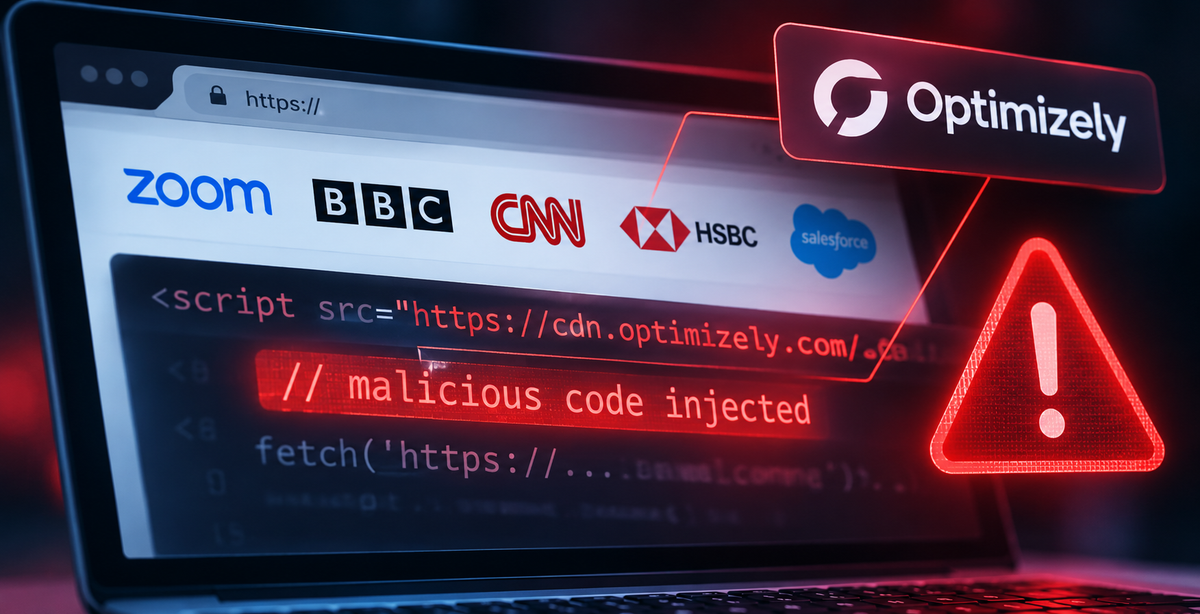
On 16 November 2026, malicious JavaScript was served to visitors of 178 organisations through the Optimizely Web experimentation platform. The list includes some of the most visited sites in the world: Zoom, the BBC, CNN, Salesforce, GitLab, IKEA, HSBC, Equifax, Air France-KLM, Ledger and Peacock .
The malware was a multi-purpose kit. It swapped cryptocurrency wallet addresses for the attacker's, skimmed payment cards, stole cookies and screenshots, and on iPhones and iPads it delivered the Coruna and DarkSword iOS exploit kits . Crypto has already been stolen, with verified transactions to the attackers.
This is exactly the kind of attack Report URI is designed to detect. Our platform can identify unexpected changes to trusted JavaScript, detect new scripts being loaded and reveal suspicious connections to external destinations. In this case, those signals would have exposed the malicious activity, even though the original script was being served from a trusted Optimizely domain. With an appropriate CSP in enforcement mode, organisations could have gone a step further and blocked key parts of the attack before they succeeded.
The important lesson here is that trusted JavaScript doesn't always remain trustworthy . A website can be compromised through a third-party dependency without its own code or infrastructure ever being breached.
Most of the malicious code has now been removed. At 21:52 UTC we found it in only 1 of the 188 infected snippets, down from 169 at 20:56 UTC. If your site uses Optimizely Web, or you visited any of the sites below today, read on.
Optimizely Web works by having each customer load a JavaScript "snippet" from Optimizely's CDN, for example . The snippet contains Optimizely's code, the customer's experiments and an optional field called Project JavaScript ( projectJS ): custom code the customer writes in their Optimizely dashboard, which runs on every page.
The attacker wrote their own code into the Project JavaScript of customer projects, and the rest of each snippet was untouched. The file was still served from cdn.optimizely.com , with Optimizely's certificate, from a host that every affected site already trusted. Here is what was added to Zoom's snippet:
We saw three versions of the injected loader:
A plain tag pointing at (most snippets).
The same URL hidden in base64 with atob() . A for "1688360.cc" won't find it. Smartsheet's snippet was cleaned at one point and then re-infected with this version, so whoever wrote the code still had access at the time.
A full inline copy of the payload , which runs through eval if 1688360.cc is blocked.
Some customers serve their snippet from their own domain, such as opt.scheels.com/js/ .js or .js . Those were affected too, because the content comes from the same Optimizely project.
We don't know how the attacker got write access to so many unrelated customer projects: a compromised Optimizely system, a compromised credential with cross-customer access, or something else. That's for Optimizely to explain. To be clear, Optimizely's CDN served exactly what it was given; this was not a CDN cache-poisoning attack. Optimizely's own sites were affected as well: the snippets for and login.optimizely.com both carried the code.
The payload was rebuilt 26 times during the day. The attacker added features, and added wallets but never removed any.
What the payload does
Every visitor received the same script, track.js , and every part of it was active at once. What a visitor experienced depended on their device and what they did on the page.
1. Crypto address swapping (already stealing money)
The script finds any valid wallet address (BTC, ETH and EVM chains, TRON, Solana, TON, Litecoin, Bitcoin Cash, Dogecoin) and replaces it with one of the attacker's. It validates checksums so it only swaps real addresses. It swaps them in:
page text, form fields, links and images;
the clipboard, on copy and through navigator.clipboard ;
outgoing fetch /XHR requests, window.open , and the iOS sheet.
It re-scans the page whenever it changes. Copy an address from any affected page, or from anywhere else while that tab is open, and you may paste the attacker's.
Added at 13:43 UTC. The script watches form submissions and every fetch /XHR POST for a card number (Luhn-checked), expiry date and CVV. When it has all three, it sends them to with navigator.sendBeacon . Cards entered in hosted payment iframes (Stripe, Adyen and similar) were out of its reach. Cards typed into a site's own form fields were not.
3. Cookie and screenshot theft
When it swaps an address to wallet or payment wording, it sends the following to :
document.cookie (cookies not marked HttpOnly );
the original addresses it replaced;
a screenshot of the page, rendered with html2canvas.
4. iOS exploit kits: Coruna and DarkSword
On iPhones and iPads the script loads boot.js from 5vobauua3ojpklx.icu and eil786npto9u5bq.icu . It reads the iOS version and loads an exploit chain in a hidden iframe:
The Coruna loader is byte-identical to a sample we analysed in October from a different campaign. The kit's own say iOS 18.7.3 and later, and 26.3 and later, are patched. Pages on iOS 18.6 or earlier reload every 60 seconds to retry the exploit, which is a visible symptom.
As of 19:25 UTC on 16 November, the attacker's wallets had received $7,040 , all within roughly nine hours on the 16th:
Funds were swept out at 13:03 to 13:05 UTC. The USDC on Ethereum went to a HitBTC deposit address . The TRON wallet has been in use since March 2026 , so this actor was active long before this campaign. We cannot see how many cards or cookies reached 1688360.cc .
We fetched 1,611 distinct Optimizely snippets , found mostly through our own crawl data, and checked each one for the malicious code. 188 snippets belonging to 178 organisations were infected. We kept a copy of every infected file, along with its response headers, SHA-256 hash and fetch time as evidence. The real number is likely higher as we could only check snippets we could find in time.
Ranked by Tranco position within each sector and the status at 21:52 UTC: every snippet except TalkTalk's had been cleaned.
Banking & Finance (32)
Technology & SaaS (23)
Retail & Fashion (20)
Streaming & Entertainment (12)
Industrial & Manufacturing (8)
& Smart (5)
The earlier webshell.lol wave, through Kissmetrics, StorifyMe and Minute Media, affected other sites and isn't included above.
How Report URI would have detected, or even prevented, this attack
Every one of these needs only a CSP in Report-Only mode, so nothing on the site breaks:
It's possible to go even further and deploy a CSP that could actively block these attacks and prevent any data breach happening. The websites affected by this attack weren't necessarily running vulnerable code of their own, they were loading JavaScript from a provider they trusted, and that trust was exploited. This is why monitoring what runs in your visitors' browsers is so important. Report URI gives organisations the visibility to detect when trusted dependencies change or behave unexpectedly, and the tools to help enforce policies that prevent malicious scripts and connections from succeeding.
Did Content Security Policy help?
We crawled 256 of the affected organisations' own hosts and evaluated their CSP against what this payload needs:
Load track.js from 1688360.cc .
Or run the inline fallback , which needs 'unsafe-eval' or 'unsafe-inline' .
Send stolen data to 1688360.cc ( connect-src ).
Load the iOS kit ( script-src , frame-src ).
Allowing cdn.optimizely.com was never going to help. The malicious code arrived from the trusted host itself. What separated the 24 protected sites from the rest was a restrictive script-src . A site that lists only the hosts it needs blocks 1688360.cc . Two common settings let it straight through:
'strict-dynamic' : any script the trusted Optimizely snippet inserts is trusted too.
'unsafe-eval' , which Optimizely's own documentation tells customers to allow: the inline-fallback version ran through eval even where track.js was blocked. That is what happened at HSBC. Its CSP blocked track.js and the data theft, but the inline copy still ran.
connect-src matters. The 17 "partial" sites blocked card, cookie and screenshot theft because they restrict where the page can send data. That doesn't stop address swapping, which happens inside the page.
If your site uses Optimizely Web:
Open every project's Project JavaScript and every experiment's custom code. Look for 1688360.cc , atob( and any script you didn't write.
Review who and what has write access to your Optimizely account (users, API tokens, integrations) and rotate credentials.
If you have card fields in your own forms, treat cards entered on 16 November as potentially exposed.
Treat any session tokens or secrets in non- HttpOnly cookies as exposed, and rotate them.
Deploy a CSP. Restrict connect-src , avoid 'unsafe-eval' where you can, and turn on reporting.
Consider if you need to communicate to your customers having served them malware.
If you visited an affected site on 16 November:
Update your iPhone or iPad to iOS 18.7.3 or later, or iOS 26.3 or later.
Check any crypto transfer you made. If the address you pasted doesn't match the one you meant to pay, it may have been swapped.
Watch your card statements if you paid by card on an affected site.
Indicators of compromise
All of these domains are attacker-owned; block them including subdomains.
Attacker wallets: BTC 19g9rZcPeiz8rUvyWpTRyXXhPnjsWrc3kW ETH/EVM 0xC4026b06D82b0F0B363eda0642D61CfbDc17884e TRON THvs6p56XkUiMkJeSc51cAP64u2RsTYqxa SOL FVtL8NMYS9PA1v3HE67XUGCtGA9JaZUvqav2fU2LrV5n TON UQAgM1VqSZQiJLSG5w-ovurq5CZdxLEK3_7CMmwALTA5e09p LTC ltc1q3wp7g6ds0ggg6fl6kncpa4sepn0q3qfacgred5 BCH qzkaaf8n6grmpr0d9lx8xutn3r9lk722f566hhpe58 DOGE DBEGrxRF7KMSuhTS4c1MFviStU6efdMnu5
We keep an archive of every infected snippet with hashes and timestamps, and can it with affected organisations and CERTs on request. During research and investigation, once we were confident that Optimizely was the source, we began efforts to reach out via various channels and provide the full details. At the time of publication, we have not had any response.
Update: 17 November 2026, 09:17 UTC
There are several updates to provide on this incident:
As of 16 Nov 23:11 UTC we observed that all infected Optimizely files were cleaned, and have remained clean since.
The attacker's domains are being taken down: 1688360.cc , the main payload and data-collection server, was put on clientHold at 17 Nov 00:37 UTC. It no longer resolves. webshell.lol , the earlier-wave injector, was put on clientHold at 17 Nov 03:37 UTC. eil786npto9u5bq.icu no longer resolves to an IP address. 5vobauua3ojpklx.icu still resolves but no longer responds.
1688360.cc , the main payload and data-collection server, was put on clientHold at 17 Nov 00:37 UTC. It no longer resolves.
webshell.lol , the earlier-wave injector, was put on clientHold at 17 Nov 03:37 UTC.
eil786npto9u5bq.icu no longer resolves to an IP address.
5vobauua3ojpklx.icu still resolves but no longer responds.
Optimizely has acknowledged the incident on their status page .
Cryptocurrency transactions were recorded against the attacker's wallets:
The attacker emptied the wallets early on 17 Nov:
04:11 UTC: 17.02 LTC → ltc1qpxvjs8u8awg8pvpwmssqlj3gzugd9vtwjtc5fc
04:13 UTC: 116 USDT → TMLQvDvpgSyx94maptc3TxvmCVtT5qHVup . This is the same address the attacker used to cash out earlier operations in March 2026 and on 3 November 2026. This has allowed us to tie them to other attacks in our Threat Intelligence data.
05:39 UTC: 0.0852 BTC → bc1q5fljq9c4g7gsjgg4etpn6k3lyusahcvjfv0u99
Note that these are on-chain receipts for crypto transactions only. We have no way to see how many credit cards were skimmed, how many cookies or screenshots were stolen, or how many iOS devices were infected before the attack was stopped.
The full story
This article is one source in a clustered incident — the cluster page carries the summary, timeline and every other outlet covering it.
