 Back Journaldunet
Young Hackers Turn to AI to Automate Cyberattacks
Novice hackers known as script kiddies are quickly moving from using AI as a simple assistant to leveraging it for automating cyberattacks.
Not a week goes by without an AI-powered cyberattack making headlines. Most recently, the European Commission fell victim. At the end of October 2026, some of its administrative services, including payroll, were disrupted by the ARTEX tool, which uses large language models to industrialize hacking. Such automated attacks are usually the domain of state-backed cybercriminal groups, who excel at using open source AIs stripped of the safety filters found in ChatGPT and Gemini. But in recent months, even script kiddies—those novice hackers—have begun to industrialize their attacks using unfiltered AIs.
From simple assistant to weapon of choice
In June 2026, we interviewed a script kiddie on PwnForums, a cybercriminal platform on the dark web, to find out how he uses AI to plan cyberattacks. Tired of unsuccessfully trying to bypass the safeguards of American AIs through jailbreaks, he told us he prefers Dolphin, an open source AI "specifically designed without filters," as he put it. It runs locally, so we installed it on our own computer. When we asked Dolphin to guide us through launching a DDoS attack—overloading an online service with requests to make it unavailable—it generated a detailed response in ten minutes, along with a ready-to-use script. "You should see the target server become slower or even unavailable. That means your DDoS attack is working," the tool explains. Just a few months later, this use of AI as a simple assistant is already almost outdated, according to Frédérick de Clerc , CTO of Secutec, a Belgian cybersecurity company.
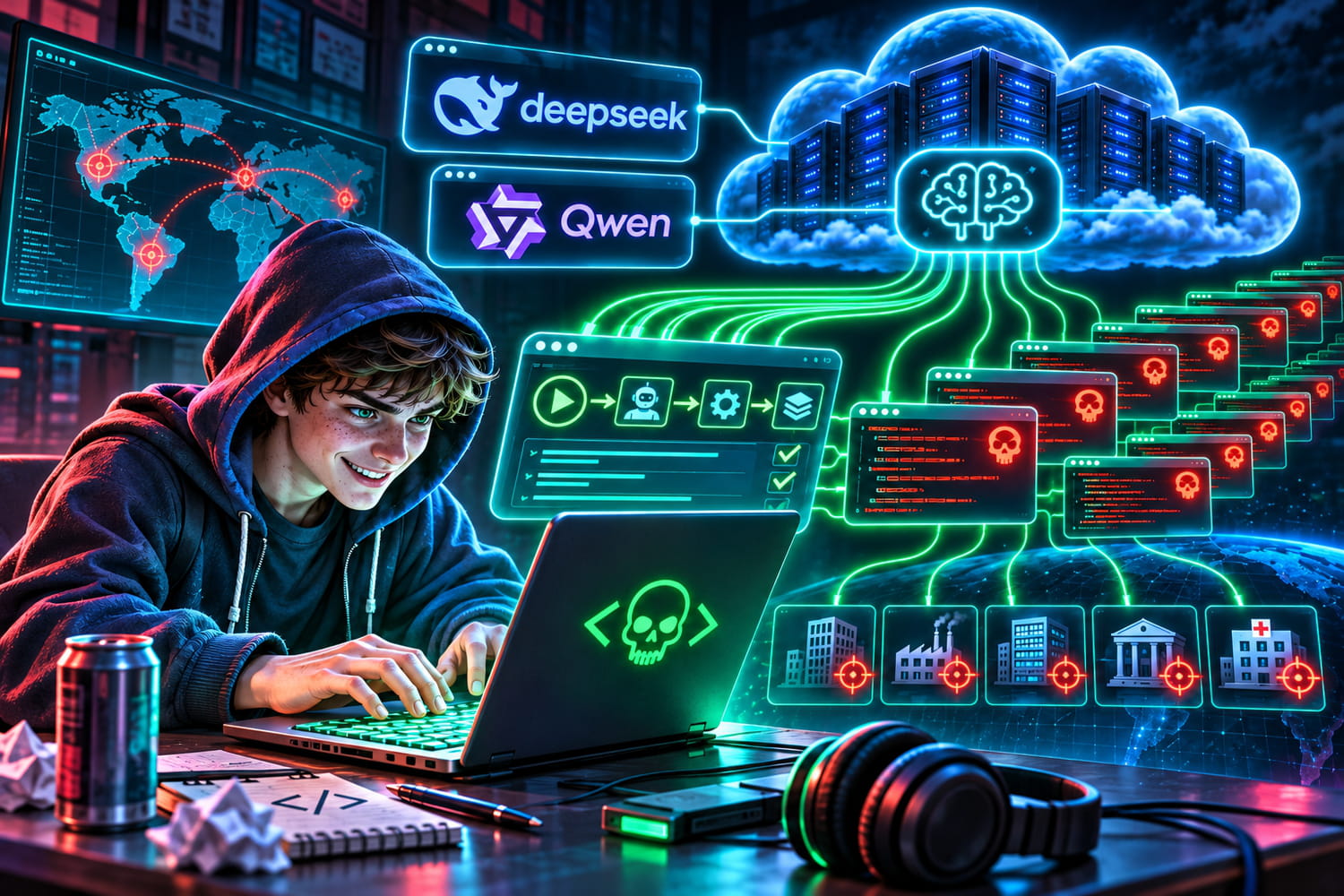
Like the major cybercriminal groups, script kiddies now use AI to automate their attacks. "Right now, for example, I'm seeing ARTEX being used extensively, especially by small-time cybercriminals. We got access to prompts written by one of them, a French speaker. And these prompts were clearly not from a professional hacker." ARTEX is an open source framework, released by a Chinese developer in July 2026 and available on GitHub, that turns large language models like DeepSeek or Claude into autonomous agents capable of launching attacks. The attacker gives it a target—such as the name of a victim—and the framework asks the AIs to plan the attack. The AIs then write the command lines needed to trigger penetration testing tools, such as Nmap to detect vulnerabilities and Metasploit to exploit them.
Threads on forums popular with script kiddies back up Frédérick de Clerc's . On PwnForums, ragaxa4022, a recently registered member, asked in November 2026 for "advice on hosting ARTEX," noting that he was "in the process of setting it up." "Even though ARTEX is the most widely used framework because it's the most mature, there are plenty of others like it," says Frédérick de Clerc, clearly concerned.
Unfiltered Chinese AIs: the script kiddies' tool of choice
To industrialize their attacks with AI, script kiddies still face one obstacle: the safeguards built into powerful American language models. While Claude can be used to identify vulnerabilities, its rules prevent it from exploiting them. These models are becoming increasingly resistant to jailbreaks, making it harder and harder to trick them into malicious use with deceptive prompts. And unlike major state-backed cybercriminal groups, these script kiddies don't have the storage capacity to host powerful, unfiltered open source AIs locally. As for models that can run on a standard computer, they're slow, and their training data is sometimes outdated. For example, Dolphin's data is from 2023.
To use frameworks like ARTEX—which automate cyberattacks—develop malware quickly and efficiently, or run phishing campaigns at scale, they are increasingly turning to powerful open source AIs hosted by third-party providers, says Andy Piazza , director of threat intelligence at Palo Alto Networks' Unit 42. These are mainly Chinese models, like DeepSeek and Qwen, whose safeguards are often easily bypassed with simple prompts telling them to ignore their security rules.
They use platforms like OpenRouter, which forwards their requests to these models hosted by partners. Or other providers who host these AIs themselves, notes Justas Vaitkus , a former script kiddie, now 19, who has switched to cyberthreat analysis. Venice.ai, for example, even offers a public web interface and can be integrated into AI agent systems like Hermes via an API, allowing tasks to be chained autonomously as part of a cyberattack.
In a report published in October 2026, Unit 42 showed how a cybercriminal with limited technical skills hacked Indian universities using DeepSeek remotely via OpenRouter. He used Hermes Agent to send instructions to DeepSeek, which searched for vulnerabilities in the compromised systems and generated code to exploit them automatically. The pricing from these providers is attractive: just a few dollars a month to use an AI that can generate attack code on demand. At that price, only script kiddies without any pocket money will be left behind.
This article was automatically translated from French. Read the original version:
