 www.vulncheck.com
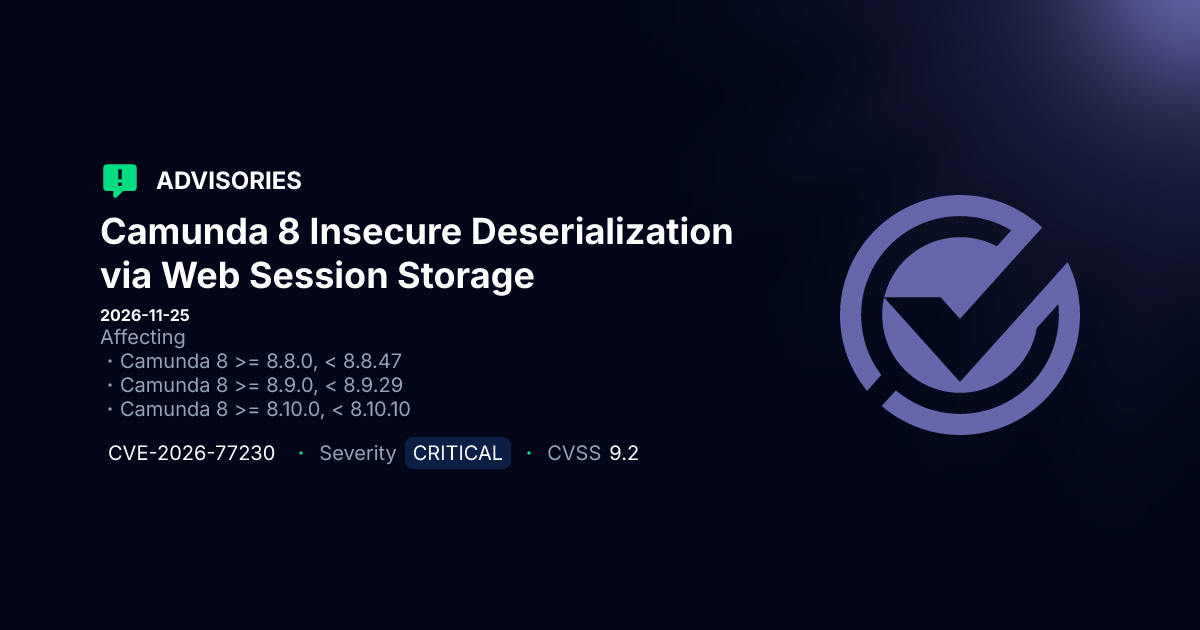
Camunda 8 Insecure Deserialization in Web Session Storage (CVE-2026-77230)
Article Content

- •CVE-2026-77230 is an insecure deserialization flaw in Camunda 8 persistent web session storage, with CVSS 9.2.
- •Exploitation requires write access to the session index, such as an exposed unauthenticated Elasticsearch deployment.
- •Successful exploitation could yield code execution as the Camunda service account.
- •No active exploitation, public PoC, or KEV listing is reported in the sources.
- •Remediation: upgrade to the vendor-fixed release for your branch and restrict session-index access.
Camunda 8.8.0 before 8.8.47, 8.9.0 before 8.9.29, 8.10.0 before 8.10.10, and 8.11.0-alpha1 contain an insecure deserialization flaw in the persistent web session feature, which stores session attributes as Java-serialized data and deserializes them without an ObjectInputFilter. Per Redpacketsecurity, an attacker with write access to the web session index, such as an unauthenticated Elasticsearch cluster from Camunda's docker-compose files, could plant a crafted serialized object and trigger it with a matching session cookie. Combined with a gadget chain such as the bundled Commons Collections 3.1-RC1 library, this could lead to code execution as the Camunda service account. Exploitation requires high attack complexity and access to session storage. Redpacketsecurity states the supplied data does not establish active exploitation, and no PoC or KEV listing was reported. The VulnCheck page linked from the cluster is background material only. The CVE is recorded with a CVSS score of 9.2, published 2026-11-25, and the vendor-fixed releases are the upgrade path.
Ask AI about this cluster
Answers cite the sources they use
Timeline
More articles in this cluster (2)
Following this threat?
Track Camunda and CVE-2026-77230 in your own feed — you're alerted when they show up in new reporting, leak sites or exploitation.
Free account · no card needed
Common questions
Am I affected?
Is this being exploited?
What should we do first?
Continue Reading
 CVE-2026-123890: Auth bypass in VMware vCenter exploited by Armory Castle before patch CVE-2026-123890, a flaw in VMware vCenter Server rated CVSS 9.8, allows an unauthenticated remote attacker to obtain an administrator session on the platform. According to the Google Threat Intelligence Group, the flaw was exploited by the espionage group Armory Castle (formerly UNC5221), which has suspected China…