 developers.googleblog.com
Google adds semantic governance policies to block risky AI agent tool calls
Article Content

- •Semantic governance policies, in Preview on Gemini, block AI agent tool calls before execution if they violate company rules or the user's request.
- •A language model judges each proposed tool call; calls must pass both a user-intent check (on by default) and any written policies.
- •Google says LLM verdicts are probabilistic and may vary, so it recommends dry-run mode before enforcing.
- •The control is designed to counter indirect prompt injection, where a document instructs the agent to act beyond the user's request.
- •Streamed model responses are not evaluated, and the policies complement rather than replace legal and compliance reviews.
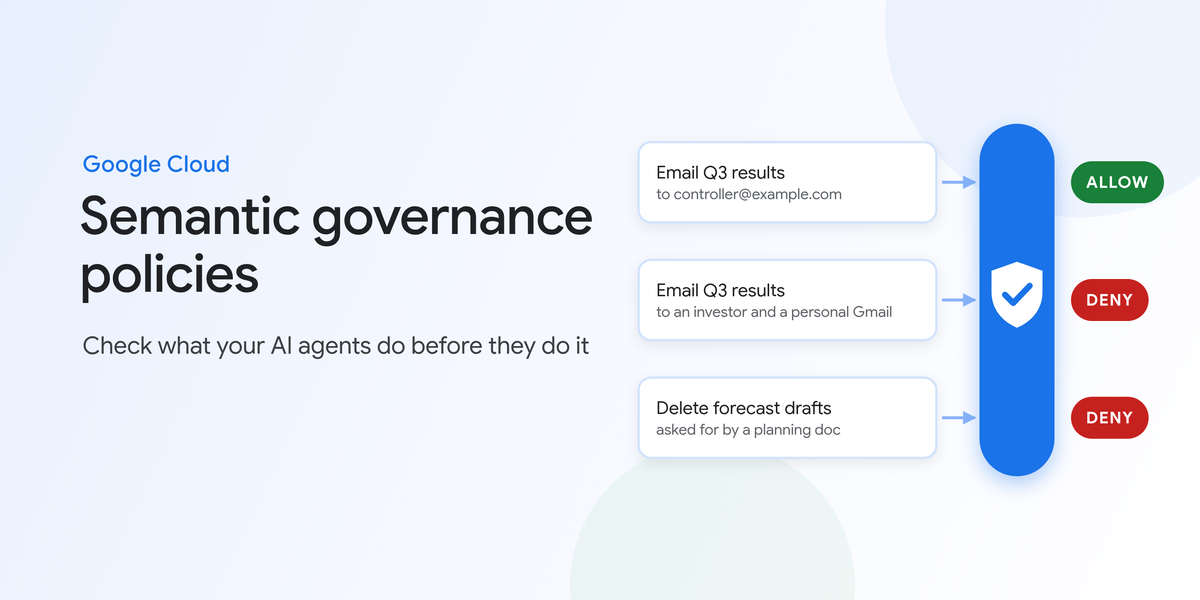
Google has released semantic governance policies in Preview on its Gemini platform, letting enterprises check each tool call an AI agent's model proposes before it runs. A language model acts as judge, comparing each call against plain-language company rules and against the user's request; a call must pass both to execute. Failed calls are replaced with a denial message and the verdict and rationale are logged to Cloud Logging. Google's example is a finance agent blocked from emailing unreleased quarterly results to an outside investor and a personal Gmail address, and from deleting drafts after reading a document containing hidden instructions (indirect prompt injection). Google states that because verdicts come from a probabilistic LLM they may vary, and recommends dry-run review before enforcement. Streamed model responses are not evaluated. The control is enforced at a policy enforcement point such as Agent Gateway, and agents must have an identity and route model requests through that gateway. Coverage is limited to Google's own platform, and the articles describe no vulnerability, attack in the wild, or patch.
Ask AI about this cluster
Answers cite the sources they use
Timeline
More articles in this cluster (3)
Following this threat?
Track Google in your own feed — you're alerted when they show up in new reporting, leak sites or exploitation.
Free account · no card needed
Common questions
Does this protect agents on platforms other than Gemini?
Should we enforce policies immediately?
Does this stop permission-based misuse?
Continue Reading
 PHP Security Updates Patch 18 Flaws, Including CVSS 9.2 PHP-FPM Request Smuggling Bug Security updates for PHP addressing 18 vulnerabilities across the core engine, session handling, PHP-FPM, and CGI were released on 19 November 2026, according to CERT-PH. The most critical flaw, CVE-2026-129289, is a PHP-FPM request smuggling vulnerability rated CVSS 9.2, which CERT-PH says may allow unauthenticated…