 dx.doi.org
 Google Introduces SynthID Bio for Watermarking AI-Generated Proteins
Article Content

- •SynthID Bio watermarks AI-generated proteins while preserving their function.
- •Laboratory tests confirmed watermarked proteins matched unwatermarked counterparts in performance.
- •The technology aims to enhance biosecurity and prevent misuse of AI in synthetic biology.
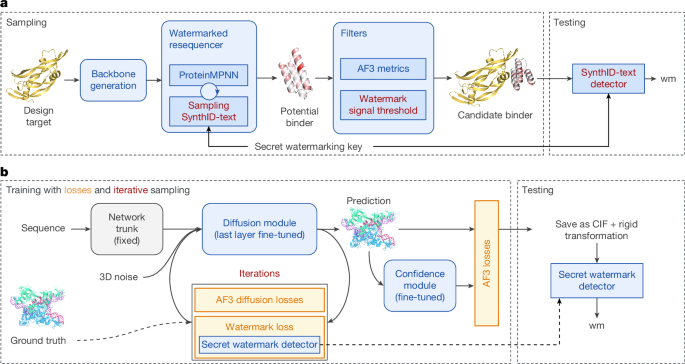
On September 30, 2026, Google DeepMind announced SynthID Bio, a technology designed to watermark AI-generated proteins while maintaining their biological function. This method embeds an imperceptible signature into protein sequences and structures, allowing for verification of their provenance. The initiative addresses biosecurity concerns as AI-generated proteins can bypass traditional DNA synthesis screening. Laboratory tests showed that watermarked proteins matched the performance and natural diversity of unwatermarked versions, thus ensuring scientific integrity. The technology aims to mitigate risks associated with the misuse of AI in synthetic biology, particularly in creating potentially harmful proteins. SynthID Bio is a response to the growing need for reliable identification of AI-designed proteins in scientific databases. This development is part of a broader effort to enhance biosecurity and integrity in biological research.
Ask AI about this cluster
Answers cite the sources they use
Timeline
More articles in this cluster (4)
Common questions
How does SynthID Bio work?
What are the benefits of this technology?
Are there any known vulnerabilities?
Continue Reading
 Critical Zero-Day Exploits Target F5 and Check Point Products F5 Networks released emergency hotfixes for a critical zero-day vulnerability, CVE-2026-94127, in its BIG-IP Access Policy Manager on September 22, 2026, after confirming active exploitation. This flaw allows unauthenticated remote code execution (RCE) and has a CVSS score of 9.8. Concurrently, Check Point disclosed…
  Critical Citrix NetScaler Zero-Day Vulnerabilities Exploited Citrix disclosed two critical zero-day vulnerabilities, CVE-2026-88771 and CVE-2026-88772, affecting NetScaler ADC and Gateway systems, which are being actively exploited. Both vulnerabilities have a CVSS score of 9.5 and allow unauthenticated attackers to execute arbitrary commands remotely. CVE-2026-88771 arises…