 Quantumcomputingreport
IBM and MIT Uncover 564 New Quantum Protocols Using AI
Article Content

- •IBM and MIT's framework identifies over 500 new quantum protocols.
- •564 of the discovered protocols were previously unknown.
- •The research aims to optimize quantum computing resource usage.
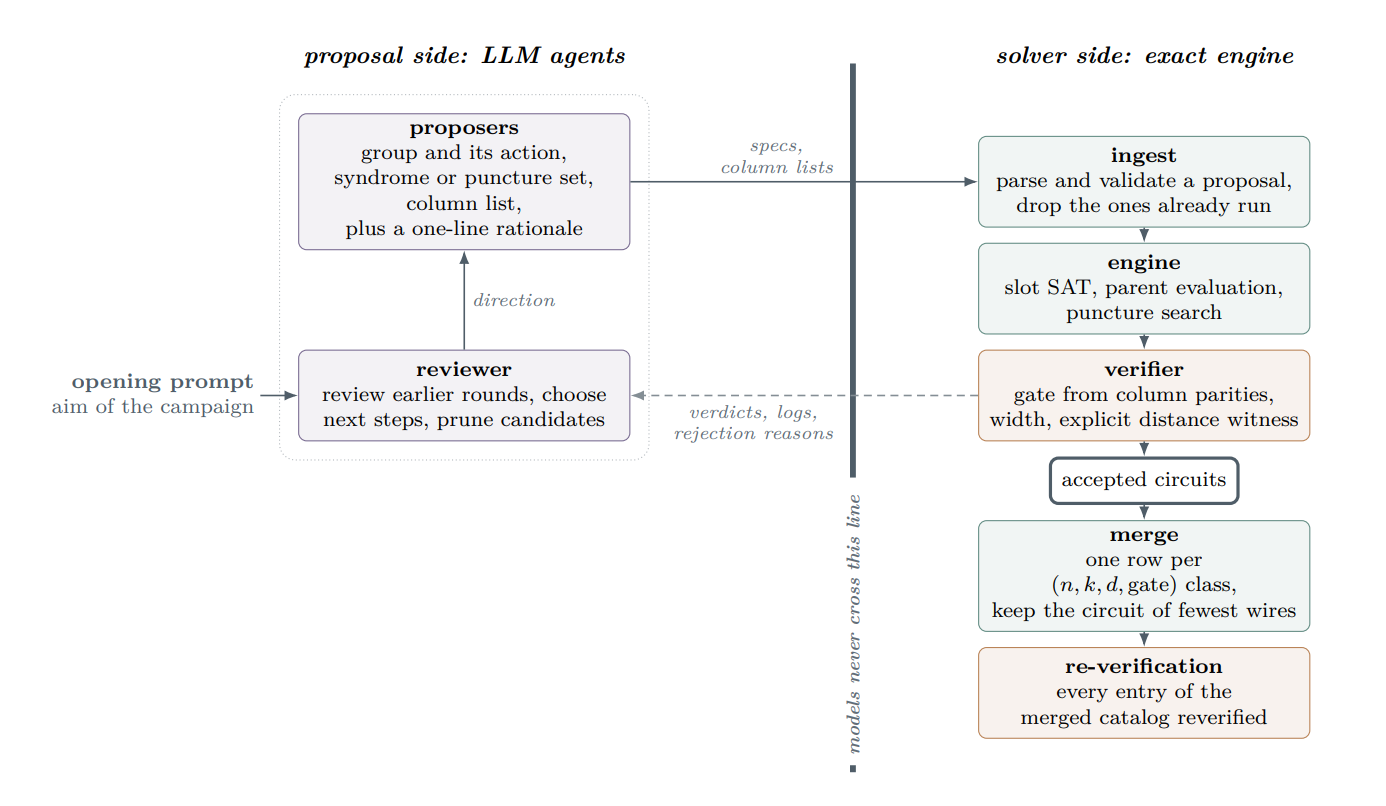
Researchers from IBM Quantum, QuICS, and MIT have developed a neuro-symbolic framework that identifies over 500 high-efficiency magic-state factories for quantum computing. This framework combines large language model agents with deterministic solvers to explore previously uncharted magic-state distillation protocols. The study, detailed in the preprint 'Symmetry and AI-assisted discovery of magic-state factories', reveals 699 factory classes, including 564 previously unknown protocols. These factories are crucial for generating non-Clifford states efficiently, which are essential for universal fault-tolerant quantum computers. The research aims to reduce the physical resource footprint of quantum operations, which traditionally consume significant qubits and runtime. The findings are shared in an open-access repository, with circuit models and code available on GitHub. The research paper is accessible on arXiv, and additional resources include an interactive Magic State Factory Catalog.
Ask AI about this cluster
Answers cite the sources they use
Timeline
More articles in this cluster (2)
Following this threat?
Track Google Quantum AI in your own feed — you're alerted when they show up in new reporting, leak sites or exploitation.
Free account · no card needed
Common questions
What are magic-state factories?
How many new protocols were discovered?
Where can I access the research paper?
Continue Reading
 Critical RCE Vulnerability in Confection WordPress Plugin (CVE-2026-115252) A critical vulnerability, CVE-2026-115252, has been identified in the Confection WordPress Cable plugin, affecting versions 0.4.0 to 0.4.7. This flaw allows unauthenticated attackers to execute arbitrary PHP code on the server by writing unmodified settings into a PHP file without proper checks. The vulnerability has…
 Critical RCE and LPE Vulnerabilities in Quest Foglight for Databases On November 3, 2026, the Zero Day Initiative disclosed multiple critical vulnerabilities in Quest Foglight for Databases, including six remote code execution (RCE) flaws and two local privilege escalation (LPE) vulnerabilities. The most severe RCE vulnerabilities, CVE-2026-92189 and CVE-2026-92190, allow…