 Nature
New Jurassic Mammaliaform Fossil Reveals Swimming and Suckling Abilities
Article Content

- •Discovery of Megacauda sungei reveals advanced feeding adaptations in Jurassic mammals.
- •Fossil suggests semiaquatic lifestyle, similar to modern platypus.
- •Findings enhance understanding of evolutionary transition to modern mammals.
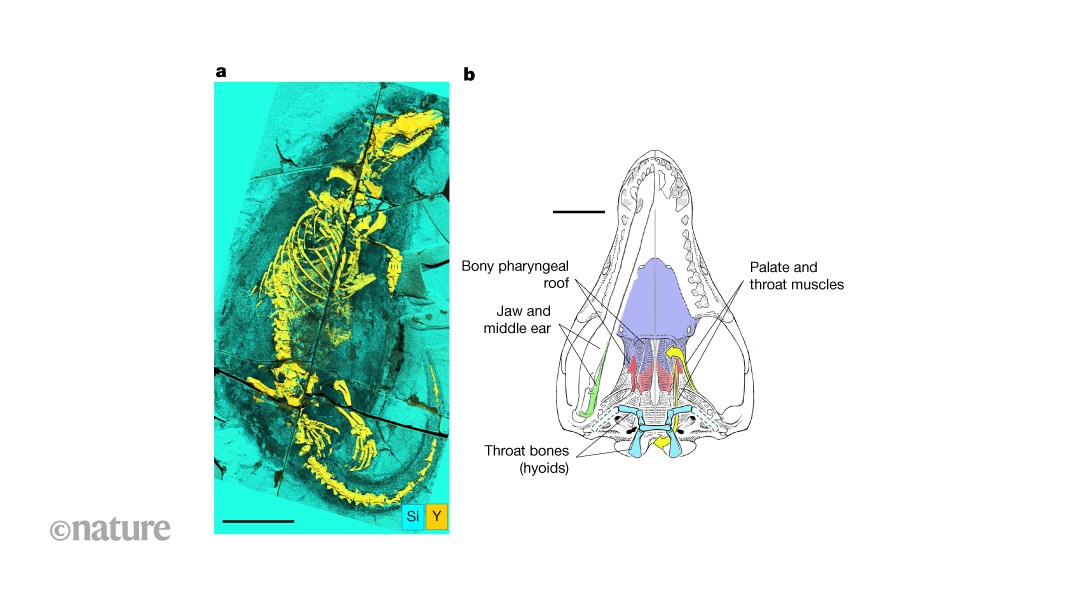
A newly discovered mammaliaform fossil from the Middle Jurassic period in China showcases features that suggest it was semiaquatic and capable of swimming, suckling, and swallowing. This species, named Megacauda sungei, exhibits a unique pharyngeal vault and hyoid skeletal anatomy, indicating advanced feeding mechanisms similar to modern mammals. The fossil, the largest of its kind, fills a significant gap in understanding the evolution of mammalian feeding structures. Researchers believe that this mammaliaform thrived in diverse ecological niches, predating the rise of modern mammals by millions of years. The findings contribute to the understanding of the evolutionary transition from early mammaliaforms to true mammals, highlighting the complexity of Mesozoic ecosystems.
Ask AI about this cluster
Answers cite the sources they use
Timeline
More articles in this cluster (2)
Common questions
What is the significance of Megacauda sungei?
Where was the fossil discovered?
How does this discovery impact our understanding of mammalian evolution?
Continue Reading
 Critical RCE Vulnerability in Confection WordPress Plugin (CVE-2026-115252) A critical vulnerability, CVE-2026-115252, has been identified in the Confection WordPress Cable plugin, affecting versions 0.4.0 to 0.4.7. This flaw allows unauthenticated attackers to execute arbitrary PHP code on the server by writing unmodified settings into a PHP file without proper checks. The vulnerability has…
 Critical Code Injection Vulnerability in Staggs Plugin for WordPress A critical code injection vulnerability, CVE-2026-78287, has been identified in the Staggs plugin for WordPress, affecting versions up to 3.3.0. This flaw allows unauthenticated attackers to execute arbitrary code remotely, posing severe risks to affected sites. The vulnerability stems from improper control over code…