 www.defensedaily.com
 Northrop Grumman Delivers 21 Satellites for U.S. Military Communications
Article Content

- •Northrop Grumman delivered 21 satellites for the U.S. Space Force's Transport Layer.
- •The Transport Layer aims to enhance secure military communications and missile deterrence.
- •The program is over a year behind schedule due to supply chain issues.
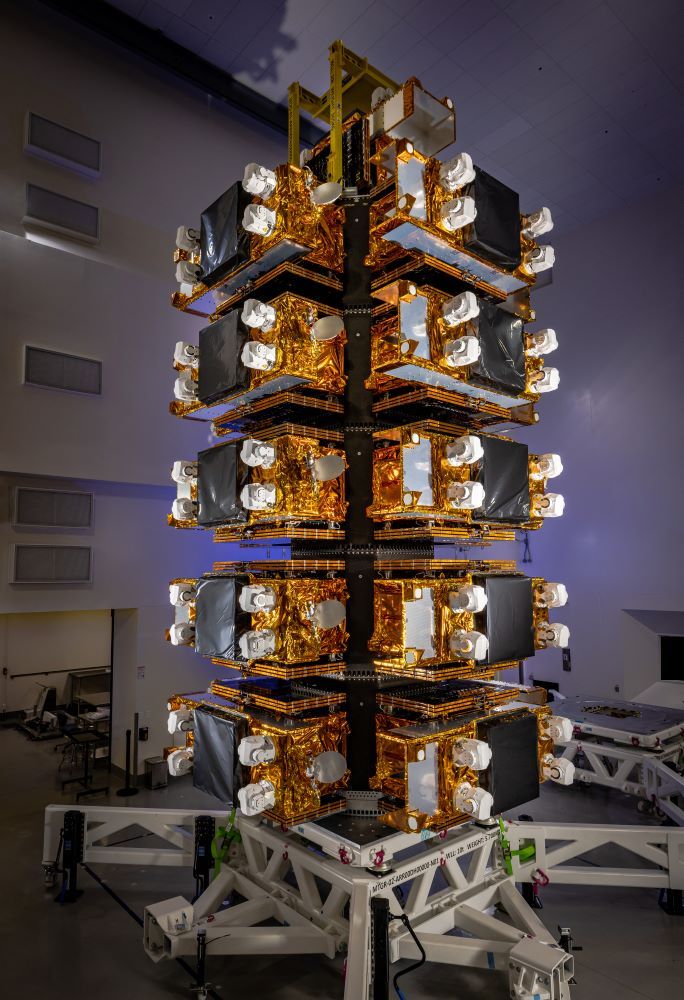
Northrop Grumman announced the delivery of 21 satellites to Vandenberg Space Force Base for the U.S. Space Force's Transport Layer (T1TL) initiative. This layer will consist of 126 low-Earth orbit satellites aimed at enhancing secure military communications and missile deterrence. The Transport Layer is a key component of the Proliferated Warfighter Space Architecture (PWSA). The delivery is part of a larger effort that includes 42 satellites each from Northrop Grumman, York Space Systems, and Lockheed Martin. The program is reportedly over a year behind schedule due to supply chain issues affecting Optical Communication Terminals. The next launch of T1TL satellites is expected in early October 2026, with all satellites projected to be operational within six to eight months.
Ask AI about this cluster
Answers cite the sources they use
Timeline
More articles in this cluster (2)
Following this threat?
Track Defense Daily in your own feed — you're alerted when they show up in new reporting, leak sites or exploitation.
Free account · no card needed
Common questions
What is the purpose of the Transport Layer satellites?
Why is the program behind schedule?
When will the next satellites be launched?
Continue Reading
 Critical Zero-Day Exploits Target F5 and Check Point Products F5 Networks released emergency hotfixes for a critical zero-day vulnerability, CVE-2026-94127, in its BIG-IP Access Policy Manager on September 22, 2026, after confirming active exploitation. This flaw allows unauthenticated remote code execution (RCE) and has a CVSS score of 9.8. Concurrently, Check Point disclosed…
  Critical Citrix NetScaler Zero-Day Vulnerabilities Exploited Citrix disclosed two critical zero-day vulnerabilities, CVE-2026-88771 and CVE-2026-88772, affecting NetScaler ADC and Gateway systems, which are being actively exploited. Both vulnerabilities have a CVSS score of 9.5 and allow unauthenticated attackers to execute arbitrary commands remotely. CVE-2026-88771 arises…