 www.infostealers.com
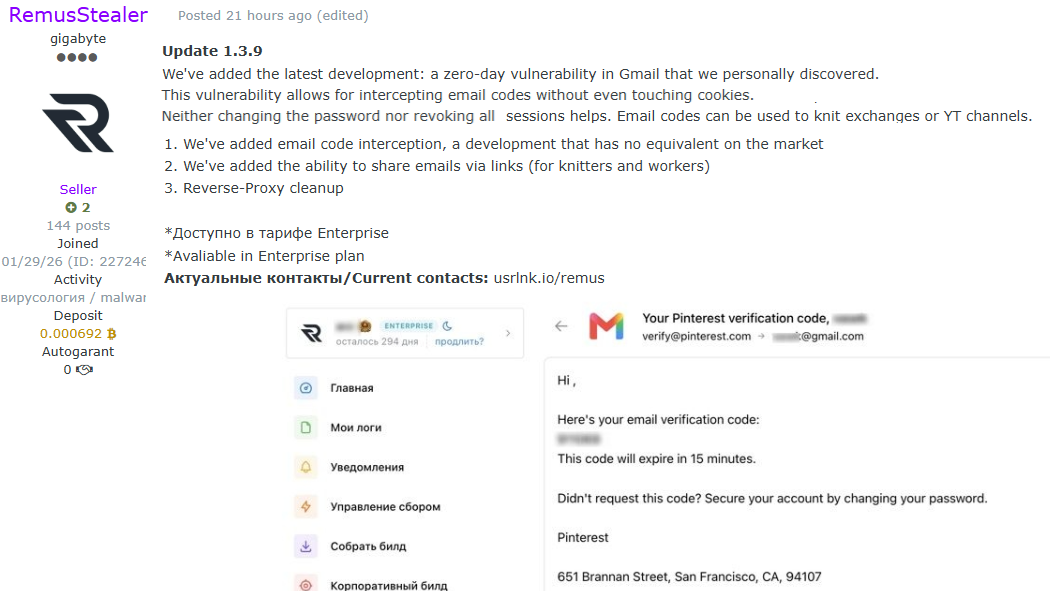
Remus Stealer Claims Persistent Gmail Access After Password Changes
Article Content

- •Remus Stealer claims to maintain Gmail access after password changes.
- •The malware's new feature allows reading inboxes directly from its control panel.
- •Hudson Rock has not confirmed the claims or identified a Gmail vulnerability.
Remus Stealer, an infostealer malware, is promoting a feature that allegedly allows attackers to access victims' Gmail inboxes even after password changes and session revocations. This feature, marketed at $1,000 per month, enables operators to read emails, including verification codes and recovery links, directly from the malware's control panel. Hudson Rock, a cybersecurity firm, has investigated these claims but has not confirmed the existence of a Gmail vulnerability that would allow such persistent access. The developer asserts that the malware interacts with browser memory, enabling continued access after the malware exits. However, no controlled tests have validated these claims, leaving the actual effectiveness of the feature unproven. Users are advised to secure their accounts from clean devices and follow Google's recovery guidance.
Ask AI about this cluster
Answers cite the sources they use
Timeline
More articles in this cluster (7)
Following this threat?
Track Remus Stealer in your own feed — you're alerted when they show up in new reporting, leak sites or exploitation.
Free account · no card needed
Common questions
How does Remus Stealer claim to access Gmail?
What should users do if infected?
Is there confirmed exploitation of this feature?
Continue Reading
 Critical RCE Vulnerability in Confection WordPress Plugin (CVE-2026-115252) A critical vulnerability, CVE-2026-115252, has been identified in the Confection WordPress Cable plugin, affecting versions 0.4.0 to 0.4.7. This flaw allows unauthenticated attackers to execute arbitrary PHP code on the server by writing unmodified settings into a PHP file without proper checks. The vulnerability has…
 Critical RCE and LPE Vulnerabilities in Quest Foglight for Databases On November 3, 2026, the Zero Day Initiative disclosed multiple critical vulnerabilities in Quest Foglight for Databases, including six remote code execution (RCE) flaws and two local privilege escalation (LPE) vulnerabilities. The most severe RCE vulnerabilities, CVE-2026-92189 and CVE-2026-92190, allow…