 Link.Springer
Review Surveys 16 Deepfake Detection Prototypes Across 15 Criteria
Article Content

- •The review covers 16 deepfake detection research prototypes published between 2023 and 2025.
- •Prototypes are compared across 15 criteria grouped into three layers: monitoring, detection and analysis, and decision and response.
- •The authors report poor generalization, limited dataset diversity, and vulnerability to novel attacks in current systems.
- •Stated priorities include multimodal analysis, self-supervised learning, and cross-domain generalizability.
- •The publication is a research survey; no CVEs, IOCs, or active attacks are reported.
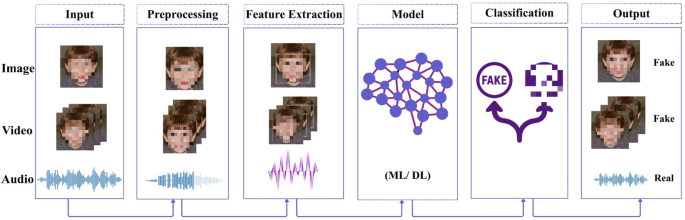
A systematic review published in Artificial Intelligence Review assesses all 16 deepfake detection research prototypes published between 2023 and 2025. The authors, from Taibah University in Saudi Arabia, classify the prototypes into three layers: Fake Data Monitoring, Detection and Analysis, and Decision and Response. Each prototype is compared against 15 criteria, including dataset source, training paradigm, modality, deepfake type, model architecture, metrics, generalizability, and explainability. The review reports that current detection systems generalize poorly, rely on datasets of limited diversity, and remain susceptible to novel attack methods. It identifies open challenges including multimodal analysis, self-supervised learning, and cross-domain generalizability. The review is presented as a reference for research teams building trustworthy AI detection systems. The articles describe a research survey only and do not report any deployed attack, exploitation, or incident.
Ask AI about this cluster
Answers cite the sources they use
Timeline
More articles in this cluster (6)
Common questions
Does this review describe an active threat I need to respond to?
What weaknesses do current deepfake detectors have?
Where can I find the full comparison?
Continue Reading
 CVE-2026-123890: Auth bypass in VMware vCenter exploited by Armory Castle before patch CVE-2026-123890, a flaw in VMware vCenter Server rated CVSS 9.8, allows an unauthenticated remote attacker to obtain an administrator session on the platform. According to the Google Threat Intelligence Group, the flaw was exploited by the espionage group Armory Castle (formerly UNC5221), which has suspected China…